Title here
Summary here
Lumen’s team has an idea: “let’s make the signup page better.” It’s a fine instinct and a useless experiment. Better how? Measured by what? Better by how much before it’s worth shipping? An experiment can only answer a question that’s been sharpened to the point where data could prove it wrong. That sharpening — from a fuzzy goal to a precise, testable claim — is the first and most important design step, and it’s where a lot of real experiments quietly fail before they even run. This lesson is about doing it well.
By the end of this lesson, you will be able to:
Let’s start with why “make signups better” isn’t something you can test.
“Make signups better” fails as an experiment for three concrete reasons. It doesn’t say what change you’re making, so you don’t know what to build into the treatment. It doesn’t name a metric, so there’s nothing to measure. And it sets no threshold, so no result could ever count as failure — any wiggle upward could be spun as success. A claim that can’t fail can’t be tested; it can only be rationalized.
Compare it to this: “Lumen’s new signup page increases signup conversion rate by at least 2 percentage points.” Now there’s a specific change (the new page), a named metric (signup conversion rate), a direction (increases), and a threshold (at least 2 points). Every one of those is something an experiment can check. This is a hypothesis — a prediction precise enough to be measured and, crucially, precise enough to be wrong.
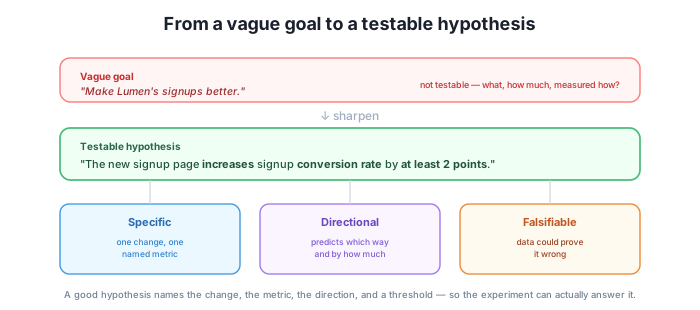
A testable hypothesis has three properties. Miss any one and the experiment gets harder to interpret:
The threshold (“at least 2 points”) deserves special attention: it’s what turns a direction into a decision rule. You’ll formalize that threshold as the minimum detectable effect later in this module — the smallest change worth caring about, which also drives how much data you’ll need.
Statisticians frame this pair of possibilities explicitly, and it’s worth adopting because it’s exactly what the test evaluates:
An experiment doesn’t try to prove the alternative directly. It asks: if the null were true — if the change really did nothing — how surprising is the difference we observed? If a difference this large would be very unlikely under “no effect,” that’s evidence against the null and for your change. That’s the logic behind every significance test you’ll run later; the hypothesis you write now is what those tests are pointed at.
Write the hypothesis before you look at data
The hypothesis — and the threshold, metric, and direction in it — must be fixed before the experiment runs. It’s tempting to run a test, look at whatever moved, and write the hypothesis to match (“aha, it improved time-on-page!”). But a prediction made after seeing the data isn’t a prediction — with enough metrics, something always looks like it moved by chance. Deciding up front what you’re testing and what result would count as success is what keeps the experiment honest. You’ll see the statistical damage that “deciding after” does when we reach peeking and multiple comparisons.
Turn this vague goal into a testable hypothesis: “Lumen’s onboarding should be more engaging.” Assume the change is adding a progress bar, and the metric is the share of new users who finish onboarding.
Hint
Something like: “Adding a progress bar to onboarding increases the onboarding-completion rate by at least 3 percentage points.” It’s specific (one change: the progress bar; one metric: completion rate), directional (increases, by ≥3 points), and falsifiable (if completion is flat or lower, it’s refuted). The exact threshold is a judgment call — but naming one is what makes it a decision.
Critique this hypothesis: “The redesigned checkout — new layout, new copy, and one-click pay — will improve the business.”
Hint
Two problems. It’s not specific: three changes are bundled, so if a metric moves you can’t tell which change caused it (a confounded treatment). And “improve the business” names no measurable metric and no threshold, so it’s not falsifiable — there’s no result that would count as failure. Fix it by isolating one change and naming one primary metric with a direction and threshold.
For the hypothesis “the new signup page increases conversion,” write the null hypothesis, and explain what the experiment actually tests.
Hint
The null (H₀) is “the new page’s true conversion rate equals the old page’s — the change has no effect.” The experiment tests how surprising the observed difference would be if the null were true: a difference too large to be plausible under “no effect” is evidence against the null and for the alternative. The test never proves the change works; it measures the evidence against the change doing nothing.
An experiment can only answer a question sharp enough to be wrong, so the first design step is turning a vague goal into a testable hypothesis. A vague goal (“make signups better”) names no change, no metric, and no threshold, so no result could ever count as failure. A good hypothesis is specific (one change, one primary metric), directional (which way, and by how much), and falsifiable (some result would refute it) — for example, “the new signup page increases conversion by at least 2 points.” Statisticians frame this as a null hypothesis (the change does nothing) versus an alternative (it has an effect); the experiment measures how surprising the observed difference would be if the null were true. And all of it is fixed before the data arrives, which is what keeps the test honest.
Most experiments that “didn’t work out” were doomed at this step: a fuzzy goal, a bundled change, or a metric chosen after the fact. Learning to write a sharp hypothesis is what makes everything downstream — choosing metrics, sizing the test, running the analysis — even possible, because each of those needs to know exactly what you’re testing. It’s also the cheapest quality lever you have: a few minutes of precision here saves weeks of an experiment that can’t answer anything. Next, you’ll choose the metrics that hypothesis points to — the one primary metric your decision hinges on, and the guardrails that protect everything else.
Pick the one primary metric the decision hinges on, plus guardrails and secondary metrics for context.
Return to the Designing an Experiment module overview
You can now turn a vague goal into a hypothesis an experiment can actually answer — specific, directional, falsifiable, and framed as a null versus an alternative, all fixed before any data arrives. Next you’ll choose the metrics that hypothesis points at: the single primary metric your decision depends on, the guardrails that must not regress, and the secondary metrics that help you understand what happened.