Title here
Summary here
Lumen is ready to split traffic: half of visitors see the new signup page, half see the old one. But “half of what?” is a real question, and the answer isn’t obvious. Half the users? Half the visits? Half the study groups? These sound interchangeable and they are not — each one flips the coin on a different thing, and the wrong choice can quietly break the experiment before a single number comes in. The thing you flip the coin on is called the randomization unit, and choosing it is a design decision every bit as important as the hypothesis. This lesson is about choosing it well.
By the end of this lesson, you will be able to:
Let’s start with the three units you’ll actually choose between.
The randomization unit is simply what you assign to treatment or control. Three units cover almost every experiment you’ll run:
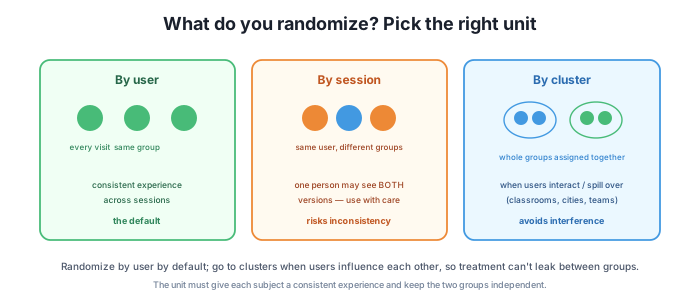
Underneath those three choices are two properties the unit has to satisfy, and every failure mode is one of them breaking:
So the rule of thumb: by user unless something breaks one of these. If users interact and treatment can spill, move up to by cluster. If a change genuinely can’t persist across visits, only then consider by session — and know what consistency you’re giving up.
Here’s the mechanism that makes “by user” actually consistent. Instead of re-flipping a coin on every visit, you hash the user ID and derive the group from the hash. The same ID always hashes to the same value, so the same user always lands in the same group — no need to store the assignment anywhere:
import hashlib

def assign(user_id, salt="signup_test"):
    h = hashlib.md5(f"{salt}:{user_id}".encode()).hexdigest()
    return "treatment" if int(h, 16) % 2 == 0 else "control"

for uid in ["u-1001", "u-1002", "u-1003"]:
    print(uid, assign(uid), assign(uid))   # same result both times -> consistent
Each ID prints the same group on both calls — that’s the point. Because the hash of a given ID never changes, a user’s assignment is deterministic: stable across every visit, so their experience stays consistent. Yet across different users the hash spreads out like a fair coin, so the split is still effectively random. The salt matters too: change it and the same users get reshuffled independently, which lets Lumen run several experiments at once without one experiment’s split leaking into another’s.
Deterministic isn’t the same as biased
“The same user always gets the same group” can sound like it defeats the randomness — it doesn’t. Randomization applies across subjects, not within one: over thousands of user IDs the hash sends roughly half to each group with no pattern tied to anything about the user. Determinism only fixes each individual’s group so their experience is consistent from visit to visit. Storing assignments in a database would achieve the same consistency, but hashing gives it to you with no lookup and no state — the same ID recomputes the same group anywhere, anytime.
One more consequence, because it sets up the next lesson. Statistics cares about the number of independent units, not the number of people. When you randomize by user, each user is an independent unit. When you randomize by cluster, the whole cluster is one unit — the students inside a study group are correlated, so a 30-person group counts as far less than 30 independent observations. That means a clustered experiment needs more total users to reach the same statistical power as a user-level one. Choosing a coarser unit buys you independence in the presence of spillover, but you pay for it in sample size — which is exactly the trade-off the next lesson starts to quantify.
Lumen wants to test a new color for the “Sign up” button. Users never interact through this button, and the change should look the same every time a person sees it. What randomization unit should you use, and why?
Hint
By user. There’s no interaction between users, so no spillover — independence is already satisfied. The remaining concern is consistency: a person shouldn’t see a blue button one visit and a green one the next, which is exactly what by-session would risk. Assigning by user gives each person one stable color across every visit, which is what you want for a UI change.
Lumen launches a referral feature: treated users can invite friends to join a shared study group. The team plans to randomize by individual user. What goes wrong?
Hint
Interference. A treated user invites control users into their group, so the treatment’s effect leaks into the control group — the two groups are no longer independent, and any measured difference is muddied by the leakage. The fix is to randomize by cluster: assign whole study groups (or whole social circles) to treatment or control together, so the invitation stays inside one group and the comparison stays clean.
A teammate proposes assigning each user by calling random.random() fresh on every page load: below 0.5 is control, above is treatment. What breaks, and how does hashing the user ID fix it?
Hint
Calling random.random() each load re-flips the coin every visit, so the same user bounces between treatment and control — consistency is destroyed and their behavior can’t be attributed to either version. Hashing the user ID makes the assignment deterministic: the same ID always hashes to the same value, so the user lands in the same group on every visit with no stored state. It’s still random across users, but fixed for each one — consistency and randomness at the same time.
The randomization unit is what you flip the coin on, and choosing it is a design decision as consequential as the hypothesis. There are three common choices: by user (the default — each person gets one consistent experience across all visits), by session (each visit assigned independently, which lets one user see both versions and correlates their observations, so use it sparingly), and by cluster (whole groups assigned together, for when users interact and treatment can spill over). Underneath, the unit must satisfy two properties: consistency (each subject gets one coherent experience) and independence (the two groups don’t influence each other). A deterministic hash of the user ID gives each user a stable group across every visit while staying random across users — and choosing a coarser unit like a cluster buys independence at the cost of needing more total users for the same power.
The randomization unit is one of the quietest ways an experiment goes wrong: pick by-session for a change users see repeatedly and you get a flickering experience nobody’s behavior can be attributed to; randomize individuals when they interact and treatment leaks into control until the comparison means nothing. Both failures are invisible in the results — the numbers still come out, they’re just uninterpretable. Getting the unit right up front, and making the assignment deterministic so it actually stays consistent, is what keeps the two groups comparable. Next, you’ll put a number on the threshold you named in your hypothesis: the minimum detectable effect, the smallest change worth caring about — and the first driver of how much data you’ll need.
Put a number on the smallest change worth detecting, and see how it drives the sample size your experiment needs.
Return to the Designing an Experiment module overview
You can now choose what to flip the coin on — by user for a consistent per-person experience, by cluster when users interact and treatment could spill over, by session only when a change can’t span visits — and make each assignment deterministic so a user stays in the same group every visit. Next you’ll turn the threshold from your hypothesis into a concrete minimum detectable effect: the smallest change worth detecting, which is the first thing that decides how much data your experiment needs.