Title here
Summary here
Across this module you took the failure modes apart one at a time: peeking inflates a 5% error rate to 19%, testing 20 metrics manufactures a false winner 64% of the time, Simpson’s paradox flips the aggregate against every subgroup, and a sample ratio mismatch quietly invalidates the whole assignment. Now you put them back together as one thing you actually do at work: a validity audit. Lumen’s growth team just handed you an experiment with a “significant winner” and a deploy request. Your job is not to admire the p-value — it’s to decide whether the experiment behind the p-value is trustworthy at all. You’ll build a repeatable audit checklist and run it on this exact experiment, and by the end you’ll have a clear, defensible verdict: ship, or don’t.
By the end of this project, you will be able to:
We’ll build the audit in stages, reusing the exact tests you wrote earlier in the module. Let’s audit Lumen’s experiment.
Here’s what landed in your inbox. Lumen ran a new onboarding flow as treatment against the current flow as control, on a planned 50/50 split. The dashboard says treatment’s conversion rate is higher, the difference is “significant,” and the growth team wants to ship this week. The instinct is to open the result, see p < 0.05, and nod.
Resist it. A significant result is only trustworthy if the experiment that produced it is valid — and validity is a property of the plumbing, not the p-value. A p-value computed on a broken experiment is a correct calculation on the wrong data, and it will look exactly as convincing as a real one. So the audit checks the plumbing first. Here is the checklist, in the order you run it:
Only after all four pass do you read the headline. Run them in this order because the earlier a check fails, the more completely it invalidates everything downstream. Start with the one that can void the entire experiment.
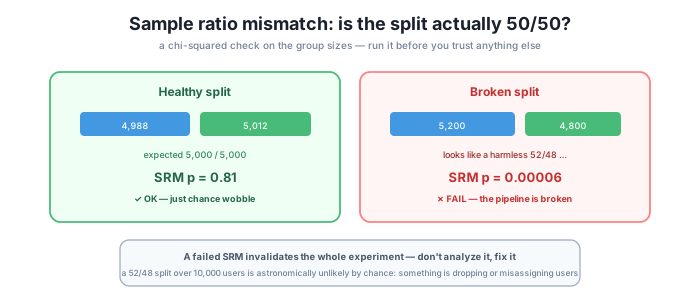
The very first number to check isn’t the conversion rate — it’s the counts. A planned 50/50 split should land close to 50/50. Lumen’s experiment reported 5,200 users in control and 4,800 in treatment. That’s 52/48. It looks like a rounding wobble. It isn’t. With 10,000 users, a chi-squared test against the expected 50/50 tells you whether that gap is plausibly chance.
from scipy import stats

def srm_pvalue(n_a, n_b, expected_ratio=0.5):
    total = n_a + n_b
    exp = [total * expected_ratio, total * (1 - expected_ratio)]
    return float(stats.chisquare([n_a, n_b], f_exp=exp).pvalue)

print(f"reported split 5200/4800: SRM p = {srm_pvalue(5200, 4800):.2e}")
print(f"healthy split  4988/5012: SRM p = {srm_pvalue(4988, 5012):.3f}")
Running it:
reported split 5200/4800: SRM p = 6.33e-05
healthy split  4988/5012: SRM p = 0.810
The reported split gives p = 6.33e-05 — about six in a hundred thousand. A 52/48 split is not a wobble at this sample size; it’s a signal that the randomization or logging is broken. For contrast, a genuinely healthy split of 4988/5012 gives p = 0.810 — exactly the kind of harmless noise you expect around 50/50. That contrast is the whole point: SRM isn’t about the size of the imbalance, it’s about whether the imbalance is explainable by chance given how many users you have.
This is why SRM is check #1. A failed SRM means users did not get assigned the way you designed, so control and treatment are no longer comparable populations — and every downstream number, including that significant p-value, is computed on a corrupted comparison. Strictly, the audit could stop right here: the experiment is broken, fix the pipeline and re-run. But it’s worth walking the rest of the checks, because a failed SRM predicts exactly the kind of damage you’ll find next.
Next, ask how the team decided to stop. This isn’t a code check — it’s a question, and the answer determines whether the “significance” is real. If the flow was designed for a fixed number of users but someone watched the dashboard and called it the first day it crossed p < 0.05, then the significance is inflated, not earned.
You proved why in Lesson 1. A p-value on accumulating data wanders, and every extra look gives it another chance to dip below 0.05 by pure noise. Here’s the evidence you cite when you ask the question:
import numpy as np
from scipy import stats

def two_prop_p(c1, n1, c2, n2):
    p1, p2 = c1 / n1, c2 / n2
    p = (c1 + c2) / (n1 + n2)
    se = np.sqrt(p * (1 - p) * (1 / n1 + 1 / n2))
    return 2 * (1 - stats.norm.cdf(np.abs((p2 - p1) / se)))

rng = np.random.default_rng(101)
N, K, batch, p0 = 40000, 10, 200, 0.10          # A/A: both arms share the same rate
inc_c = rng.binomial(batch, p0, size=(N, K))
inc_t = rng.binomial(batch, p0, size=(N, K))
cum_c, cum_t = inc_c.cumsum(1), inc_t.cumsum(1)
cum_n = batch * np.arange(1, K + 1)
pvals = two_prop_p(cum_c, cum_n, cum_t, cum_n)

single_look = np.mean(pvals[:, -1] < 0.05)          # one honest look at the end
peeked      = np.mean((pvals < 0.05).any(axis=1))   # stop at first significant look
print(f"single fixed look:   {single_look:.3f}")
print(f"peeking (10 looks):  {peeked:.3f}")
Running it:
single fixed look:   0.051
peeking (10 looks):  0.190
On 40,000 experiments where there is nothing to find, one honest look gives the promised 0.051 false-positive rate; stopping at the first of 10 crossings gives 0.190. So the question to Lumen’s team is direct: was the sample size set in advance and analyzed once, or did you stop when it looked good? If it’s the latter, this “significant winner” carries a false-positive rate closer to 19% than 5%, and the significance tells you nothing. The fix is the one from Module 3: pre-register the sample size, run to it, and analyze exactly once.
The growth team also sends a segmented view “to be thorough” — treatment wins overall, they say, and here’s the breakdown. Recompute it yourself rather than trusting the summary. Lumen has two segments, new and returning users:
seg = {
    "new users":       {"control": (200, 2000), "treatment": (90, 1000)},
    "returning users": {"control": (300, 1000), "treatment": (570, 2000)},
}

for name, arms in seg.items():
    cc, cn = arms["control"]; tc, tn = arms["treatment"]
    winner = "treatment" if tc/tn > cc/cn else "CONTROL"
    print(f"{name:16s} control {cc/cn:.1%}  treatment {tc/tn:.1%}  -> {winner} wins")

cc = sum(a["control"][0] for a in seg.values());  cn = sum(a["control"][1] for a in seg.values())
tc = sum(a["treatment"][0] for a in seg.values()); tn = sum(a["treatment"][1] for a in seg.values())
overall = "TREATMENT" if tc/tn > cc/cn else "control"
print(f"{'OVERALL':16s} control {cc/cn:.1%}  treatment {tc/tn:.1%}  -> {overall} wins")
Running it:
new users        control 10.0%  treatment 9.0%   -> CONTROL wins
returning users  control 30.0%  treatment 28.5%  -> CONTROL wins
OVERALL          control 16.7%  treatment 22.0%  -> TREATMENT wins
Look at what just happened. Treatment loses in every single segment — 9.0% vs 10.0% for new users, 28.5% vs 30.0% for returning — yet wins overall, 22.0% vs 16.7%. That’s Simpson’s paradox, and it’s not magic: it’s the mix. Control’s users are weighted toward low-converting new users, treatment’s toward high-converting returning users, so the aggregate reflects the mix difference more than any real effect of the flow. And notice where that mix difference comes from — it’s exactly what a failed SRM produces. Stage 2’s broken assignment and Stage 4’s misleading aggregate are the same wound seen from two angles.
One more caution while you’re in the segments: don’t go the other way and start hunting for a segment where treatment wins. Lesson 2 showed that slicing enough ways guarantees a “significant” slice by chance alone. A subgroup view is for sanity-checking the aggregate against the segments, not for shopping until you find a winner. If you do report a segment, it has to be one you pre-declared, and a lone significant slice among many is a multiple-comparisons artifact until a correction or a replication says otherwise.
Validity before significance
The single habit this whole audit trains is check the plumbing before you read the number. A p-value is a summary of the data you collected; if the collection was broken — wrong split, wrong stopping rule, wrong comparison — then the summary is a precise description of the wrong thing. That’s why the checklist runs SRM, stopping rule, and segment sanity first, and only reads the headline result last. A significant result on an invalid experiment isn’t a weak result. It’s not a result at all.
Write the verdict the way you’d hand it to the growth team. Every check told the same story from a different direction:
Recommendation: do not ship. The headline “significant winner” is an artifact of a broken experiment, not evidence that the new flow is better. Concretely: fix the assignment pipeline so the split is genuinely random, re-run with a pre-set sample size, and analyze once on the single pre-declared primary metric. When you re-run, the SRM check should pass (p well above 0.001), and only then does the conversion result mean anything.
Here is the reusable checklist — run it on every experiment, in this order, before you trust a result:
VALIDITY AUDIT  (run top to bottom; stop and fix on the first hard fail)
  1. SRM              chi-squared on the split; p > 0.001 or the test is void
  2. Stopping rule    sample size pre-set and analyzed once? no dashboard peeking
  3. Primary metric   read the ONE pre-declared metric, not a slice found later
  4. Segment sanity   do segments agree with the aggregate? watch for Simpson's
  5. THEN read result only now is the p-value worth interpreting
That ordering is the lesson. Validity is a gate, not a footnote: the p-value is the last thing you look at, because it’s the only thing that means nothing until everything above it passes.
The audit flags SRM at p < 0.001, not the usual p < 0.05. Why the stricter threshold for this particular check?
Hint
Because SRM is a health check you run on every experiment, and a true, correctly randomized split will still produce p < 0.05 about 5% of the time by pure chance. If you halted every experiment on p < 0.05, you’d cry “broken pipeline” on one in twenty perfectly good tests. A real SRM — a genuine plumbing bug — produces a screamingly small p-value (Lumen’s was 6.33e-05), so p < 0.001 catches the real breaks while almost never false-alarming on a healthy split like 4988/5012 (p = 0.81). You want this gate to fire on bugs, not on noise.
Lumen fixes the assignment pipeline and asks you to design the re-run so this audit passes cleanly. What do you specify up front?
Hint
Three commitments, all made before launch. (1) Fixed sample size: compute the required n from the power analysis in Module 3, run to it, and analyze once — this kills peeking. (2) One pre-declared primary metric: name the single metric that decides ship/no-ship before you see any data — this kills segment- and metric-hunting. (3) An SRM check as the first gate on the new data — if the split still fails, you don’t even look at the result, you go back to the pipeline. Optionally pre-register any segments you’ll report and correct for them. The through-line: decide the rules while you’re still honest, i.e. before the data can tempt you.
Suppose the team hadn’t shown the aggregate at all — instead they sliced 20 ways and found one segment where treatment “significantly” wins. Would applying a Bonferroni correction make that finding trustworthy?
Hint
Bonferroni fixes the false-positive problem, not the broken-experiment problem. Testing a lone slice at 0.05/20 correctly stops you from being fooled by one lucky segment out of twenty — so a Bonferroni-surviving segment is real evidence of a difference in that slice. But it does nothing for the SRM: if assignment is broken, even a Bonferroni-corrected segment result is computed on non-comparable populations. So the correction is necessary for the multiple-comparisons pitfall and useless for the validity pitfall. Fix the plumbing first (Stage 2), then a correction makes a pre-declared multi-metric analysis honest.
You turned four separate pitfalls into one repeatable validity audit and ran it on a real request to ship. Lumen’s experiment reported a significant winner on a planned 50/50 split, but the audit checked the plumbing before the p-value. The SRM check on the reported 5200/4800 split gave p = 6.33e-05 — a hard fail, versus p = 0.810 for a healthy 4988/5012 split — meaning assignment was broken and the comparison invalid. The stopping-rule check cited the peeking simulation, where an honest single look gives a 0.051 false-positive rate but stopping at the first of 10 looks gives 0.190, so any dashboard-triggered “significance” is inflated. The subgroup check recomputed the segments: treatment loses in every one (new: 9.0% vs 10.0%; returning: 28.5% vs 30.0%) yet wins overall (22.0% vs 16.7%), a Simpson’s reversal driven by the very mix imbalance a failed SRM produces. Verdict: do not ship — fix the pipeline, re-run with a pre-set sample size, and analyze once on the pre-declared primary metric.
p < 0.001, not 0.05.Real growth teams don’t hand you clean experiments labeled “invalid” — they hand you a significant winner and a deadline, and the plumbing failures are silent. Every number in Lumen’s experiment was computed correctly; the experiment was still worthless, and only the audit caught it. Running these four checks in order, before you interpret a single result, is what separates a team that ships real wins from one that ships a stream of changes that do nothing while congratulating itself on its p-values. This audit is the habit that makes every earlier lesson in the module actually protect a decision.
Variance reduction (CUPED), sequential testing, Bayesian A/B, and multi-armed bandits.
Return to the Pitfalls and Validity module overview
You can now take any “significant winner” and decide whether it deserves your trust — by checking the split, the stopping rule, and the segments before you ever read the headline. That audit is the capstone of everything this module taught: validity is a property you verify, not assume. The next module moves past the basic two-arm test to the methods that make experiments faster and sharper — variance reduction with CUPED, honest sequential testing, Bayesian A/B, and multi-armed bandits. On to Beyond Basic A/B.