Title here
Summary here
“Agent” might be the most overused word in AI right now. It gets attached to chatbots, prompt chains, and anything that calls an API twice. So before you build one, let’s pin down what an agent actually is — because the definition is simple, precise, and it shapes every decision you’ll make in this course. The short version: an agent is a language model placed inside a loop, where the model itself decides what to do next, takes an action (usually by calling a tool), looks at the result, and repeats — until it judges the goal is met. The defining feature isn’t intelligence or size. It’s that the model, not your code, chooses the path.
By the end of this lesson, you will be able to:
Let’s begin with the loop at the heart of every agent.
You’ve almost certainly made a single call to a language model: you send a prompt, you get back text, and that’s the end of the interaction. That’s powerful — it can classify, summarize, draft, and answer — but it’s one shot. The model can’t check a fact it doesn’t know, run a calculation it can’t do in its head, or take an action in the world. Whatever it produces, it produces in a single pass from the information you gave it.
An agent breaks out of that single pass. Instead of one prompt-and-done, you put the model in a loop and give it tools — functions it can ask to run, like “search the web,” “look up a price,” or “save this note.” Now the interaction can span many steps: the model can call a tool, read what comes back, decide what to do with it, and call another. It keeps going until it has what it needs to finish. The single call answers from what it already has; the agent can go get what it’s missing.
Here’s the cycle that defines an agent. It’s worth committing to memory, because the rest of this course is really just this loop with more capable pieces plugged into it:
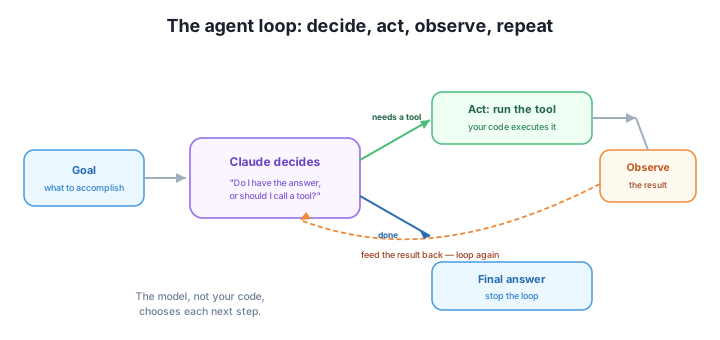
Read it as four beats that repeat:
Two things make this work, and they’re easy to miss. First, the model drives — it picks each action based on what it has learned, rather than following steps you hardcoded. Second, your code is the hands — the model proposes, but your program is what actually calls the tool, checks the result, and decides whether to keep looping. You’ll build exactly this loop, for real, in the next module.
Every agent, no matter how fancy, is assembled from the same small set of parts. We’ll devote whole modules to most of these later; for now, just learn the vocabulary:
An agent is the combination of these in a loop. Take away the tools and the loop, and you’re back to a single, one-shot call.
The model proposes; your code disposes
A crucial safety and design point: the model never executes anything on its own. When Claude “calls a tool,” it really just emits a structured request — “please run search with this input.” Your program decides whether and how to honor that request, runs the actual function, and returns the result. That separation is what lets you validate inputs, require approval for risky actions, log everything, and stay in control — themes we’ll return to throughout the course.
A loop that never ends is a bug, not an agent. Every agent needs stopping conditions, and getting them right is part of the craft. The natural stop is when the model decides it has finished and returns a final answer instead of a tool call. But you also need guardrails for when it doesn’t converge: a maximum number of steps, a budget cap, or a timeout, so a confused agent fails safely instead of looping forever or running up a bill.
For now, just hold the idea: an agent runs until it’s done or until a limit you set says “stop.” We’ll implement both the natural stop and the safety limits when we build the loop in Module 2.
In your own words, define an AI agent in a single sentence — and name the one feature that most distinguishes it from a plain LLM call.
Hint
An agent is a language model placed in a loop where it chooses its own next action, uses tools, observes the results, and repeats until the goal is met. The distinguishing feature is that the model decides the path step by step, rather than running a single fixed pass like a plain LLM call.
A user asks an agent, “What’s the weather in the city where our next conference is?” The agent has two tools: lookup_conference() and get_weather(city). Walk through the decide-act-observe steps the agent would likely take.
Hint
Decide → call lookup_conference(); Observe → “the conference is in Lisbon”; Decide again → call get_weather("Lisbon"); Observe → “18°C and clear”; Decide again → it now has everything, so it returns a final answer. Two tool calls, each chosen based on the previous result.
When Claude “calls a tool” in an agent, does Claude execute the function itself? Explain what actually happens.
Hint
No. The model only emits a structured request to run a tool with certain inputs. Your code receives that request, executes the real function, and feeds the result back to the model. The model proposes the action; your program performs it — which is what keeps you in control.
An AI agent is a language model placed in a loop where the model itself chooses each next action, calls tools, observes the results, and repeats until the goal is met. That’s the whole idea — and the distinguishing feature is that the model, not hardcoded steps, drives the path. The agent loop is decide → act → observe → repeat: the model decides whether to answer or call a tool, your code runs any tool it requests and feeds the result back, and the loop continues until the model returns a final answer or a safety limit stops it. Every agent is built from the same parts — a model, a goal and instructions, tools, the loop, and memory — and crucially, the model only requests actions while your code actually performs them.
This single mental model — a model driving a decide-act-observe loop — is the foundation everything else in the course builds on. Get it right and the rest (tool design, memory, planning, multi-agent systems) is just adding better pieces to a loop you already understand. Get it wrong — treating “agent” as a synonym for “smart prompt” — and you’ll reach for an agent when a simple call would do, or build a loop with no idea why it misbehaves. Next, you’ll sharpen the most important judgment call this model enables: knowing when you actually need an agent, and when a plain workflow is the better tool.
Learn when an agent is the right choice — and when a simpler, predictable workflow wins.
Return to the Agent Foundations module overview
You now have the one mental model that the whole course rests on: an agent is a model in a decide-act-observe loop, choosing its own actions with tools. Next you’ll learn the judgment that separates good agent builders from the rest — deciding when that loop is worth it, and when a plain workflow is the smarter choice.