Title here
Summary here
Your agent works. You typed a request, it planned, retrieved, coordinated specialists, and gave a great answer. So it’s done, right? Not quite. A demo proves the agent can work; a product needs it to work for every user, on every request, every time — without crashing on a hiccup, without quietly burning your budget, and without silently getting worse the next time you change a prompt. That last mile is what this final module is about. It’s less glamorous than building the agent, and it’s exactly what separates something you show off from something you ship.
By the end of this lesson, you will be able to:
Let’s look at what actually goes wrong once real users show up.
A demo is one person, one friendly request, one run, and you watching. Production is thousands of requests you’ll never see, some malformed, some adversarial, over a flaky network, on a budget. Four things break:
None of these show up when you’re demoing happily to yourself. All of them show up at scale. The good news: each has a well-understood fix, and this module builds all four.
The fixes map to four pillars — and, true to the whole course, none of them is a new engine. They wrap around the run_agent loop you already have:
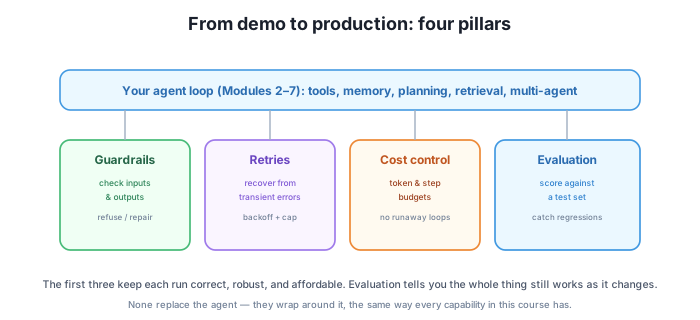
The module ends with a capstone (Lesson 5): a production-ready Atlas that assembles everything — memory, retrieval, multi-agent coordination — behind guardrails, retries, budgets, and an eval harness.
Reliability is mostly wrapping, not rewriting
Notice the shape of this module: you won’t rebuild the agent. You’ll wrap it — a check before it runs, a check after it answers, a retry around a flaky call, a budget around the loop, a scorer around the whole thing. That’s deliberate. Production-hardening is layers of protection around working code, added where the risk is, not a redesign. It also means you can adopt these one at a time on an agent you already have.
For each, name which pillar addresses it: (a) a user asks your trip planner to debug their code; (b) the model API returns a 529 “overloaded” once; (c) a confused agent loops 20 times on one request.
Hint
(a) guardrails — an input guardrail refuses the out-of-scope request before the agent runs; (b) retries — a transient error should be retried with backoff, not surfaced as a failure; (c) cost control — a step budget caps the loop so it can’t run away. Evaluation is the fourth pillar, for measuring quality over time rather than handling a single run.
Your agent gave a great answer in your demo. Why is that a weak guarantee that it’s production-ready?
Hint
A demo is one friendly request, one run, with you watching. It says nothing about malformed or adversarial inputs, transient network failures, cost under load, or whether your next change will break cases you didn’t test. Production quality is about the requests you don’t see — which is exactly what guardrails, retries, budgets, and evaluation address.
Three pillars protect a single run; one protects quality over time. Which is which, and why does that one need a test set?
Hint
Guardrails, retries, and cost control each make one run correct, robust, and affordable. Evaluation is different: it measures whether the agent, as a whole, is getting better or worse as you change it — and you can’t measure that from one run, so it needs a repeatable test set scored the same way each time.
A working demo proves an agent can work; production requires it to work for every user, every time, affordably — and four things break in between. Bad inputs/outputs, transient failures, runaway cost, and silent quality regressions are all invisible in a demo and unavoidable at scale. The fixes are four pillars that wrap around the loop you already built: guardrails (validate the way in and the way out — refuse or repair), retries (recover from transient errors with backoff and a cap), cost control (token and step budgets so nothing runs away), and evaluation (score against a test set so quality is a number you track). The first three protect each run; evaluation protects quality over time. The module builds all four and assembles them on a production-ready Atlas.
This is the difference between an impressive prototype and an agent you’d put in front of real users or customers. The failures here are the ones that generate the 3 a.m. page, the surprise bill, and the “it used to work” bug report — and every one of them is preventable with a pattern that takes a few lines to add. Just as important, evaluation changes how you build: once quality is a number, you can improve the agent deliberately instead of guessing, and ship changes with confidence instead of hope. Next, you’ll build the first pillar — guardrails on the agent’s inputs and outputs.
Validate what goes into the agent and what comes out — refuse out-of-scope requests and repair bad answers.
Return to the Reliability and Evaluation module overview
You now know the gap between a demo and a product, and the four pillars that close it — guardrails, retries, cost control, and evaluation, each wrapping the agent loop rather than replacing it. Next you’ll build the first pillar: guardrails that check what goes into the agent and what comes out, refusing out-of-scope requests and repairing bad answers before they reach a user.