Title here
Summary here
Draft-critique-revise improves one attempt, step by step. But for some tasks, the first attempt is a coin flip — a tagline, a creative concept, a name — where two tries can differ wildly in quality and polishing the first one just refines a lucky, or unlucky, start. The pattern for these is generate and test: produce several independent candidates, then test them against your check and pick the best. Instead of improving one attempt serially, you explore several in parallel and let the check choose. It’s a different shape for a different kind of task, and knowing when to reach for it is the skill.
By the end of this lesson, you will be able to:
Let’s look at the pattern.
Generate-and-test has two moves. Generate: from one goal, produce several independent candidates — not variations of one draft, but genuinely different attempts. Test: score each against your check and pick the winner. That’s it. Where draft-critique-revise walks one attempt toward done, generate-and-test lays out several and keeps the best.
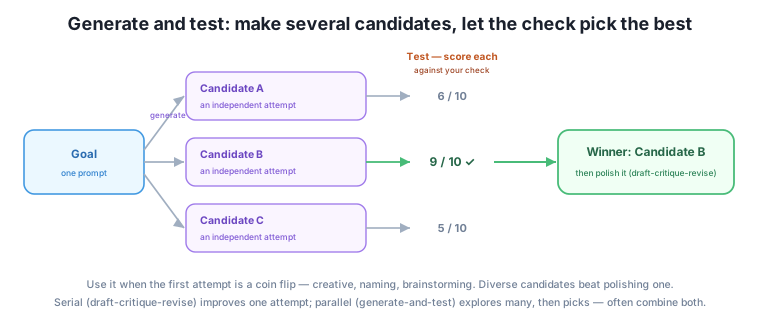
The test is your check, doing the same job as always but in a new role: instead of deciding “is this one done?”, it decides “which of these is best?” Everything about building good checks (Module 3) applies — a vague test picks a winner at random, a concrete test picks a genuinely better one. And notice the check is now comparing candidates, which is often easier than judging one in isolation: you may struggle to say whether a single tagline is “good,” but you can usually tell which of three is best. Comparison is a friendlier job for a check than absolute judgment.
The key question is variance: how much do independent attempts differ in quality? That tells you which pattern fits.
Low variance → refine one (draft-critique-revise). For a factual bio or a tidy product description, any reasonable first attempt is close, and the work is polishing it. Generating five wouldn’t help — they’d all be similar, and you’d still have to refine the one you pick. Serial refinement is right.
High variance → generate several (generate-and-test). For a tagline, a campaign concept, a shop name, a creative headline, attempts differ wildly and the first one is a gamble. Polishing one traps you in that idea; the good version might be a completely different concept you’d never reach by revising. Generating several independent, diverse candidates and picking the best explores the space, so you’re choosing the best idea, not perfecting the first one that showed up.
The tell that you should switch to generate-and-test is the feeling from Lesson 1: you start a draft-critique-revise and it feels like polishing a mediocre thing rather than finding the right thing. That’s variance talking — stop refining and generate alternatives instead.
Generating candidates isn’t free — each one costs a little time and, for automated loops, a little money — so “how many” is a real choice, and it follows the budgeting instinct from Module 6. A handful is almost always the right number: three to six diverse candidates give the check a real range to choose from without much waste. Below three, you’re barely exploring; far above six, you’re paying to generate options you won’t seriously consider, and the check has more to wade through. The sweet spot is enough candidates to span the space of reasonable approaches — a few genuinely different angles — not an exhaustive catalog. And the higher the variance and the higher the stakes, the more candidates earn their keep: a throwaway internal name might warrant three, while the tagline going on every poster for a year is worth generating eight and choosing carefully. As with budgets, size the count to what the decision is worth.
Diversity is the whole point
Generate-and-test only works if the candidates are genuinely different. Ask for varied approaches, not slight rewordings: “give me five taglines taking completely different angles — one playful, one elegant, one blunt, one nostalgic, one bold.” Five near-identical taglines give the check nothing meaningful to choose between. The value comes from spanning the space of possibilities, so the winner is the best of a real range, not the least-bad of five similar tries.
The patterns aren’t rivals — the strongest approach often uses both. Generate-and-test to find the right idea, then draft-critique-revise to perfect it. Generate five diverse taglines, test them, and pick the strongest concept — that’s the exploration. Then take that winner and run a draft-critique-revise on it — tighten the wording, fix the length, match the brand voice — that’s the refinement. You get the best idea from the parallel step and the best execution from the serial step.
This combination is a good default for any creative-but-standards-bound task: explore widely first so you don’t polish the wrong thing, then refine deeply so the right thing is finished well. It’s the same instinct a designer has — sketch many options, choose one, then perfect it — expressed as loop patterns. The order matters: exploring after you’ve committed to refining one idea rarely happens, because sunk effort makes you defend the thing you’ve already polished. Generating the alternatives first, before any polishing, is what keeps you honest about whether your starting idea was actually the best one.
The owner needs a name for a new monthly event. They start a draft-critique-revise on their first idea, “Book Chat,” and it feels like sanding down something dull — the tell that variance is high and they’re on the wrong pattern. So they switch to generate-and-test: “Give me eight event-name ideas in genuinely different styles — cozy, clever, literary, playful, community-focused.” Eight arrive, spanning a real range. They test against a quick check — memorable, not already used locally, fits our warm voice, works on a poster — and one clearly wins: “Chapter & Chat.” Comparison made the choice easy in a way judging “Book Chat” alone never could.
Then they combine: they run a short draft-critique-revise on the winner — checking it’s not taken, drafting a one-line description, confirming it fits the poster. Exploration found the right name; refinement finished it. Had they only refined “Book Chat,” they’d have ended with a polished dull name instead of the good one that was three ideas away.
For each, is it draft-critique-revise or generate-and-test: (a) fixing the grammar in a finished report, (b) coming up with a slogan for a sale, (c) tightening a bio to under 80 words, (d) naming a new product?
Hint
(a) and (c) are low-variance refinement — draft-critique-revise. (b) and (d) are high-variance creative choices — generate-and-test: produce several diverse options and pick the best, because the good one might be a totally different idea than your first.
Why is “which of these three is best?” often an easier check than “is this one good?”
Hint
Absolute judgment (“is this good?”) has no reference point, so it’s vague and easy to fudge. Comparison gives the check concrete alternatives to weigh against each other, which is a more answerable question — you can usually rank three options even when you can’t score one in isolation.
You’ve generated six campaign concepts and picked the best. What’s the natural next step, and which pattern is it?
Hint
Refine the winner with draft-critique-revise — tighten the wording, fix the length, match the brand voice. Generate-and-test found the best idea; draft-critique-revise perfects its execution. Explore widely, then refine deeply.
Generate-and-test produces several independent candidates from one goal and picks the best against your check — parallel exploration rather than the serial refinement of draft-critique-revise. The test is your check in a new role, comparing candidates rather than judging one, which is often easier than absolute judgment. The pattern to use depends on variance: low-variance tasks (a factual bio, a tidy description) call for refining one, while high-variance tasks (a tagline, a name, a creative concept) call for generating several — because polishing one traps you in that idea when the good version might be a completely different one. Diversity is essential: candidates must genuinely differ, spanning the space, or the check has nothing meaningful to choose between. And the two patterns combine: generate-and-test to find the right idea, then draft-critique-revise to perfect it — explore widely, then refine deeply.
Knowing generate-and-test frees you from the trap of polishing the first idea that appeared, which is where a lot of mediocre creative work comes from — a decent-but-not-great concept, sanded smooth. For anything with real creative variance, exploring several options and choosing the best simply produces better outcomes, and it’s cheap to do. Combined with draft-critique-revise, it mirrors how good creative work actually happens: many options, one choice, then careful finishing. You’ve now got three patterns — refine one, decompose a big one, explore several. The last pattern lesson scales up further: running loops in parallel and handing work between more than one agent.
You can now reach for generate-and-test on high-variance tasks — several diverse candidates, tested against your check, best one wins — and combine it with draft-critique-revise to explore then refine. Watch for the “polishing something mediocre” feeling; it’s your cue to generate alternatives instead. Next, you’ll scale patterns up to more than one loop at once: parallel loops and handoffs between agents, for work that’s too big or too varied for a single pass.
Keep DATATWEETS free. Help fund practical data, AI, and engineering lessons for learners worldwide.