Title here
Summary here
You have the whole toolkit now — goals, checks, tools, stopping, patterns. This final module is about using all of it responsibly in real work, and it starts with the most important habit of all: knowing what you must still check yourself. However good a loop’s own check is, its “done” is a claim, not proof (Module 3), and for some things the final check has to be a human — you. This lesson is about calibrating your trust to what’s at stake, so you neither waste time double-checking trivia nor ship a confident error where it counts.
By the end of this lesson, you will be able to:
Let’s start with the core idea.
Everything in Module 3 built toward one line: a “done” is a claim, not a fact. That was about building honest checks; here it becomes a working habit. When a loop — or an agent, or your own self-review — says “done,” it’s asserting the work meets the goal. Usually it’s right. But “usually” isn’t “always,” and the whole point of verification is deciding when usually is good enough and when you need to confirm it yourself.
This isn’t distrust of AI; it’s ordinary professional judgment. You’d skim a colleague’s draft before sending it to a client even if they said it was ready — not because you think they’re incompetent, but because your name is on it and the cost of a mistake is yours. The same instinct applies to a loop’s output. The loop does the work and runs the first check; you own the consequences, so you make the final call on anything where being wrong actually costs something.
The practical skill is matching how much you check to the cost of being wrong. Over-checking everything is slow and defeats the point of the loop; under-checking the important things is how confident errors ship. The right amount of self-verification slides with the stakes.
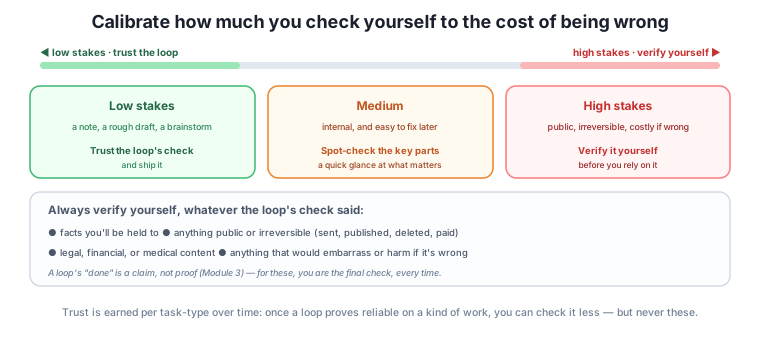
Low stakes — a private note, a rough draft you’ll rework, a brainstorm — trust the loop’s check and move on. Verifying these yourself is wasted effort; the loop being occasionally imperfect costs nothing. Medium stakes — internal work, easily fixed if wrong — spot-check the parts that matter and ship. High stakes — anything public, irreversible, or costly if wrong — verify it yourself before you rely on it. The loop’s check is your first line; your own eyes are the last.
Regardless of the general stakes, a few categories should get a personal check every time, because the cost of a confident error in them is high and often irreversible:
These aren’t a failure of loop engineering — they’re the point of it. A well-built loop does the heavy lifting and hands you something close, so your personal check is fast: a thirty-second read of the facts that matter, not a rebuild. The loop earns you the time; you spend a little of it on the parts that count.
Fluency is not accuracy — especially here
The reason these categories need a human is the trap from Module 1: AI output is fluent, and fluency reads as correct. A confidently-worded wrong date, a smooth but invented statistic, a polished but legally-off sentence — all look right. Your check on high-stakes content isn’t “does this read well?” (it will); it’s “is this specific fact actually true?” Check the substance, not the polish, precisely because the polish is what disarms you.
Trust in a loop isn’t all-or-nothing, and it isn’t fixed — it’s earned gradually, per kind of task. The first few times you run a newsletter loop, you check its output closely. After it’s produced ten good newsletters and you’ve caught how it behaves, you can check less — maybe just the facts and the length — because it’s proven reliable on that task. That’s healthy calibration: trust grows with evidence.
But two cautions keep this honest. Trust is task-specific — a loop you trust for newsletters hasn’t earned trust for legal summaries; each kind of work builds its own track record. And it never extends to the always-check categories above — no amount of good history lets you skip verifying a public, irreversible, or high-consequence output, because there the cost of the rare miss is too high to gamble. Trust the loop more as it proves itself; keep your hand on the important releases regardless.
The owner runs three loops with very different verification. The internal to-do summary loop: low stakes, trusted — they read the loop’s “done” and move on, and if it occasionally misses something small, no harm. The customer newsletter loop: it goes to two thousand people (public, irreversible), so no matter how reliable the loop has become, they personally check the two things that matter — every fact and the event date — in thirty seconds before sending. The response to a customer’s refund complaint: high-stakes and reputational, so the loop drafts it but the owner reads every word and adjusts the tone before it goes out.
Same person, same tools, three levels of trust — each matched to the cost of being wrong. That calibration is the whole skill: let the loop save you time everywhere, and spend a little of that saved time verifying the things that would actually hurt if the loop’s confident “done” turned out to be wrong.
For each, how much do you verify yourself: (a) a brainstormed list of blog topics, (b) a press release going on the website, (c) an internal meeting summary, (d) the dosage figure in a health leaflet?
Hint
(a) trust the loop — low stakes. (c) spot-check — internal, easily fixed. (b) verify yourself — public and irreversible. (d) verify yourself thoroughly — medical content is an always-check category where a confident error is dangerous.
An AI-written bio “reads perfectly.” Why isn’t that enough for a public bio, and what should you actually check?
Hint
Fluency isn’t accuracy — a smooth bio can still have a wrong job title, date, or invented award. It’s public and factual (two always-check categories), so verify the specific facts against the truth (title, dates, claims), not whether it reads well. Polish is exactly what disarms the check.
Your newsletter loop has produced twelve good issues. What can you now check less, and what must you still always check?
Hint
You can trust its structure, tone, and general quality more — it’s proven reliable on this task. But you must still always check the facts and the event date every time, because the newsletter is public and irreversible: earned trust reduces routine checking, never the always-check categories.
A loop’s “done” is a claim, not proof, so however good its own check is, you remain responsible for what matters — the same judgment that has you skim a colleague’s draft before it reaches a client. The practical skill is to calibrate your self-verification to the stakes: trust the loop on low-stakes work, spot-check the medium, and personally verify the high-stakes. And regardless of stakes, a few categories get a human check every time — facts you’ll be held to, anything public or irreversible, legal/financial/medical content, and anything that would embarrass or harm if wrong — because a confident error there is costly and hard to undo, and AI’s fluency reads as accuracy, so you check the substance, not the polish. Trust in a loop is earned gradually and per task, growing with evidence, but it never extends to the always-check categories. Let the loop save you time everywhere; spend a little of it on the things that would actually hurt if its “done” were wrong.
This lesson is what keeps loop engineering trustworthy in the real world: the loop does the work and the first check, and you provide the judgment about when that’s enough — which is exactly the division of labor that lets you rely on AI without getting burned by it. The confident errors that damage people and businesses almost always come from skipping the human check on something public, factual, or high-stakes because the output “looked fine.” Calibrated verification is the cure. With trust handled, the next real-world guardrail is about what a loop should never touch in the first place. Next: cost, privacy, and what never goes into a loop.
You can now calibrate how much you verify to the stakes, and you know the categories — facts, public, irreversible, legal/financial/medical — that always get your own eyes no matter how much you trust the loop. Let the loop save you time; spend a little of it checking what would actually hurt if it were wrong. Next, you’ll set the other real-world guardrail: the cost and privacy rules for what a loop should never touch, and what information should never go into one.
Keep DATATWEETS free. Help fund practical data, AI, and engineering lessons for learners worldwide.