Title here
Summary here
You’ve built the two foundations — a goal that can finish and a check that’s honest. Now you’ll run loops for real, in the tools you already have open: ChatGPT and Claude, in a browser, no code. This first lesson tackles the single biggest failure mode of a hand-run loop in a chat window: drift. The longer a conversation goes, the more the AI loses track of what you originally asked for, until it’s confidently solving a slightly different problem. Keeping a loop on target is a skill, and it’s mostly about managing the conversation’s context.
By the end of this lesson, you will be able to:
Let’s start with why drift happens at all.
An AI in a chat doesn’t hold your goal in mind the way a person does. It re-reads the conversation each turn and pays the most attention to what’s recent. Early on, that’s fine — your goal is right there. But as the chat grows, with tangents, second thoughts, and a dozen little corrections, the original brief slides further and further up, out of the model’s focus. It starts attending to the last few messages instead of the goal, and that’s when things go wrong: it “forgets” a constraint you set ten turns ago, reintroduces an error you’d already fixed, or quietly follows a tangent as if it were the main task.
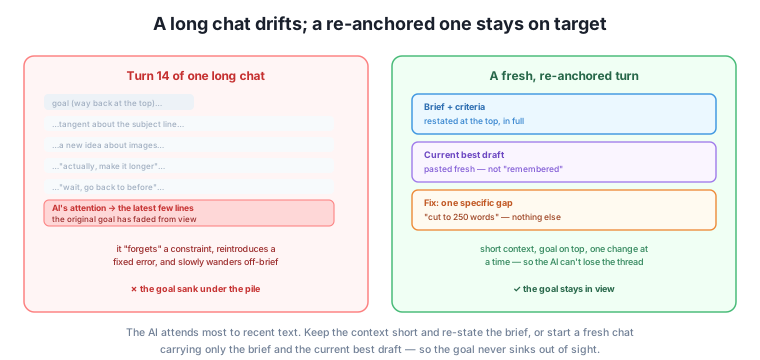
The important insight is that this isn’t the model being “dumb.” It’s a predictable consequence of how attention works in a chat: recent text dominates. Once you know that, the fix is obvious — keep the thing you care about recent, and keep the noise out.
Three habits keep a manual loop from drifting, and they all follow from the same principle: make the goal easy for the AI to keep in view.
Re-anchor the brief. Every few rounds — and always if you feel the loop wandering — restate the goal and the criteria. You don’t have to retype them; paste your brief again. This drags the finish line back into the model’s recent attention, right where it’s looking. A loop that’s re-anchored every few turns barely drifts at all.
Correct one thing at a time. When the check finds several gaps, it’s tempting to fire them all back at once: “shorten it, fix the date, warm up the tone, and add a call to action.” Bundled corrections invite the AI to change many things at once and lose track of some. One focused correction per round — “first, cut it to 250 words” — keeps each change clean and checkable, and stops the loop from trading one fixed problem for a new one.
Carry the draft, don’t rely on memory. Instead of “make the last version shorter,” paste the current best draft fresh and say “cut this to 250 words.” Pasting the actual text you mean removes any ambiguity about which version you’re refining — a common source of drift is the AI editing a different draft than the one in your head.
The three habits above combine into one simple, high-leverage move: paste a short status block at the top of each round. It re-anchors the goal, records what’s passing, names what’s still failing, and points at the single next correction — all at once:
Loop status — iteration 3 of 5
Goal: 250-word Harborlight newsletter, warm tone, this week's event, only in-stock books.

Passing:
- Under 250 words
- Event date correct

Still failing:
- Mentions two books we don't stock
- Tone is a bit formal

Next correction (one thing):
- Replace the two out-of-stock books with in-stock ones.
Pasting this each round does the work of all three habits in one step: the goal stays in view (re-anchor), the AI can see exactly what not to touch (the passing items) and the one thing to fix (a single correction), and there’s no ambiguity about which draft you mean. It also doubles as your record of the run — keep the blocks and you’ve got a simple trace of the loop, which is exactly what Module 6 builds on. For any loop longer than two or three rounds, a status block is the cheapest way to keep it from drifting.
Sometimes a chat is simply too tangled to rescue. It’s twenty turns deep, you’ve changed direction twice, and the AI keeps dragging back old mistakes. Don’t keep fighting it — reset. Open a fresh chat and carry across only what matters: the brief (goal and criteria) and the current best draft. Everything else — the false starts, the abandoned ideas, the meandering — stays behind.
This feels wasteful, but it’s the opposite. A fresh chat with a clean brief and a good draft is a loop running at full strength again, with none of the accumulated noise pulling it off course. Think of the long chat as scratch paper: useful while you’re exploring, but once you have a decent draft and a clear goal, a clean sheet is faster than erasing. The reset is the same move as the two-hat review from Module 3 — a fresh context is a powerful tool, and here you’re using it to escape drift rather than to get an unbiased check.
Tool-specific note (durable idea underneath)
The exact button to start a new chat, and the size of the context each tool holds, change often and differ between ChatGPT and Claude — so this lesson doesn’t lean on either. The durable idea is what matters: recent text dominates, so keep the goal recent and the noise low. That’s true in any chat tool, this year and next, whatever the menus look like.
The owner is drafting the weekly newsletter and it’s gone fifteen turns. Early on they set “under 250 words, no invented books.” By now they’ve wandered through subject-line ideas, an image discussion, and two changes of mind about the lead story. The latest draft is 340 words and — again — mentions a book they don’t stock. The loop is drifting: the AI is attending to the recent image-and-subject-line chatter, not the original constraints.
Two moves fix it. First, they re-anchor: paste the brief back in — “Here’s the goal and criteria again” — and the current draft, and ask for a check against the criteria. The AI, with the goal now fresh, immediately flags the length and the invented book. Second, because the chat is a mess, they reset: a new chat, just the brief and the best draft, and the last two focused corrections land cleanly. The newsletter is done in three tight turns, after fifteen loose ones. The lesson isn’t “don’t have long chats” — it’s “notice drift, re-anchor, and reset before the loop wanders off entirely.”
You’re twelve turns into refining an email and notice the AI just re-added a sentence you deleted five turns ago. What’s happening, and what’s the quickest fix?
Hint
The deleted sentence is “recent enough” to be back in the model’s attention while your deletion has faded — classic drift. Quickest fix: re-anchor by pasting the current correct draft fresh and stating the goal, so the AI works from the right version rather than its fading memory of the thread.
Rewrite this bundled correction into a tighter approach: “make it shorter, fix the tone, add the date, remove the second paragraph, and make the ending stronger.”
Hint
Do them one at a time, checking after each: round 1 “cut to under 200 words”; round 2 “add the event date”; round 3 “warm up the tone”; and so on. Each change stays clean and checkable, and the loop can’t quietly undo a fix while doing five things at once.
Your chat is 25 turns deep, you’ve changed the goal once, and the AI keeps reintroducing an old error. Push on, or reset? What do you carry across?
Hint
Reset. Carry across only the brief (updated goal + criteria) and the current best draft. Leave behind the false starts and the old error that keeps resurfacing — in a fresh chat it isn’t in the context to come back.
The biggest failure of a hand-run loop is drift: as a chat grows, the AI attends most to recent messages, so your original goal fades and the loop starts solving a slightly different problem — forgetting constraints, undoing fixes, following tangents. It isn’t the model being dumb; it’s how attention in a chat works, and knowing that gives you the fix: keep the goal easy to keep in view. Three habits do it — re-anchor by restating the brief every few rounds, correct one thing at a time so changes stay clean, and carry the draft by pasting the current text rather than relying on the model’s memory. And when a chat is too tangled to rescue, reset: a fresh chat carrying only the brief and the best draft is a loop at full strength again. The exact buttons differ by tool and change often; the durable principle — recent text dominates, so keep the goal recent and the noise low — holds in any chat tool.
Drift is why so many people feel an AI “got worse the longer I used it” — the tool didn’t degrade, the context did, and nobody told them to manage it. These habits are the difference between a browser chat that stays useful across a real task and one that slowly turns to mush. They also cost nothing and work in any tool. Next, you’ll go one step further and stop retyping your setup altogether — saving a loop’s brief and check into a Project so every new chat starts already anchored.
You can now keep a hand-run loop from drifting: re-anchor the brief, correct one thing at a time, carry the draft, and reset when a chat gets tangled. That single skill makes browser loops reliable across real, multi-step work. Next, you’ll make the setup permanent — using Projects and custom instructions so your brief and check are always loaded, and you never start a loop cold again.
Keep DATATWEETS free. Help fund practical data, AI, and engineering lessons for learners worldwide.