Title here
Summary here
There’s a quiet gap in how most people use AI, and almost everyone falls into it. You type a request, you read what comes back, and you treat that reply as the finished thing. Sometimes it is. But most of the time what you actually wanted wasn’t an answer — it was an outcome: a newsletter your customers will actually read, a report you can hand to your boss, a tidy folder you can find things in. An answer is what the AI says. An outcome is what the world looks like after the work is done. This whole course lives in the gap between those two, and this first lesson is about learning to see it.
By the end of this lesson, you will be able to:
No tools or setup are needed for this lesson — just a willingness to look at your own habits.
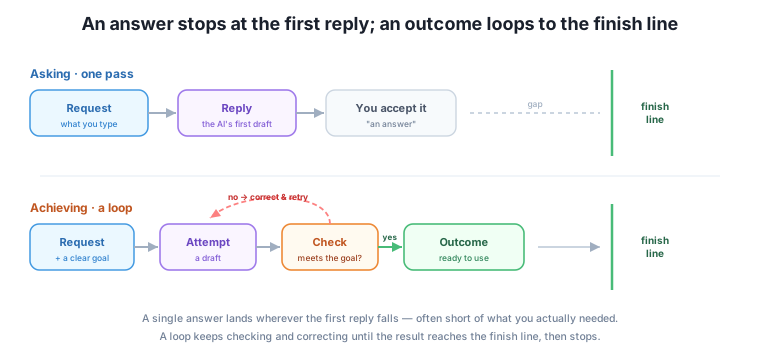
Asking is a single request and a single reply. You ask “what’s a good subject line for a bookstore newsletter?” and the AI gives you five. That’s an answer, and it might be all you need. Achieving is different: it means the thing you wanted actually exists and is good enough to use. “Achieving” a newsletter means there’s a finished newsletter that fits your brand, your length, your event calendar, and that you’d be comfortable sending to real customers.
The trap is that AI is so good at the asking part that we forget the achieving part is the real job. A fluent, confident reply feels like a finished product. It reads well. It’s grammatical. It sounds sure of itself. So we accept it — and then discover, an hour or a day later, that it missed the point, invented a fact, ignored a constraint, or solved a slightly different problem than the one we had.
Here’s the mental shift this course asks you to make: stop grading the reply, and start grading the outcome. The question is never “did the AI say something reasonable?” It’s “is the thing I actually needed now done?” Those are different questions, and the second one is almost never answered by a single pass.
Let’s make this concrete with the example you’ll use all course: Harborlight, a small community bookstore that sends a weekly newsletter to about two thousand customers. Imagine the owner opens Claude and types: “Write this week’s Harborlight newsletter.”
Back comes a polished-looking newsletter. It has a warm greeting, three book recommendations, a friendly sign-off. It reads like a finished newsletter — so it’s tempting to copy it, paste it into the email tool, and hit send. That’s treating the reply as the outcome.
But look at what a real check would catch. The recommended books aren’t ones Harborlight actually stocks — the AI invented plausible titles. There’s no mention of Saturday’s poetry evening, which is the whole reason this week’s newsletter matters. The tone is a notch more corporate than Harborlight’s chatty voice. And it’s 600 words when the ones customers actually read are closer to 250. None of that is visible if you grade the reply. All of it is obvious the moment you grade the outcome against what you needed: accurate stock, this week’s event, the right voice, the right length.
The fix isn’t to type a longer first prompt and hope. It’s to run a loop: state what “done” means (real stock, the poetry event, Harborlight’s voice, ~250 words), let the AI attempt it, check the draft against that list, and send back the specific gaps to correct — until every item is satisfied. Same tool, same AI. The difference is entirely in the method wrapped around it.
Think about how you do good work. You don’t write a report in one perfect draft. You write something rough, read it back, notice it’s too long, cut it, realize you forgot the numbers, add them, check the tone, and only then send it. Good work is iterative. It comes from attempts and corrections, not from a single flawless stroke.
An AI writing in a single pass is doing the opposite of that. It produces its whole answer in one forward motion, with no chance to step back and look at what it made. It can’t reread its draft against your goal, because in that one pass there is no “reread” — there’s just the initial output. So anything that requires checking the work against a standard — which is almost all real work — can’t happen in a single reply. Not because the model isn’t smart, but because one pass has no room for it.
Note
This isn’t a limitation you fix with a better prompt. Even the best prompt still produces one pass. The fix is structural: give the work more than one pass, with a check in between. That structure is a loop, and building it well is what this course teaches.
It would be silly to loop everything. Plenty of tasks really are one-and-done, and forcing a loop onto them just wastes your time. A single pass is usually fine when:
The skill isn’t “always loop.” The skill is noticing which tasks have a real finish line that a single reply can’t reach — and treating those differently. A throwaway list of ideas is an answer. A newsletter going to two thousand customers is an outcome. You’ll learn to tell them apart quickly.
Watch for a specific moment. You get a reply, you read it, and you think “close, but…” — and then you type a correction. That “but” is the exact instant a single answer turned into a loop. You just did the most important move in loop engineering: you checked the output against what you wanted, found a gap, and corrected.
Most people do this a few times, get tired, and settle for “good enough” or give up. That’s not a character flaw; it’s what happens when you run a loop without a method — you have no clear finish line, so you either stop too early or spin forever. The rest of this course gives you the method: a clear goal, a real check, a correction step, and a rule for when to stop. But it all starts with noticing that “close, but…” moment for what it is: the beginning of a loop.
For each task, decide whether a single answer is enough or whether it needs an outcome (and therefore a loop): (a) “What’s a synonym for ‘cozy’?” (b) “Write the copy for our spring event flyer.” (c) “Summarize this 2-page article in three bullets for me.” (d) “Turn our messy event notes into a clean, publishable schedule.”
Hint
(a) and (c) are usually fine as a single answer — low stakes, easy to verify. (b) and (d) are outcomes: they have to meet a standard (brand, length, accuracy, usability) that you’d naturally check and correct, so they’re loops.
Think of the last time you used ChatGPT or Claude for something that mattered. Did you accept the first reply, or did you say “close, but…”? Write down the correction you made — that’s the first turn of a loop you were already running.
Hint
There’s no wrong answer here. The point is to notice that you were checking the output against a goal in your head and correcting toward it. You had a loop; you just didn’t have it written down.
Pick one thing you’d genuinely like AI help with at work. In one sentence, describe not the answer you’d ask for, but the outcome you actually want — what the world should look like when it’s done.
Hint
“Write me some newsletter ideas” is an answer. “A finished 300-word newsletter about this week’s events that matches our friendly tone and is ready to send” is an outcome. The outcome names a finish line — which is exactly what you’ll need to build a loop.
Most AI use stops at the answer — the text the model returns — when the thing you actually wanted was an outcome: the finished, good-enough result that changes the world in the way you needed. Fluent replies feel finished, so we accept them, then discover they missed the point. The fix isn’t a better prompt; it’s structural. Real work is iterative, and a single pass has no room to check itself against a standard. Some tasks are genuinely one-and-done, and the skill is telling those apart from the ones with a real finish line. The moment you look at a reply and think “close, but…” is the moment a single answer becomes a loop — and running that loop on purpose is what this course is about.
Every hour wasted “fighting” an AI comes from treating a loop like a single answer — accepting a fluent reply that isn’t actually done, or nudging endlessly with no finish line in sight. Once you see the difference between asking and achieving, you stop grading replies and start grading outcomes, which is the only standard that matters at work. Next, you’ll give this loop a proper shape: the four beats every loop runs through, plus the fifth thing beginners always forget.
You’ve made the shift that the whole course rests on: from grading what the AI says to grading whether the outcome is done. Hold onto that “close, but…” moment — it’s the seed of every loop. Next you’ll give the loop a shape you can name and reuse.
Keep DATATWEETS free. Help fund practical data, AI, and engineering lessons for learners worldwide.