Title here
Summary here
Here’s a reassuring truth: you already know how to run a loop. Every time you’ve read an AI’s reply, decided it wasn’t quite right, and typed a follow-up, you were the loop — specifically, you were the check and the corrector, running the cycle by hand. You don’t need to learn looping from scratch. You need to see the manual loop you already run, notice exactly where it breaks down, and then learn to shore up those weak spots. That’s the whole arc of this course, and this lesson sets it up.
By the end of this lesson, you will be able to:
Let’s watch a manual loop in action, then break it.
Picture a normal session. You ask Claude to draft a customer apology email. You read it. You think “too formal.” You say “make it warmer.” You read the new one. “Better, but it doesn’t mention the refund.” You say “add that we’ve refunded them.” You read again. “Good.” You send it.
That’s a textbook loop, and you supplied three of the five parts yourself. The goal lived in your head (“a warm apology that mentions the refund”). Claude produced each attempt. But you were the check — you’re the one who noticed “too formal” and “missing the refund.” You wrote each correction. And you decided when to stop. The AI did the drafting; you did the engineering. You’ve been doing it all along.
This is genuinely good news. It means loop engineering isn’t a new superpower — it’s making the thing you already do reliable, repeatable, and less exhausting. But to do that, we have to be honest about where the hand-run version falls apart.
Running a loop in your head works fine for small stuff. It breaks down predictably in four places, and each one maps to a part of the loop from Lesson 2.
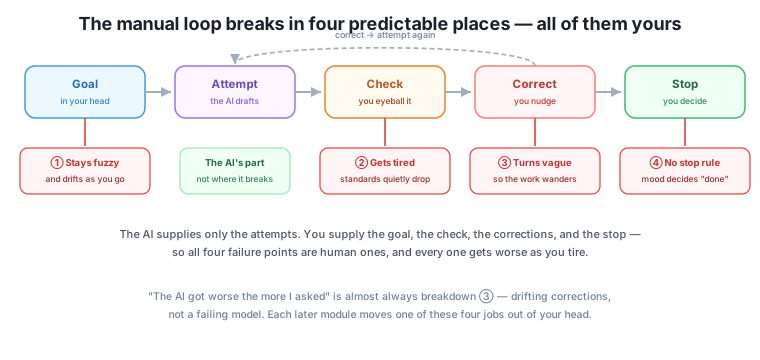
Because the goal lives only in your head, it’s usually vague and it shifts as you go. You start wanting “a warm email” and end up also wanting it short, on-brand, and refund-mentioning — but you never wrote that down, so each round you’re checking against a moving target. A fuzzy, drifting goal is the root cause of most loop frustration.
You are the check, and you’re a human. By the fourth or fifth round you’re skimming, not really checking. Your standards quietly drop because you’re tired of the task, and you accept something you’d have rejected on round one. A human check doesn’t just get slower over a long loop — it gets worse, and it never complains, so you don’t notice.
Under fatigue, corrections turn vague — “hmm, just make it flow better” — and vague corrections make the AI change semi-random things. So the loop wanders sideways instead of homing in. You’ve probably felt this as “the more I asked, the worse it got.” That’s almost never the model degrading; it’s your corrections losing their aim.
You stop when you’re satisfied or when you’re exhausted — and those are very different finish lines. With no rule for “done,” you either quit too early (settling) or grind too long (polishing something already fine). Either way, “done” is decided by your mood, not by the goal.
The real diagnosis
When people say “AI is unreliable for real work,” they’re usually describing one of these four breakdowns — a fuzzy goal, a tired check, drifting corrections, no stop rule. The loop broke, not the model. That’s great news, because loops are something you can engineer.
Here’s how the four breakdowns pile up in a real-feeling session. The Harborlight owner wants a short blurb for the shop’s Instagram about a weekend sale.
Round 1. “Write an Instagram post about our weekend book sale.” The goal in their head is really “short, warm, mentions 20% off, mentions it’s this Saturday and Sunday, no hashtags” — but none of that was said, so the AI returns a chirpy 90-word post full of hashtags. Breakdown ① — the goal was fuzzy, so the attempt aimed at the wrong target.
Round 2. “Shorter, and drop the hashtags.” Better. The owner reads it, thinks good enough, and almost stops — then notices it says “this weekend” but never the actual dates. They only half-caught that because they were already skimming. Breakdown ② — the check got tired by round two on a low-stakes task.
Round 3. “Make it pop more.” The AI, given a vague nudge, rewrites the whole thing in a louder voice and quietly drops the “20% off.” Breakdown ③ — the correction drifted, so the loop moved sideways and lost ground it had already won.
Round 4. The owner is now annoyed, pastes in whatever the last version was, and posts it — missing the discount. Breakdown ④ — no stop rule, so “done” was decided by irritation, not by the goal.
Every one of those failures is fixable before you start, by writing the goal and a stop rule down. That single move — getting the goal out of your head and onto the page — is what Module 2 is entirely about, and it prevents breakdowns ① and ④ outright while making ② and ③ far easier to catch.
Notice that every breakdown above is a manual loop asking too much of a tired human. So the fixes write themselves, and they preview the rest of the course:
And once those parts are written down instead of held in your head, something powerful becomes possible: you can hand the whole loop to an agent that runs it for you without getting tired — which is Module 5. But that only works if the goal, check, and stop rule are solid. Hand a fuzzy loop to an automated agent and you just get the same four breakdowns, faster and more expensively.
Recall a recent multi-message AI session. Which loop parts did you personally supply — the goal, the check, the corrections, the stop? Which did the AI supply?
Hint
In almost every hand-run session, you supplied the goal (in your head), the check, the corrections, and the stop; the AI supplied only the attempts. That’s exactly why the work felt like effort — you were doing four of the five jobs.
“I asked for a bio, tweaked it eight times, and somehow the last version was worse than the third.” Which of the four breakdowns is this, most likely?
Hint
Drifting corrections (and a fuzzy goal). With no written goal, the later nudges got vaguer and moved the bio sideways. The fix is a clear goal plus specific corrections — not a “smarter” model.
For “draft a 250-word event announcement,” write a one-sentence stop rule you could decide before starting, so “done” isn’t left to your mood.
Hint
Something like: “Stop when it’s under 250 words, names the event, date, and time, has no invented details, and reads warmly — or after four rounds, whichever comes first.” A concrete finish line plus a safety limit.
You’ve been running loops by hand all along: the AI supplies the attempts, but you supply the goal, the check, the corrections, and the stop. Manual looping works for small tasks but breaks down in four predictable places — the goal stays fuzzy and drifts, the human check gets tired and lowers its standards, corrections turn vague and wander, and there’s no stop rule so “done” is decided by mood. Almost every “AI is unreliable” complaint is really one of these four breakdowns, which means it’s a loop problem you can fix, not a model problem you can’t. The rest of the course fixes each one: write the goal down, make the check explicit, keep corrections specific, and set a stop rule — after which you can hand the whole loop to an agent.
Seeing the manual loop’s four breakdowns turns a frustrating experience (“AI just isn’t reliable”) into a solvable engineering problem (“my goal was fuzzy and my check got tired”). Every future module is really about moving one of these four jobs out of your tired head and into something written and repeatable. But before you invest in building loops, you need judgment about when a loop is even worth it — because some tasks should stay one-shot. That’s next.
You’ve caught yourself running the loop by hand and named the four places it breaks. That’s the diagnosis; the rest of the course is the treatment. Next, a crucial piece of judgment: knowing when a loop is worth building at all.
Keep DATATWEETS free. Help fund practical data, AI, and engineering lessons for learners worldwide.