Title here
Summary here
A loop is a tool, and like any tool it’s the right choice sometimes and the wrong one other times. It’s tempting, once you’re excited about loops, to loop everything — but every round of a loop costs time, money, and your attention. If those costs don’t buy you a better outcome, the loop is pure waste. This lesson gives you the judgment to tell the difference, so you spend your looping effort where it actually pays off.
By the end of this lesson, you will be able to:
Let’s start with what a loop actually costs.
Each trip around a loop costs three things. Time — every round is another wait and another read. Money — if you’re using a paid AI, each attempt and each check is a call you pay for, and automated agents can rack up many rounds fast. Attention — in a hand-run loop, you are the check, and your focus is a limited resource you’re spending each round.
So a loop is worth it only when repeating the cycle reliably improves the outcome by more than it costs. That sounds obvious, but it’s the exact judgment beginners skip. They loop a task that was fine after one pass (wasting rounds), or they refuse to loop a high-stakes task that badly needed it (shipping something broken). The goal is to loop deliberately, not reflexively.
The cost is easy to underestimate because a hand-run loop only feels like it costs your patience. But the moment you hand a loop to an automated agent — which you’ll do from Module 5 on — the cost becomes literal and can run without you watching. An agent told to “keep improving this until it’s perfect,” with no clear check and no limit, will happily run twenty, fifty, a hundred rounds, each one a paid request, chasing a “perfect” it has no way to recognize. The same loop that’s mildly annoying by hand becomes a real bill when automated. That’s why the judgment in this lesson — should this loop run at all, and when should it stop? — matters more, not less, as you move toward automation.
Before you build a loop, ask three quick questions. If the answers lean “yes,” loop. If they lean “no,” don’t.
High stakes, clear check, real variability → loop. Low stakes, no check, or identical every time → don’t.
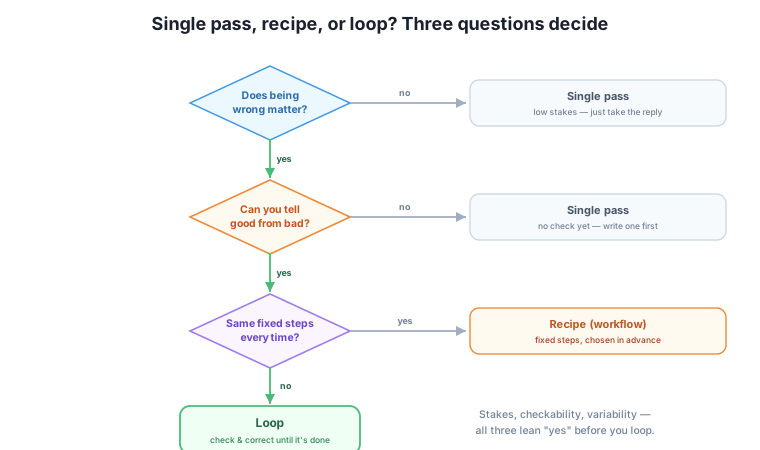
Take Harborlight’s weekly newsletter. Does being wrong matter? Yes — it goes to two thousand customers, so a wrong date or invented book is a real cost. Can you tell good from bad? Yes — you can check it against a short list: real stock, this week’s event, right voice, under 250 words. Does it vary each week? Yes — different books, different events, so it needs fresh judgment every time. Three yeses: this is a loop, and a good one.
Now take “turn the raw sales export into this month’s summary table.” It matters, and you can check it — but the steps are identical every month. That third answer is “no,” so it drops out of the loop lane and into the recipe lane. Same amount of care, different tool. Running the three questions in order, out loud, takes ten seconds and saves you from both mistakes we’ll look at next.
There’s a third option people forget, sitting between “single pass” and “loop”: a recipe, also called a workflow. A recipe is a fixed sequence of steps you decide in advance — do A, then B, then C — with no room for the AI to choose its own path. A loop is adaptive: the AI decides what to do next based on what the check found.
The rule of thumb: if you already know the exact steps, write a recipe; if the right next step depends on what you find, use a loop. Converting a monthly sales spreadsheet into the same three charts every time is a recipe — the steps never change. Researching a competitor is a loop — what you look up next depends on what the last search turned up. Loops are more powerful and more expensive and less predictable, so reach for a recipe whenever the steps are actually fixed.
A note on vocabulary
Different AI companies define “agent” and “workflow” a little differently, and no single definition is settled across the industry. Don’t get hung up on the labels. The useful distinction is the practical one: fixed steps you chose in advance (recipe) versus the AI choosing its next step based on a check (loop).
Beginners fail in one of two symmetric ways.
Under-looping is shipping the first pass on something that mattered — sending the confident-but-wrong report, publishing the newsletter with the invented author. The reply looked finished, so it got treated as finished. The cost shows up later, as an embarrassing correction or a lost customer.
Over-looping is the opposite: grinding a fine result through round after round of “make it a bit better,” spending time and money and often making it worse (remember the drifting-corrections breakdown from Lesson 3). Over-looping also includes looping tasks that should have been a one-shot answer or a fixed recipe.
The test above catches both. Under-looping usually means you underrated the stakes. Over-looping usually means the check couldn’t actually tell better from worse, so more rounds were never going to help. Deliberate looping is the cure for both.
Apply the stakes / checkability / variability test to each: (a) a private brainstorm list of blog ideas, (b) the store’s printed grand-opening poster, (c) turning last month’s raw sales export into the same summary table you make every month.
Hint
(a) Low stakes, brainstorm — single pass. (b) High stakes, public, checkable — loop. (c) Same fixed steps every month — a recipe, not a loop.
A team sends every customer email straight from the AI’s first draft with no review, but spends 30 minutes re-prompting internal meeting notes nobody rereads. Name each mistake.
Hint
Under-looping the customer emails (high stakes, no check) and over-looping the meeting notes (low stakes, polishing something disposable). They’ve got their effort exactly backwards.
Harborlight wants to (a) generate three social posts from each new blog article using the same format every time, and (b) research what local events are happening next month to feature. Which is a recipe, which is a loop?
Hint
(a) is a recipe — fixed input, fixed format, same steps each time. (b) is a loop — what you search next depends on what you found, and you check the results against “is this relevant and current?”
Loops cost time, money, and attention every round, so they’re only worth it when repeating the cycle reliably improves the outcome by more than it costs. Use a quick test: stakes (does being wrong matter?), checkability (can you tell good from bad?), and variability (does the task need judgment each time?). High-stakes, checkable, varying tasks deserve a loop; low-stakes, uncheckable, or identical-every-time tasks don’t. When the steps are fixed in advance, a recipe (workflow) beats a loop — loops are for when the next step depends on what the check finds. Avoid both under-looping (shipping a risky first pass) and over-looping (grinding a fine result, or looping what should’ve been a recipe).
Deliberate looping is what separates someone who uses AI well from someone who either trusts it blindly or fights it endlessly. Knowing when not to loop is as valuable as knowing how — it saves money and prevents the “I made it worse” spiral. With this judgment in hand, you’re ready to meet the four tools you’ll run loops in, and see which each is best at. That’s the final lesson of Module 1.
You can now decide, before you start, whether a task deserves a loop, a single pass, or a fixed recipe — and you can spot both under-looping and over-looping. That judgment protects your time and your budget. Next, meet the four tools you’ll actually run these loops in.
Keep DATATWEETS free. Help fund practical data, AI, and engineering lessons for learners worldwide.