Title here
Summary here
In Module 1 you learned that every loop needs a place to stop, and that the check is the hinge the loop turns on. But a check can’t work on its own — it needs something to compare each attempt against. That something is the goal. This lesson is about the most common way a goal fails: it’s too vague to ever be satisfied. Ask for “a better newsletter” and the loop has nothing to measure against, so it polishes forever and you eventually give up out of exhaustion, not completion.
By the end of this lesson, you will be able to:
No tools are needed — just your own recent experience of an AI session that wouldn’t end.
Think about what the word better actually means. It’s a comparison — better than what came before. It points in a direction (up, more, improved) but it never names a place to arrive. You can always be a little “better.” There’s no amount of good writing at which “better” becomes impossible, so there’s no point at which the request is satisfied.
Now put that word inside a loop. The loop runs: the AI makes an attempt, you check it, and the check asks “is this better?” The honest answer is almost always “yes, a little — and it could be a little more.” So you correct, it attempts again, and the check asks the same unanswerable question. Nothing about that cycle ever produces a “no more changes needed,” because “better” contains no finish line for the check to detect.
This is the trap, and it’s worth stating plainly: a goal that can’t be failed also can’t be finished. If there’s no version of the work that would make you say “that’s done, stop,” then the loop has no exit, and you’ll leave it the same way you leave a conversation that won’t wrap up — abruptly, unsatisfied, and usually worse off than a few rounds ago.
Let’s connect this precisely to the loop anatomy from Module 1. The check’s job is to compare the attempt to the goal and return one of two answers: good enough (stop) or not yet (correct). That comparison only works if the goal is concrete enough to compare against. “Make it better” gives the check nothing to hold the attempt up to — so the check can never confidently return “good enough.” It defaults to “not yet, keep going,” every single time.
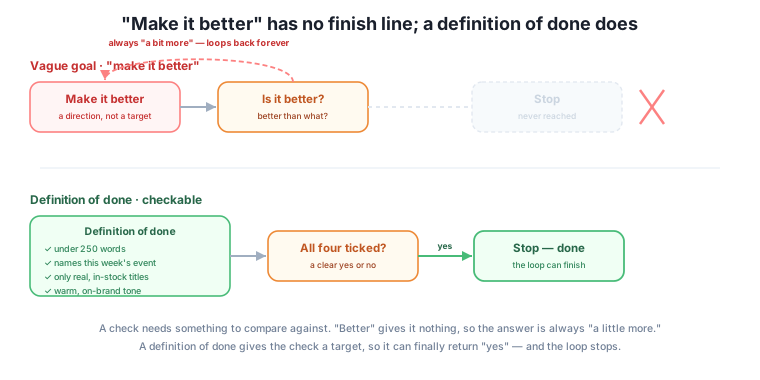
Notice what changed between the two rows. It isn’t the AI, the prompt, or the effort — it’s whether the goal gave the check a target it could tick off. The top row loops forever not because the work is bad, but because the question “is it better?” has no end state. The bottom row finishes because “are all four criteria met?” has a real yes.
This is a goal problem, not a model problem
When a session drags on and on, it’s tempting to blame the AI for not “getting it.” But an endless loop is almost always a sign that you never defined an end. No model can finish a task that has no definition of finished. The fix is upstream, in the goal — which is good news, because the goal is the part you control.
If “better” fails because it has no end state, the fix is to give the goal an end state you can check. The professional term for this is a definition of done: a short list of concrete criteria that, when all met, mean the work is finished. Good criteria share a few traits — they’re specific (they name a concrete thing, not a vibe), measurable (you can get a clear yes or no), and relevant (each one actually matters to the outcome).
Watch a vague goal turn finishable:
The second version isn’t longer for the sake of it. Each phrase converts a fuzzy wish into a checkable criterion. “Under 250 words” is a yes/no you can count. “Leads with the poetry night” is a yes/no you can see. Together they draw a finish line the check can actually detect — which is the entire point.
There’s a simple test for whether your goal is concrete enough, and it doesn’t involve any AI at all: could you hand the goal to a colleague with no context, and would they know when they’d finished? If a person would be unsure whether they were done, the AI will be too. “Make it better” fails that test instantly. The four-criteria version passes it. You’ll build this into a full definition of done in the next lesson; for now, the goal is just to feel the difference between a wish and a finish line.
Picture the Harborlight owner improving the shop’s “About” page.
The vague way. “Rewrite our About page to be better.” The AI returns a polished version. “Hmm, make it warmer.” Warmer version. “Good, but punchier.” Punchier. “Now it lost the bit about being family-run — better bring that back and make it flow.” Forty minutes later there are nine versions, the owner isn’t sure which is best, and “better” is still just as reachable as it was at the start. The loop never had a finish line, so it never crossed one.
The finishable way. Before touching the AI, the owner writes down what “done” means: under 200 words, mentions we’re family-run since 2009, names our two weekly events, ends with the shop’s opening hours, and sounds friendly rather than corporate. Now the loop has a target. The AI attempts it; the owner checks against the five criteria; two are missing, so those are the corrections; the next attempt satisfies all five; the loop stops. Same tool, far fewer rounds, and — crucially — a clear moment of done.
The difference wasn’t skill with prompts. It was five minutes spent turning “better” into something a check could actually finish. That five minutes is what this whole module teaches you to do well.
For each goal, decide whether a loop could ever finish on it: (a) “Make this email more professional.” (b) “Rewrite this email so it’s under 120 words, keeps the meeting time, and drops the apology in the first line.” (c) “Improve our product description.” (d) “Cut the product description to three bullet points, each under 15 words.”
Hint
(b) and (d) can finish — each names checkable criteria you can tick off. (a) and (c) can’t — “more professional” and “improve” are directions with no end state, so the check can always ask for “a bit more.”
Recall a recent AI session that dragged on longer than you expected. What was the goal you gave it? Was it a direction (“better,” “nicer,” “cleaner”) or a destination with checkable criteria? Write down what the unstated finish line in your head actually was.
Hint
Most drawn-out sessions started with a direction word. The finish line existed — but only in your head, never written down, so the loop couldn’t see it. Getting that finish line onto the page is the fix.
Take this Harborlight request and rewrite it so a loop could finish on it: “Make our event flyer better.” Invent reasonable concrete criteria.
Hint
Something like: “Fits on one page, shows the event name, date, time, and location, uses our logo, and has no more than two fonts.” Each item is a yes/no. When all are met, the flyer is done — the loop has somewhere to stop.
A loop can only stop when its goal is checkable, and vague goals like “make it better” aren’t. “Better” is a direction, not a destination — a comparison with no end state — so the check can always answer “a bit more,” and the loop polishes forever until you quit out of exhaustion. This isn’t a model failure; it’s a goal failure, and the goal is the part you control. The fix is to give the goal an end state the check can detect: a definition of done, a short list of specific, measurable, relevant criteria that together draw a finish line. A quick test — would a colleague with no context know when they were done? — tells you whether your goal is concrete enough. Turn “better” into a handful of yes/no criteria and the loop suddenly has somewhere to stop.
Endless, frustrating AI sessions are rarely the model’s fault — they’re the predictable result of a goal with no finish line. Once you can feel the difference between a direction and a destination, you stop launching loops that were never going to end, and you save the time you used to burn on version nine of something you couldn’t even evaluate. This single shift — writing goals a loop can actually finish — is the foundation the rest of the module builds on. Next, you’ll turn this instinct into a repeatable skill: writing a full definition of done you can hand to any loop.
You’ve seen the trap at the heart of most runaway AI sessions: a goal that points a direction instead of naming a finish line. Hold onto the colleague test — it’s the fastest way to catch a vague goal before it costs you an afternoon. Next, you’ll build a definition of done properly, turning that instinct into criteria you can write down and reuse for every loop.
Keep DATATWEETS free. Help fund practical data, AI, and engineering lessons for learners worldwide.