Title here
Summary here
In Lesson 1 you saw that a loop can only finish when its goal names a finish line, and you met the fix in passing: a definition of done. Now you’ll learn to write one well. This is the single highest-leverage skill in the whole module, because the definition of done is exactly what your check compares each attempt against. Get it right and the loop practically runs itself; get it vague and you’re back to polishing forever.
By the end of this lesson, you will be able to:
Let’s start with what a good criterion actually looks like.
A definition of done is just a list. Each item on it is a criterion — one condition that must be true for the work to count as finished. The whole skill is writing criteria that a check can answer with a clear yes or no. Three quick tests tell you whether a criterion is pulling its weight:
You don’t need fancy language for this. You need to take each thing you secretly mean by “good” and write it down as something you could point at and say “yes, that’s there” or “no, it isn’t.”
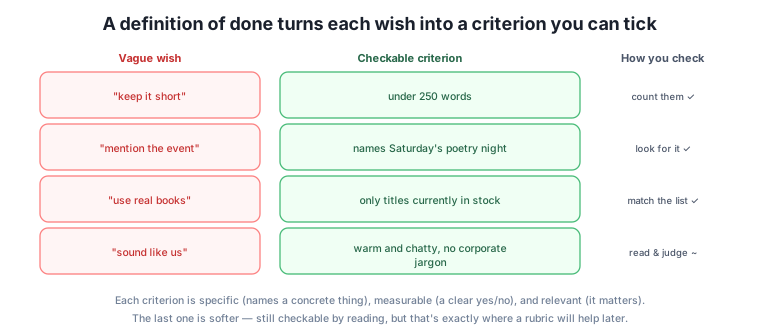
Look at the bottom row. “Sounds like us” is the hardest to pin down, and you’ll notice its check is “read and judge” rather than a clean count. That’s fine — a definition of done can include softer criteria, as long as you can still make a call on them. Module 3 is entirely about making those judgment-based checks reliable. For now, the goal is just to write each criterion as concretely as the thing allows.
The most common objection to definitions of done is “but my goal is creative — you can’t reduce ‘a warm newsletter’ to a checklist.” You can, and you should, and it doesn’t kill the creativity. The trick is to name the observable signs of the quality you want, rather than the quality itself.
“Warm” feels un-checkable until you ask: what would I actually see in a warm newsletter that I wouldn’t see in a cold one? Maybe it addresses the reader as “you,” uses the shop’s first name, includes a personal aside, and avoids corporate words like “leverage” and “utilize.” Now “warm” is four checkable signs. It’s not that you’ve measured warmth — you’ve named the evidence you’d look for, which is exactly what a check needs.
The ‘what would I see?’ trick
Whenever a criterion feels too soft to check, ask: “What would I actually see in the finished work if this were true?” The answer is your real criterion. “Engaging” becomes “opens with a question or a story”; “clean” becomes “no section longer than three sentences.” You’re naming evidence, not measuring a mood.
A definition of done is a tool, not a contract. If it runs to twenty items, nobody — not you, not the AI — will actually check them all, and the loop bogs down. Aim for a handful of criteria that capture what genuinely matters. A good rule of thumb: if you’d still be happy with the result when a criterion is broken, it probably doesn’t belong on the list.
It also helps to split the list into two kinds:
Keeping must-haves and nice-to-haves separate stops a common failure: burning ten extra rounds chasing a nice-to-have as if it were mandatory. The loop finishes when the must-haves are all met; the nice-to-haves are where you spend leftover effort, if any.
As for how many criteria, there’s a comfortable sweet spot: roughly three to six must-haves. Fewer than three and you’ve usually left something important unstated, so the check passes work that isn’t really done. More than six and the list gets skipped rather than checked, and the loop bogs down as each round tries to satisfy a dozen things at once. If you find yourself with ten must-haves, look hard for ones that are really the same thing said twice, or that are nice-to-haves in disguise. A tight list of the few criteria that genuinely decide “done or not” beats an exhaustive one nobody runs — the goal is a checklist you’ll actually use, every round, without dreading it.
Here’s the owner writing one for the weekly newsletter, out loud:
“What do I actually mean by a good newsletter? It has to be under 250 words — people don’t read past that. It has to lead with this week’s main event. Every book I mention has to be one we actually stock. And it has to sound like us: warm, first-name, no corporate-speak. That’s my must-have list. If there’s a clever subject line on top, great, but I won’t hold the send for it.”
Written down, that becomes:
Must-haves
Nice-to-have
Four must-haves and one nice-to-have. That’s a definition of done a check can run in under a minute, and a loop can actually finish on. Notice it took about ninety seconds to write and will be reused every single week — which is the payoff of the brief you’ll build in Lesson 4.
For each criterion, decide whether it’s specific, measurable, and relevant — and fix any that fail: (a) “reads nicely,” (b) “includes the price,” (c) “is professional,” (d) “no more than three bullet points.”
Hint
(b) and (d) pass — concrete and countable. (a) “reads nicely” and (c) “professional” fail the specific/measurable tests. Fix them by naming what you’d see: (a) “no sentence over 20 words, no jargon”; (c) “no slang, no exclamation marks, uses full sentences.”
Turn “make our About page feel welcoming” into three checkable criteria using the “what would I see?” trick.
Hint
For example: “addresses the reader as ‘you’ at least once,” “mentions we’re a local, family-run shop,” and “ends with an invitation to visit.” You’ve named the visible signs of ‘welcoming’ rather than trying to measure the feeling itself.
Sort these criteria for a Harborlight event flyer into must-haves and nice-to-haves: names the date and time; fits on one page; uses a fun font; includes the shop address; has a clever tagline.
Hint
Must-haves: date and time, fits on one page, shop address — get any of these wrong and the flyer fails its job. Nice-to-haves: fun font, clever tagline — welcome if they come easily, but the flyer still works without them.
A definition of done is a short list of criteria, and each criterion should be specific (names a concrete thing), measurable (gives a clear yes/no), and relevant (actually matters). Soft, subjective qualities like “warm” or “professional” become checkable when you name the observable signs you’d look for instead of trying to measure the mood — the “what would I see?” trick. Keep the list short — if you’d be happy with the result when a criterion is broken, cut it — and split it into must-haves (the loop isn’t done until all are met) and nice-to-haves (taken if cheap, never blocking). A tight, honest definition of done is the finish line your check runs against, and writing one takes a minute but pays off every time you reuse it.
The definition of done is the highest-leverage thing you write in a loop, because it’s what every check measures against — a vague one dooms the loop no matter how good your prompts are, and a sharp one lets even a simple loop finish cleanly. This is also the skill that transfers straight to working with people: a clear definition of done is how you hand any task off, to an AI or a colleague, without endless back-and-forth. Next, you’ll add the other half of a finishable goal: the boundaries — scope, constraints, and the non-goals that stop a loop from “improving” things you never wanted touched.
You can now turn a fuzzy wish into a short, honest list of criteria a check can actually run — the finish line your loop has been missing. Practice the “what would I see?” trick until it’s automatic; it’s the move that makes even creative goals checkable. Next, you’ll draw the boundaries around that goal, so the loop fixes what you meant and leaves alone what you didn’t.
Keep DATATWEETS free. Help fund practical data, AI, and engineering lessons for learners worldwide.