Title here
Summary here
You now have all the pieces of a finishable goal: an outcome, a definition of done, scope, constraints, and non-goals. This lesson gathers them into one short document — a brief — that you write once and reuse. The brief is the single most practical artifact in this course. You’ll paste it at the top of loops in ChatGPT and Claude, drop it into a Project’s instructions, and hand it to Claude Code and Codex as standing orders. Learn the shape once here and you’ll reuse it in every module that follows.
By the end of this lesson, you will be able to:
Let’s put the pieces together.
A brief is a short, structured statement of a goal a loop can finish. It has six parts, and you’ve already built five of them. The sixth, context, is new but small.
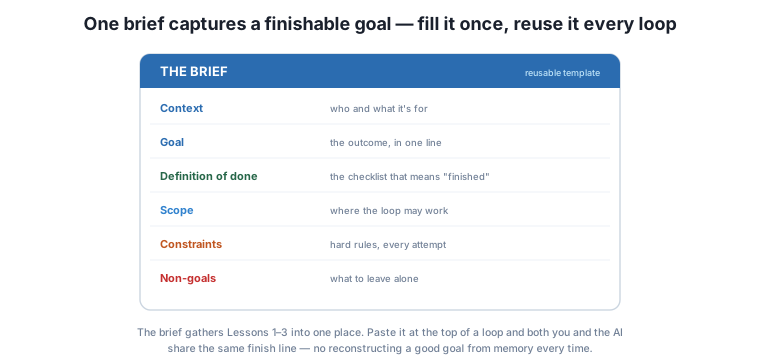
That’s the whole template. It’s deliberately short — a brief that runs to a page won’t get written or reused. The goal is a document you can fill in about five minutes and paste at the top of any loop.
Here’s the blank you’ll reuse. Keep a copy somewhere you can grab it:
BRIEF
Context:     <who/what this is for, one line>
Goal:        <the outcome you want, one sentence>
Definition of done (must be true to finish):
  - <criterion 1>
  - <criterion 2>
  - <criterion 3>
Scope:       <where the loop may work; what's out>
Constraints: <hard rules every attempt must obey>
Non-goals:   <what to deliberately leave alone>
Nothing about this is fancy — it’s plain text, and that’s the point. A non-developer can write it in a notes app; it drops cleanly into a chat window or a Project’s custom instructions; and later in the course it becomes the backbone of the CLAUDE.md and AGENTS.md files you’ll give to file agents. The same six-part shape carries all the way through.
A brief is written once, used many times
The five minutes you spend on a brief isn’t overhead for one loop — it’s an investment you cash in every time you run that task again. Harborlight’s newsletter brief is written once and reused every week for a year. That reuse is why briefs pay off so much more than they cost.
Not every task needs all six sections filled to the brim, and a brief that feels like paperwork won’t get written. Match the effort to the stakes. For a throwaway task, a one-line goal plus two done-criteria is a perfectly good “brief” — you’re just making the finish line explicit. For a high-stakes, repeated task like the newsletter, fill all six sections properly, because you’ll reuse them and the cost of drift is real. The template is a checklist of things to consider, not a form you must complete in full every time. The discipline isn’t “always write six sections”; it’s “always pause long enough to name the finish line and the boundaries that matter for this task.” A tiny task earns a tiny brief; a task you’ll run fifty times earns a careful one.
Here’s the newsletter task as a finished brief, pulling together everything from Lessons 1–3:
BRIEF
Context:     Harborlight's weekly customer newsletter, ~2,000 subscribers, friendly local bookshop.
Goal:        A ready-to-send newsletter featuring this week's events and book picks.
Definition of done (must be true to finish):
  - Under 250 words
  - Leads with this week's main event
  - Every title mentioned is currently in stock
  - Warm and personal: addresses the reader as "you", no corporate jargon
Scope:       The newsletter body text only. Not the subject line, subscriber list, or email template.
Constraints: Never mention a book not in stock. No discount codes or price promises. Under 250 words.
Non-goals:   Don't change the standard sign-off, the opening-hours line, or the section order.
Read that and notice how little room it leaves for the loop to go wrong. The AI knows what to produce (goal), how you’ll judge it (definition of done), where to work and where not to (scope), what it must never do (constraints), and what to leave untouched (non-goals). A loop run against this brief can genuinely finish — and you’d be comfortable letting it run several rounds unattended, because the boundaries are all written down. Compare that to “write our newsletter,” and you can feel the difference five minutes of briefing buys.
You might wonder why this needs to be written at all — you know what you want, so why not just keep it in your head? Three reasons, all of which you’ve now met.
First, an unwritten goal drifts (Lesson 1): held in memory, it shifts round to round, so you check against a moving target. Second, a check can’t run against a thought — the whole point of a definition of done is that it’s external to your tiring attention. Third, and most practically, a written brief is the only version you can hand off: to a colleague, to a Project’s saved instructions, or to an automated agent that will run the loop without you. A goal in your head helps exactly one loop, once. A brief on the page helps every future run, and every tool and person you share it with.
That’s the whole case for the brief: it converts a good intention into a reusable, shareable, checkable object. In the final lesson of this module, you’ll practice writing several — turning a stack of vague Harborlight requests into briefs a loop could finish.
A colleague’s brief lists Context, Goal, Definition of done, Scope, and Constraints — but the loop keeps rewriting a tagline they wanted kept. Which section did they forget, and what should it say?
Hint
Non-goals. Add: “Non-goals: don’t change the tagline.” Everything else was defined, but nothing told the loop that the tagline was off-limits, so it treated it as fair game.
Write a full six-part brief for this task: “a short social post announcing Harborlight’s Saturday poetry night.” Invent reasonable, checkable details.
Hint
Aim for something like — Context: a Harborlight Instagram post. Goal: announce Saturday’s poetry night and invite people. Definition of done: under 60 words; names date, time, and that it’s free; one clear call to action. Scope: the caption text. Constraints: no hashtags; don’t overstate attendance. Non-goals: don’t change our handle or bio.
What’s wrong with this brief? “Goal: make the About page great. Definition of done: it’s really good. Constraints: none. Non-goals: none.”
Hint
The goal is a direction, not a destination (Lesson 1), and the definition of done (“really good”) isn’t checkable (Lesson 2). With no constraints or non-goals, nothing is protected either. It’s a brief in shape only — none of its sections would actually let a loop finish.
A brief is a short, structured statement of a finishable goal, and it has six parts: context (who/what it’s for), goal (the outcome in one sentence), definition of done (the must-have checklist your check runs against), scope (where the loop may work), constraints (hard rules every attempt must obey), and non-goals (what to leave alone). Five of the six come straight from Lessons 1–3; context is the small new addition. The template is plain text on purpose — quick to fill, easy to paste into a chat, a Project, or later a CLAUDE.md. Written beats remembered because an unwritten goal drifts, a check can’t run against a thought, and only a written brief can be handed to another person, tool, or agent. Spend five minutes on a brief and you get a reusable, shareable, checkable object that every future run of the task cashes in on.
CLAUDE.md.The brief is where loop engineering stops being an idea and becomes a habit you can actually use at work. It’s the artifact you’ll reach for before every serious loop in the rest of the course — and, not by coincidence, it’s exactly how strong teams hand off work to each other: a clear outcome, a definition of done, and explicit boundaries. Master the brief and you’ve got a tool that outlives any single tool or model. Next, you’ll put it to work in a goal clinic, turning a pile of vague, real-world Harborlight requests into briefs a loop can finish.
You’ve assembled the one document this whole module was building toward: a six-part brief that turns a good intention into something reusable, shareable, and checkable. Keep the blank template handy — you’ll reach for it constantly from here on. Next, you’ll get your reps in at the goal clinic, rewriting five messy real-world requests into briefs a loop can actually finish.
Keep DATATWEETS free. Help fund practical data, AI, and engineering lessons for learners worldwide.