Title here
Summary here
Over the last four lessons you learned the full machine learning workflow, how k-nearest neighbors makes predictions, how to evaluate a classifier honestly, and how to tune it. Each idea arrived on its own. This lesson is where they all come together.
You are going to build a complete diagnostic model from scratch on a real medical dataset, the kind of work a data scientist does on the job. There is no new algorithm to learn here. Instead, you will practice the discipline of moving from a raw file to a trustworthy, well-measured model, making sensible decisions at every step and reading what the results actually tell you.
By the end of this lesson, you will be able to:
You should already be comfortable with train_test_split, StandardScaler, KNeighborsClassifier, and the confusion-matrix and ROC ideas from Lesson 3. Let’s get to work.
Imagine you have joined the data team at a hospital research lab. Pathologists examine fine-needle aspirate (FNA) samples of breast tissue under a microscope and measure properties of the cell nuclei: how large they are, how irregular their borders look, how much they vary in size. These measurements are recorded automatically from a digitized image.
Your task is to build a model that takes those measurements and predicts whether a tumor is malignant (cancerous) or benign (not cancerous). A good model can act as a second opinion that helps flag cases for closer review. It does not replace a doctor, but it can make the screening process faster and more consistent.
This is a binary classification problem. The two outcomes are malignant and benign, and the cost of the two kinds of mistake is very different, a point we will return to when we evaluate the model.
The data comes from the well-known Wisconsin Diagnostic Breast Cancer study. It contains 569 real patient samples, each with 30 numeric measurements and a confirmed diagnosis.
You can download the dataset and follow along:
import pandas as pd

df = pd.read_csv("breast_cancer.csv")  # download: https://datatweets.com/datasets/breast_cancer.csv

# How big is the dataset, and is anything missing?
print("Shape:", df.shape)
print("Missing values:", df.isna().sum().sum())
# Output:
# Shape: (569, 31)
# Missing values: 0
You have 569 rows and 31 columns: 30 numeric feature columns plus a target column. There are no missing values, which spares you a cleaning step and lets you focus on modeling.
Every row describes one tumor sample. The 30 feature columns are not 30 unrelated measurements. They are ten base properties of the cell nuclei, each reported three ways: the mean across nuclei in the image, the error (standard error) of that measurement, and the worst (largest) value observed. That gives you mean radius, radius error, and worst radius, and the same pattern for the other nine properties.
The ten base properties are:
| Property | What it captures |
|---|---|
radius | Average distance from the center of a nucleus to its edge |
texture | Variation in gray-scale intensity (how mottled the nucleus looks) |
perimeter | Length of the nucleus boundary |
area | Size of the nucleus |
smoothness | Local variation in the radius (how even the border is) |
compactness | Perimeter squared over area, minus one |
concavity | Severity of concave (inward-curving) portions of the border |
concave points | Number of concave portions of the border |
symmetry | How symmetric the nucleus shape is |
fractal dimension | “Coastline” roughness of the border |
And the target:
| Column | Meaning |
|---|---|
target | 1 = benign (357 cases), 0 = malignant (212 cases) |
Larger, more irregular, less symmetric nuclei tend to indicate malignancy, so you can expect features like worst radius, worst perimeter, and worst concave points to carry a lot of signal. You do not need to memorize the biology; the model will learn which measurements separate the two classes.
Before training anything, you should understand the shape of the problem. The single most important question for a classifier is: how balanced are the classes? If 95% of samples were benign, a lazy model could score 95% accuracy by always guessing “benign” while catching zero cancers. Accuracy would lie to you.
Let’s count the two outcomes. The dataset stores the target as 0 and 1; mapping those to readable labels makes the output easier to interpret.
# Map the numeric target to readable labels for exploration
labels = df["target"].map({0: "malignant", 1: "benign"})
print(labels.value_counts())
# Output:
# target
# benign       357
# malignant    212
# Name: count, dtype: int64
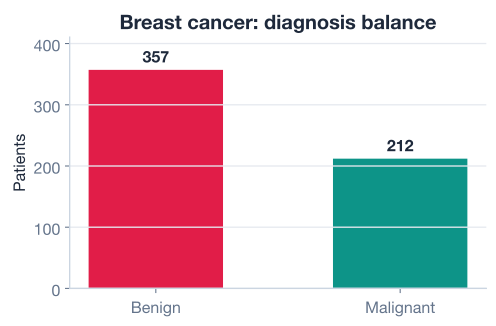
So you have 357 benign and 212 malignant cases. That is roughly a 63 / 37 split, mildly imbalanced but not severe. A model needs to do real work to beat the “always benign” baseline of about 63% accuracy.
The bar chart below makes the balance concrete.
A quick look at the feature scales also matters for k-NN. Because k-NN measures distance between points, features on large numeric scales dominate features on small ones.
# Compare the typical magnitude of a few features
print(df[["mean area", "mean radius", "mean smoothness"]].describe().loc[["mean", "max"]])
# Output:
#         mean area  mean radius  mean smoothness
# mean   654.889104    14.127292         0.096360
# max   2501.000000    28.110000         0.163400
Look at the ranges. mean area runs into the thousands, mean radius sits in the tens, and mean smoothness is a fraction below one. Without intervention, mean area alone would swamp the distance calculation and mean smoothness would barely register. That is exactly why you will scale the features before training. This is the WHY behind a step that is easy to apply mechanically and forget the reason for.
Preparation for this project has three parts: choose the feature matrix and target, split into train and test sets, and scale. The order matters.
All 30 columns are numeric and informative, so you can use them all. The target is already numeric (0/1), which is exactly what scikit-learn wants.
# Features: every column except the target
X = df.drop(columns=["target"])

# Target: 0 = malignant, 1 = benign (already numeric)
y = df["target"]

print("Feature matrix shape:", X.shape)
print("Target shape:", y.shape)
# Output:
# Feature matrix shape: (569, 30)
# Target shape: (569,)You split into a training set and a test set before you scale. The test set must stand in for data the model has never seen, so it cannot influence any decision made during training, including the mean and standard deviation used for scaling. Letting test data leak into the scaler is a subtle but real form of cheating that inflates your scores.
Use stratify=y so the train and test sets keep the same 63 / 37 class balance. With a small, imbalanced dataset, an unlucky random split could otherwise pile most malignant cases into one side.
from sklearn.model_selection import train_test_split

X_train, X_test, y_train, y_test = train_test_split(
    X, y,
    test_size=0.25,
    random_state=42,
    stratify=y,
)

print("Training samples:", X_train.shape[0])
print("Test samples:", X_test.shape[0])
# Output:
# Training samples: 426
# Test samples: 143Now scale. You fit the StandardScaler on the training data only, then transform both sets with that same fitted scaler. The training set teaches the scaler each feature’s mean and spread; the test set is merely transformed using what was learned. This is the correct, leak-free pattern.
from sklearn.preprocessing import StandardScaler

scaler = StandardScaler()

# Learn the scaling from training data, then apply it everywhere
X_train_scaled = scaler.fit_transform(X_train)
X_test_scaled = scaler.transform(X_test)   # transform only, never fit
After this step every feature has roughly mean 0 and standard deviation 1 on the training set, so mean area and mean smoothness finally contribute to the distance calculation on equal footing.
With clean, scaled data, training k-nearest neighbors is short. The one decision you control is , the number of neighbors that vote on each prediction. A small follows the training data closely and can overfit; a large smooths the decision boundary and can underfit.
A practical rule of thumb is to start near . With 426 training samples that is about 20, so a value in the high single digits to low twenties is reasonable. Let’s settle on , a common, robust starting point, and train.
from sklearn.neighbors import KNeighborsClassifier

# Seven neighbors vote on each prediction
knn = KNeighborsClassifier(n_neighbors=7)
knn.fit(X_train_scaled, y_train)

# Accuracy on the held-out test set
test_accuracy = knn.score(X_test_scaled, y_test)
print(f"test accuracy: {test_accuracy:.4f}")
# Output:
# test accuracy: 0.9790
A test accuracy of 0.9790 means the model correctly classifies about 98% of tumors it has never seen. That is a strong result and a large jump over the 63% “always benign” baseline. But accuracy alone never tells the whole story in a medical setting, so let’s dig into where the model is right and where it is wrong.
A single accuracy number hides the most important question: what kind of mistakes does the model make? For a cancer screen, missing a malignant tumor (a false negative) is far more dangerous than flagging a benign one for extra review (a false positive). The confusion matrix splits the errors apart so you can see both.
from sklearn.metrics import confusion_matrix, classification_report

y_pred = knn.predict(X_test_scaled)

print(confusion_matrix(y_test, y_pred))
print(classification_report(
    y_test, y_pred,
    target_names=["malignant", "benign"],
))
# Output:
#               precision    recall  f1-score   support
#
#    malignant       1.00      0.94      0.97        53
#       benign       0.97      1.00      0.98        90
#
#     accuracy                           0.98       143
#    macro avg       0.98      0.97      0.98       143
# weighted avg       0.98      0.98      0.98       143
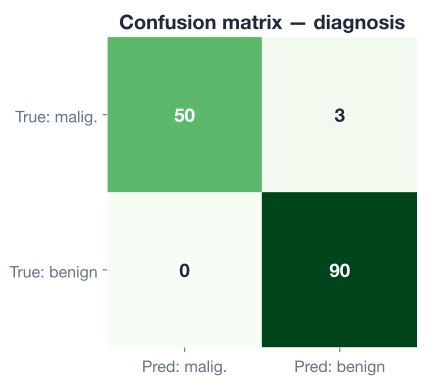
Read the report row by row. For the malignant class, precision is 1.00: every tumor the model called malignant truly was. Recall is 0.94: it caught 94% of the actual malignant cases, meaning a small number of malignant tumors were missed. For the benign class, recall is 1.00: no benign tumor was wrongly labeled malignant.
In a real screening tool, that missed-malignant rate is the number you would scrutinize most, because those are the dangerous false negatives. We will see how to trade precision for recall in a moment, but first let’s visualize the errors.
The confusion matrix below shows the four outcome counts: correctly identified malignant cases, correctly identified benign cases, and the few off-diagonal mistakes.
Accuracy and the confusion matrix judge the model at one fixed decision threshold (predict “benign” when the predicted probability passes 0.5). But you can move that threshold. Lower it and the model becomes more cautious, catching more malignant cases at the cost of more false alarms. The ROC curve traces the model’s performance across every possible threshold, plotting the true positive rate against the false positive rate.
The single number that summarizes the whole curve is the area under the curve (AUC). An AUC of 0.5 means the model is no better than a coin flip; an AUC of 1.0 means perfect separation of the two classes.
from sklearn.metrics import roc_auc_score

# predict_proba returns probabilities; column 1 is the "benign" class
y_proba = knn.predict_proba(X_test_scaled)[:, 1]

auc = roc_auc_score(y_test, y_proba)
print(f"BC ROC AUC = {auc:.3f}")
# Output:
# BC ROC AUC = 0.992
An AUC of 0.992 is excellent. It tells you that if you picked one random malignant tumor and one random benign tumor, the model would rank the malignant one as more likely malignant about 99% of the time. The two classes are very well separated, which the curve below shows visually as it hugs the top-left corner.
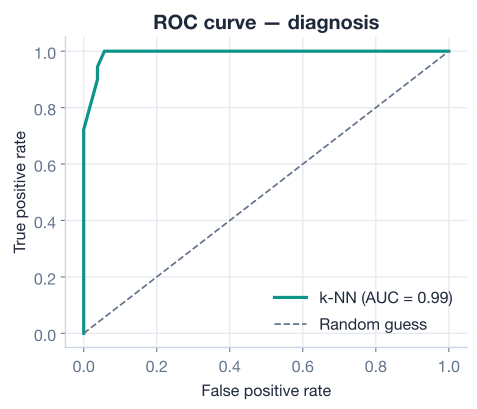
A high AUC is reassuring because it means the model’s ranking is sound regardless of threshold. If the lab decided that missing a malignant tumor is unacceptable, they could lower the threshold to push malignant recall toward 1.00, accepting a few more benign cases flagged for review. The ROC curve is the map for making that trade-off deliberately.
Step back and look at the full pipeline you assembled:
That is the entire supervised learning workflow, applied end to end to a dataset that matters. The same sequence, swap the data and the algorithm, is what professional data scientists run every day.
Try these before moving on. Each one deepens a decision you made above.
You chose by rule of thumb. Loop over the values [1, 3, 5, 7, 9, 15, 21], train a fresh KNeighborsClassifier for each, and print the test accuracy. Which value wins, and is 7 close to the best?
# Your code hereHint
Iterate with for k in [1, 3, 5, 7, 9, 15, 21]:, create KNeighborsClassifier(n_neighbors=k), fit it on X_train_scaled, and print knn.score(X_test_scaled, y_test) each time. Reuse the scaled arrays you already built.
Train one k-NN model on the unscaled X_train / X_test and another on the scaled versions, both with . Compare their test accuracies. How much does skipping the scaler cost you?
# Your code hereHint
You already have X_train, X_test, X_train_scaled, and X_test_scaled. Fit one classifier on each pair and print both scores side by side. The unscaled model will be noticeably worse because mean area dominates the distance calculation.
Using predict_proba, classify a tumor as malignant whenever its malignant probability exceeds 0.3 instead of the default 0.5. Build the new confusion matrix. Does malignant recall improve? What does it cost in false positives?
# Your code hereHint
Malignant is class 0, so its probability is knn.predict_proba(X_test_scaled)[:, 0]. Create predictions with (proba_malignant > 0.3) and convert the boolean array into the right labels before calling confusion_matrix.
You completed a full machine learning project on a real medical dataset, from a raw CSV to an evaluated, trustworthy classifier.
Project Workflow
stratify=y to preserve class proportions in small datasetsModel and Evaluation
classification_report reveal which errors occur, not just how manyA model is only as good as the process that produced it. The same accuracy number can come from a sound, leak-free pipeline or a flawed one that quietly cheated. By splitting before scaling, checking class balance, and reading the confusion matrix and ROC curve instead of a lone accuracy figure, you produced a result you can actually defend. In a domain like medicine, where a false negative carries real consequences, that discipline is the difference between a demo and a tool a professional would trust.
You have finished the Machine Learning Foundations module. You can now load data, prepare it correctly, train a classifier, and evaluate it like a professional. Next, you will move beyond predicting categories to predicting continuous numbers with regression.
Predict continuous values with linear regression and gradient descent, on real data.
Return to the Machine Learning Foundations module overview.