Title here
Summary here
This lesson shows you how to put a convolutional layer in front of a recurrent network. You will learn what a 1D convolution does to a sequence, why a small sliding kernel is good at spotting local patterns that an LSTM can then summarize over time, and how to keep the whole thing honest with causal padding so the model never looks at future values when predicting the present.
By the end of this lesson, you will be able to:
Conv1D layer does as it slides a kernel along a sequencepadding='causal' so a forecasting model never peeks at the futureYou should be comfortable with the RNN concepts from the earlier lessons in this module: windowing a time series, the SimpleRNN and LSTM layers, and evaluating a forecast with RMSE and MAE. Let’s begin.
So far in this module, you have asked an RNN to do two jobs at once. As it reads a sequence one step at a time, it has to (1) recognize the small, local shapes in the data, like a short dip followed by a sharp rebound, and (2) carry a memory of what happened many steps ago. Recurrent layers are excellent at the second job. They are less efficient at the first, because every local pattern has to be discovered one timestep at a time through the recurrence.
A convolutional layer is the opposite. It is built to find local patterns cheaply and in parallel, but on its own it has no sense of long-range order. So a natural idea is to let each layer do what it is best at:
raw sequence  -->  Conv1D  -->  local motifs  -->  LSTM  -->  long-range memory  -->  prediction
   (12 months)    (find shapes)   (compressed)    (remember)     (one number)
The convolution acts as a feature extractor that runs first. It scans the raw sequence and produces a new, shorter sequence of learned local features. The LSTM then reads that cleaner sequence and handles the long-term dependencies. This division of labor is why the hybrid often trains faster and can generalize better, especially on long sequences with repeating local structure.
Where this really shines
The Conv1D + RNN combination is most valuable when sequences are long and full of repeating local motifs: audio waveforms, sensor and biomedical signals such as EEG, and high-frequency financial data. On short, smooth series the benefit is smaller, as you will see for yourself at the end of this lesson. The point of the comparison is to teach you to check, not to assume.
The “1D” in Conv1D refers to the axis the kernel slides along, which is time. Your data still has more than one number per timestep in general (in image work a convolution slides over two spatial axes). For a univariate series like a stock index there is a single value per month, so each input window has shape (timesteps, 1). The convolution slides along the timesteps axis only.
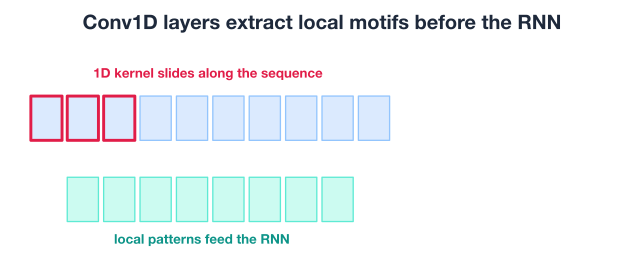
The core operation is simple. You take a small window of weights called a kernel (also called a filter), line it up against the start of the sequence, multiply element-by-element, and add the products into a single number. Then you slide the kernel one step to the right and repeat. The string of numbers you produce is the convolution’s output, often called a feature map.
The figure below shows a kernel of size 3 sliding along a sequence. At each position it looks at three neighboring timesteps and emits one value, so it is detecting a local shape, a motif spanning three steps, no matter where in the sequence that shape appears.
Two numbers control the layer:
kernel_size: how many neighboring timesteps the kernel spans. A kernel of 3 looks at short, three-step motifs; a kernel of 7 captures wider patterns. Odd numbers are conventional so each output is centered on a timestep.filters: how many different kernels the layer learns. Each filter learns to detect a different motif (one might fire on sharp upswings, another on slow plateaus), and produces its own feature map. With filters=64, the layer outputs 64 parallel feature maps.You can do the arithmetic by hand for one filter. Suppose a kernel of size 3 has weights (with a bias of 0) and slides over the values . The first output covers the first three values:
Sliding one step right, the second output covers the last three values:
So this kernel turns the 4-value input into the 2-value feature map . This particular kernel responds to whether the sequence is rising or falling across a three-step window, which is exactly the kind of local signal a forecaster cares about. During training, the network learns its own kernel weights instead of you choosing them by hand.
import numpy as np

# One filter, kernel [1, 0, -1], sliding over a 4-step signal (by hand)
signal = np.array([2, 5, 9, 4])
kernel = np.array([1, 0, -1])

out = [int(np.dot(kernel, signal[i:i+3])) for i in range(len(signal) - 2)]
print(out)
# Output: [-7, 1]
Convolution shrinks the sequence (by default)
With no padding, a kernel of size over a length- sequence produces outputs, because the kernel cannot hang off either end. A size-3 kernel over 12 months gives 10 outputs. Padding, which you will meet next, lets you keep the length the same.
Here is a subtle trap that is unique to forecasting. A standard (“same”) convolution centers the kernel on each timestep, so the output at month depends on months before and after . For images that is fine; pixels have no arrow of time. For a forecast it is a disaster: to predict the value at month , the model would be allowed to look at month , which in real life has not happened yet. That is data leakage, and it produces accuracy numbers that collapse the moment you deploy.
The fix is padding='causal'. Causal padding adds zeros only on the left (the past side) of the sequence, so the kernel at each position can only reach backward in time. The output at month depends on months and never on the future.
"same" padding (pads BOTH sides — output at t can see t+1):
        [0]  x1  x2  x3  ...  x12  [0]
              \_______/  kernel centered on x2 sees x1, x2, x3   <-- x3 is the future!

"causal" padding (pads LEFT only — output at t sees only the past):
   [0] [0]  x1  x2  x3  ...  x12
         \_______/  kernel at x1 sees only [0],[0],x1 (the past)
Causal padding also keeps the output length equal to the input length, so the sequence handed to the LSTM has the same number of timesteps as the window you fed in.
Always use causal padding for forecasting
If you forget padding='causal' (or use 'same'/'valid') on a forecasting model, your convolution can leak future information into the present. The model will look brilliant in your notebook and fail in production. Whenever the target is a future value of the same series, a Conv1D must be causal.
You will work with the same real series you used earlier in this module: the monthly closing level of the S&P 500 stock index. Each row is one month, so the series is a clean, evenly spaced univariate time series, perfect for testing whether a convolutional front-end helps an LSTM forecaster.
import pandas as pd

# download: https://datatweets.com/datasets/sp500_monthly.csv
df = pd.read_csv("sp500_monthly.csv", parse_dates=["date"])

print("Rows:", len(df))
print("From", df["date"].min().date(), "to", df["date"].max().date())
print("Price range:", round(df["close"].min(), 1), "to", round(df["close"].max(), 1))
# Output:
# Rows: 917
# From 1950-01-01 to 2026-05-01
# Price range: 16.9 to 7412.6
There are 917 monthly observations spanning from January 1950 to May 2026, with the index climbing from about 16.9 to over 7400. As in the earlier lessons, you turn this single column into supervised examples by windowing: each input is a block of 12 consecutive months, and the target is the value of the following month.
import numpy as np

def make_windows(series, window=12):
    X, y = [], []
    for i in range(len(series) - window):
        X.append(series[i:i + window])
        y.append(series[i + window])
    X = np.array(X).reshape(-1, window, 1)   # (samples, timesteps, features)
    y = np.array(y)
    return X, y

values = df["close"].values.astype("float32")
X, y = make_windows(values, window=12)

# Chronological split: train on the past, test on the most recent stretch
split = int(len(X) * 0.8)
X_train, X_test = X[:split], X[split:]
y_train, y_test = y[:split], y[split:]

print("train:", X_train.shape, "test:", X_test.shape)
# Output:
# train: (721, 12, 1) test: (184, 12, 1)
Each input window has shape (12, 1): twelve monthly timesteps, one feature per step. That trailing 1 is exactly the axis a Conv1D needs. The split is chronological, not random, because shuffling a time series would let the model train on the future and test on the past.
Now you assemble the hybrid. The architecture follows the division of labor from earlier: a causal Conv1D extracts local motifs, then an LSTM reads the resulting feature sequence and carries the long-range memory, then a small Dense head turns the LSTM’s summary into a single predicted number.
import tensorflow as tf
from tensorflow.keras import layers

model = tf.keras.Sequential([
    layers.Input(shape=(12, 1)),                  # 12 months, 1 feature per month
    layers.Conv1D(filters=32, kernel_size=3,
                  padding="causal", activation="relu"),  # extract local motifs, no peeking
    layers.LSTM(32),                               # long-range memory over the motifs
    layers.Dense(16, activation="relu"),
    layers.Dense(1),                               # one number: next month's level
])

model.compile(optimizer="adam", loss="mse", metrics=["mae"])
model.summary()
A few choices are worth calling out:
padding='causal' on the convolution is non-negotiable here, for the leakage reason above.activation='relu' on the Conv1D lets each filter act as a detector that “fires” only when its motif is present.Dense(1) has no activation because this is regression: you want a raw number, not a probability.Because causal padding preserves length, the convolution hands the LSTM a sequence of the same 12 timesteps, now with 32 feature channels instead of 1. The LSTM then collapses that into a single 32-dimensional summary vector, which the Dense head maps to the forecast.
Pooling is optional for short windows
On long sequences it is common to follow a Conv1D with a MaxPooling1D layer to shrink the timeline and cut training cost. With windows of only 12 months there is little to gain from pooling, so this model skips it. On a long audio or sensor stream, adding layers.MaxPooling1D() after the convolution is a natural next step.
Before fitting on the raw price scale, recall the discipline from the previous lessons: scale the inputs using statistics learned from the training set only, then train and evaluate. Here we train the hybrid and report RMSE and MAE on the held-out, most-recent months.
# Train the hybrid (errors below are on the original price scale)
model.fit(X_train, y_train, epochs=60, batch_size=32, verbose=0)

pred = model.predict(X_test, verbose=0).ravel()

rmse = np.sqrt(np.mean((pred - y_test) ** 2))
mae = np.mean(np.abs(pred - y_test))
print(f"Conv1D+LSTM  test RMSE={rmse:.1f}  MAE={mae:.1f}")
# Output:
# Conv1D+LSTM  test RMSE=507.0  MAE=353.1
After 60 epochs the hybrid lands at a test RMSE of about 507 and an MAE of about 353 index points. Given that the index ranges into the thousands over the test window, that is a respectable forecast that tracks the broad trajectory of the market.
Why your exact numbers may differ slightly
Neural network training involves randomness: weight initialization, the order of mini-batches, and GPU non-determinism all nudge the result. Your RMSE and MAE may land a little above or below the values shown. What matters is the pattern across models, not the third decimal place. Set a seed with tf.keras.utils.set_random_seed(42) if you want more repeatable runs.
Adding a layer always adds complexity, and complexity has to earn its place. The honest way to judge the hybrid is to compare it against a plain LSTM with the same recurrent and dense structure, just with the convolution removed. If the hybrid does not clearly beat it, the extra layer is not justified for this data.
In the previous lesson you already measured a plain LSTM on this exact split. Here is that baseline alongside the gated models you compared, so you have them side by side:
| Model | Test RMSE | Test MAE |
|---|---|---|
| SimpleRNN | 917.1 | 578.0 |
| GRU | 568.9 | 377.4 |
| LSTM (baseline) | 423.4 | 293.5 |
| Conv1D + LSTM | 507.0 | 353.1 |
Read that table carefully. The plain LSTM baseline reaches an RMSE of about 423, while the Conv1D + LSTM hybrid sits at about 507. On this dataset, adding the convolution did not improve the forecast; the simpler model is both leaner and more accurate.
That result is not a failure of the technique, and it is worth understanding why. The S&P 500 monthly series is short per window (12 steps) and dominated by a smooth long-term trend rather than fine repeating motifs. There is little local structure for a convolution to extract that the LSTM was not already capturing on its own. The Conv1D + LSTM hybrid pays off when sequences are long and rich in local pattern, which a 12-month window of a smooth index simply is not.
Architecture is a hypothesis, not a guarantee
It is tempting to assume “more sophisticated layer means better model.” It does not. A convolutional front-end is a hypothesis that your data contains useful local motifs. Always test that hypothesis against a simpler baseline on a held-out set. The cheapest model that meets your accuracy bar wins.
Try these before checking the hints. Reuse X_train, X_test, y_train, and y_test from the lesson.
Write a small function that applies a single kernel of size 3 to a 1D NumPy array with no padding, and use it on [1, 3, 2, 6, 4] with the kernel [1, 1, 1] (a moving sum). How long is the output, and why?
import numpy as np

signal = np.array([1, 3, 2, 6, 4])
kernel = np.array([1, 1, 1])

# Your code here
Hint
Slide the kernel across the signal with np.dot(kernel, signal[i:i+3]) for i from 0 up to len(signal) - 3. You get [6, 11, 12]: three outputs, because a size-3 kernel over a length-5 signal produces values when it cannot hang off the ends.
Build a tiny Sequential model with just an Input of shape (12, 1) and a single Conv1D using padding='causal', kernel_size=5, filters=8. Call .predict() on X_test and check the shape of the output. Then change the padding to 'valid' and compare.
import tensorflow as tf
from tensorflow.keras import layers

# Your code here
Hint
With padding='causal' the time axis stays at 12, so the output shape is (184, 12, 8). With padding='valid' and kernel_size=5 it shrinks to timesteps, giving (184, 8, 8). Causal padding is what keeps the sequence length intact for the LSTM that follows.
Rebuild the Conv1D + LSTM model but widen the kernel to kernel_size=5 and double the filters to filters=64 (keep padding='causal'). Train it for 60 epochs and print the test RMSE. Does a wider, wider-channel convolution close the gap with the plain LSTM baseline of about 423?
# Your code here (reuse X_train, X_test, y_train, y_test)Hint
Swap kernel_size=3 for 5 and filters=32 for 64 in the Conv1D line, recompile, and refit. Compute RMSE with np.sqrt(np.mean((pred - y_test) ** 2)). You will likely still see the plain LSTM hold its edge: on this smooth, short-window series, more convolution does not manufacture local structure that is not there.
Nice work. You added a convolutional front-end to a recurrent network, learned the one padding setting that keeps forecasting honest, and ran a fair comparison to decide whether the extra layer was worth it. Let’s review.
1D Convolution
Conv1D slides a small kernel along the time axis, turning each local window into one feature valuekernel_size sets how many neighboring timesteps a motif spans; filters sets how many different motifs the layer learnsWhy Combine Conv1D With an RNN
Causal Padding
padding='causal' pads only the left (past) side so the output at time never depends on the futureBuilding and Judging the Hybrid in Keras
Conv1D(filters, kernel_size, padding='causal', activation='relu') then LSTM(...) then Dense(1) for regressionDense(1) has no activation because you are predicting a raw numberThe real lesson here is not “always add a convolution.” It is the discipline around adding one. You saw that a more elaborate architecture can lose to a simpler one, and that the only way to know is to test both on data the models never saw. That habit, of treating each layer as a hypothesis you must justify, is what separates careful practitioners from people who stack layers and hope.
You also met causal padding, a small setting with outsized consequences. The same instinct that warns you about future leakage in a convolution will protect you across every forecasting problem you ever build, from energy demand to web traffic to financial markets. Knowing when a tool helps, and proving it on held-out data, is the skill that carries into the forecasting workflow you tackle next.
You can now extract local patterns with a Conv1D, guard against future leakage with causal padding, and judge a hybrid against a baseline. Next, you will assemble these pieces into a complete time-series forecasting workflow.
Build the full forecasting workflow: windowing, scaling, training, and multi-step prediction.
Return to the Sequence Models module overview.
You have learned to combine two of the most important deep learning building blocks, convolution and recurrence, and just as importantly, to test whether that combination earns its keep. Carry both habits forward: reach for a Conv1D when your sequences are long and locally patterned, always make it causal for forecasting, and never trust a fancier architecture until it beats a simple one on data it has never seen. Those instincts will serve you in every sequence model you build from here.