Title here
Summary here
This project brings the whole module together on the one DAG that matters most: CityFlow’s real ETL pipeline. cityflow_etl_instrumented_dag.py is a real variant of Module 5’s cityflow_etl_dag.py — a separate file, a separate DAG id, the original untouched — instrumented with everything this module built: Lesson 1’s unit-tested validation logic instead of a second copy of the same five checks, and Lesson 4’s real on_failure_callback instead of no alerting at all.
By the end of this project, you will be able to:
dag_run.conf and confirm the real alert it producesThree real changes from Module 5’s original, and nothing else: validate_trips imports cityflow_validation_logic.validate_trips_df instead of reimplementing the checks; default_args wires cityflow_on_failure_alert; and ingest_taxi_trips reads its parquet path from dag_run.conf (falling back to the real path) so the same file can be triggered against a genuinely bad path without editing it between runs.
# gate: skip
"""CityFlow's real instrumented ETL DAG (Module 6 Guided Project).

A real variant of Module 5's cityflow_etl_dag.py -- the original file is
untouched, this is a separate DAG id and a separate file -- instrumented
with everything this module built:

- validate_trips no longer reimplements the five real data-quality checks
  inline. It imports and calls cityflow_validation_logic.validate_trips_df
  (Lesson 1), the exact function this module unit-tested in isolation.
- default_args wires cityflow_on_failure_alert (Lesson 4's real callback,
  itself a thin wrapper around the already-tested cityflow_alerting module)
  as this DAG's on_failure_callback.
- ingest_taxi_trips reads its parquet path from dag_run.conf (falling back
  to the real path), so this same file can be triggered against a
  genuinely bad path to prove the alert fires on a real failure, and
  against the real data to prove it does not fire on a real success --
  without editing the DAG file between the two runs."""
import sys
from datetime import datetime

from airflow.decorators import dag, task

sys.path.insert(0, "/opt/airflow/dags")
import cityflow_alerting  # noqa: E402

PARQUET_PATH = "/opt/airflow/dags/data/yellow_tripdata_2024-01.parquet"
ZONE_LOOKUP_PATH = "/opt/airflow/dags/data/taxi_zone_lookup.csv"
WORK_DIR = "/opt/airflow/dags/data/work/etl_instrumented"
RAW_TRIPS_PATH = f"{WORK_DIR}/raw_trips.csv"
CLEAN_TRIPS_PATH = f"{WORK_DIR}/clean_trips.csv"
QUARANTINE_PATH = f"{WORK_DIR}/quarantine_trips.csv"
VALIDATION_REPORT_PATH = f"{WORK_DIR}/validation_report.json"
TRANSFORMED_PATH = f"{WORK_DIR}/daily_borough_summary.csv"
ALERT_PATH = "/opt/airflow/dags/data/work/etl_instrumented/cityflow_alerts.jsonl"
INGEST_START = "2024-01-01"
INGEST_END_EXCLUSIVE = "2024-01-04"  # same real three-day slice as Module 5's guided project
KEEP_COLUMNS = [
    "tpep_pickup_datetime", "tpep_dropoff_datetime", "passenger_count",
    "trip_distance", "PULocationID", "DOLocationID", "payment_type",
    "fare_amount", "tip_amount", "total_amount",
]
MIN_PASS_RATE = 0.5
POSTGRES_CONN_ID = "cityflow_postgres"
TABLE_NAME = "cityflow_etl_instrumented_daily_borough_summary"


def cityflow_on_failure_alert(context):
    """This module's real on_failure_callback, wired at the DAG level via
    default_args -- fires once per real task failure, never on success."""
    ti = context["task_instance"]
    record = cityflow_alerting.record_failure_alert(
        alert_path=ALERT_PATH,
        dag_id=ti.dag_id,
        task_id=ti.task_id,
        run_id=context["run_id"],
        execution_date=str(context["logical_date"]),
        exception=repr(context.get("exception")),
    )
    print(f"cityflow_on_failure_alert: real alert recorded -> {record}")


@dag(
    dag_id="cityflow_etl_instrumented",
    schedule=None,
    start_date=datetime(2026, 1, 1),
    catchup=False,
    default_args={"on_failure_callback": cityflow_on_failure_alert, "retries": 0},
    tags=["cityflow", "module-6", "guided-project", "instrumented-etl"],
)
def cityflow_etl_instrumented_dag():
    @task
    def ingest_taxi_trips(**context) -> int:
        import os

        import pandas as pd

        # Reads the real parquet path by default -- but a caller can point
        # this at a genuinely bad path via dag_run.conf, the same
        # conf-driven pattern Module 5 Lesson 1 used to prove its own point.
        parquet_path = context["dag_run"].conf.get("parquet_path", PARQUET_PATH)
        raw = pd.read_parquet(parquet_path, columns=["tpep_pickup_datetime"] + [
            c for c in KEEP_COLUMNS if c != "tpep_pickup_datetime"
        ])
        raw["tpep_pickup_datetime"] = pd.to_datetime(raw["tpep_pickup_datetime"])
        raw["tpep_dropoff_datetime"] = pd.to_datetime(raw["tpep_dropoff_datetime"])
        start = pd.Timestamp(INGEST_START)
        end = pd.Timestamp(INGEST_END_EXCLUSIVE)
        sliced = raw[(raw["tpep_pickup_datetime"] >= start) & (raw["tpep_pickup_datetime"] < end)]
        sliced = sliced[KEEP_COLUMNS]
        os.makedirs(WORK_DIR, exist_ok=True)
        sliced.to_csv(RAW_TRIPS_PATH, index=False)
        print(f"ingest_taxi_trips: read {len(sliced)} real CityFlow trips from {parquet_path} -> {RAW_TRIPS_PATH}")
        return len(sliced)

    @task
    def validate_trips(ingested_rows: int) -> dict:
        """Unlike cityflow_etl_dag.py's original task, this one does not
        reimplement the five checks -- it imports and calls Lesson 1's
        already-unit-tested cityflow_validation_logic.validate_trips_df."""
        import sys

        import pandas as pd

        sys.path.insert(0, "/opt/airflow/dags")
        import cityflow_validation_logic as vlogic

        trips = pd.read_csv(RAW_TRIPS_PATH, parse_dates=["tpep_pickup_datetime", "tpep_dropoff_datetime"])
        assert len(trips) == ingested_rows

        report, any_fail = vlogic.validate_trips_df(trips)
        with open(VALIDATION_REPORT_PATH, "w") as f:
            import json
            json.dump(report, f, indent=2)
        trips[any_fail].to_csv(QUARANTINE_PATH, index=False)
        trips[~any_fail].to_csv(CLEAN_TRIPS_PATH, index=False)
        print(f"validate_trips: {report}")

        assert report["pass_rate"] >= MIN_PASS_RATE
        return report

    @task
    def transform_daily_borough_summary(validation_report: dict) -> dict:
        import pandas as pd

        clean = pd.read_csv(CLEAN_TRIPS_PATH, parse_dates=["tpep_pickup_datetime", "tpep_dropoff_datetime"])
        assert len(clean) == validation_report["rows_passed"]

        zones = pd.read_csv(ZONE_LOOKUP_PATH)[["LocationID", "Borough"]].rename(columns={"LocationID": "PULocationID"})
        clean = clean.merge(zones, on="PULocationID", how="left")
        clean["Borough"] = clean["Borough"].fillna("Unknown")
        clean["trip_duration_minutes"] = (
            clean["tpep_dropoff_datetime"] - clean["tpep_pickup_datetime"]
        ).dt.total_seconds() / 60.0
        clean["pickup_date"] = clean["tpep_pickup_datetime"].dt.date

        agg = clean.groupby(["pickup_date", "Borough"]).agg(
            trip_count=("fare_amount", "size"),
            avg_fare_amount=("fare_amount", "mean"),
            avg_trip_distance=("trip_distance", "mean"),
            avg_trip_duration_minutes=("trip_duration_minutes", "mean"),
            total_revenue=("total_amount", "sum"),
        ).reset_index()
        for col in ("avg_fare_amount", "avg_trip_distance", "avg_trip_duration_minutes", "total_revenue"):
            agg[col] = agg[col].round(2)
        agg.to_csv(TRANSFORMED_PATH, index=False)

        total_trip_count = int(agg["trip_count"].sum())
        assert total_trip_count == validation_report["rows_passed"]
        print(f"transform_daily_borough_summary: {len(agg)} rows, total_trip_count={total_trip_count}")
        return {"summary_rows": len(agg), "total_trip_count": total_trip_count}

    @task
    def load_daily_borough_summary_to_postgres(transform_result: dict) -> int:
        import pandas as pd
        from airflow.providers.postgres.hooks.postgres import PostgresHook

        summary = pd.read_csv(TRANSFORMED_PATH)
        hook = PostgresHook(postgres_conn_id=POSTGRES_CONN_ID)
        hook.run(f"DROP TABLE IF EXISTS {TABLE_NAME};")
        hook.run(f"""
            CREATE TABLE {TABLE_NAME} (
                id SERIAL PRIMARY KEY, pickup_date DATE NOT NULL, borough TEXT NOT NULL,
                trip_count INTEGER NOT NULL, avg_fare_amount REAL, avg_trip_distance REAL,
                avg_trip_duration_minutes REAL, total_revenue REAL
            );
        """)
        rows = list(summary[["pickup_date", "Borough", "trip_count", "avg_fare_amount", "avg_trip_distance",
                              "avg_trip_duration_minutes", "total_revenue"]].itertuples(index=False, name=None))
        hook.insert_rows(table=TABLE_NAME, rows=rows,
                          target_fields=["pickup_date", "borough", "trip_count", "avg_fare_amount",
                                         "avg_trip_distance", "avg_trip_duration_minutes", "total_revenue"],
                          commit_every=50)
        row_count = hook.get_first(f"SELECT COUNT(*) FROM {TABLE_NAME};")[0]
        total_trip_count = hook.get_first(f"SELECT SUM(trip_count) FROM {TABLE_NAME};")[0]
        assert row_count == len(summary)
        assert total_trip_count == transform_result["total_trip_count"]
        print(f"load_daily_borough_summary_to_postgres: {row_count} rows, SUM(trip_count)={total_trip_count}")
        return row_count

    load_daily_borough_summary_to_postgres(
        transform_daily_borough_summary(validate_trips(ingest_taxi_trips()))
    )


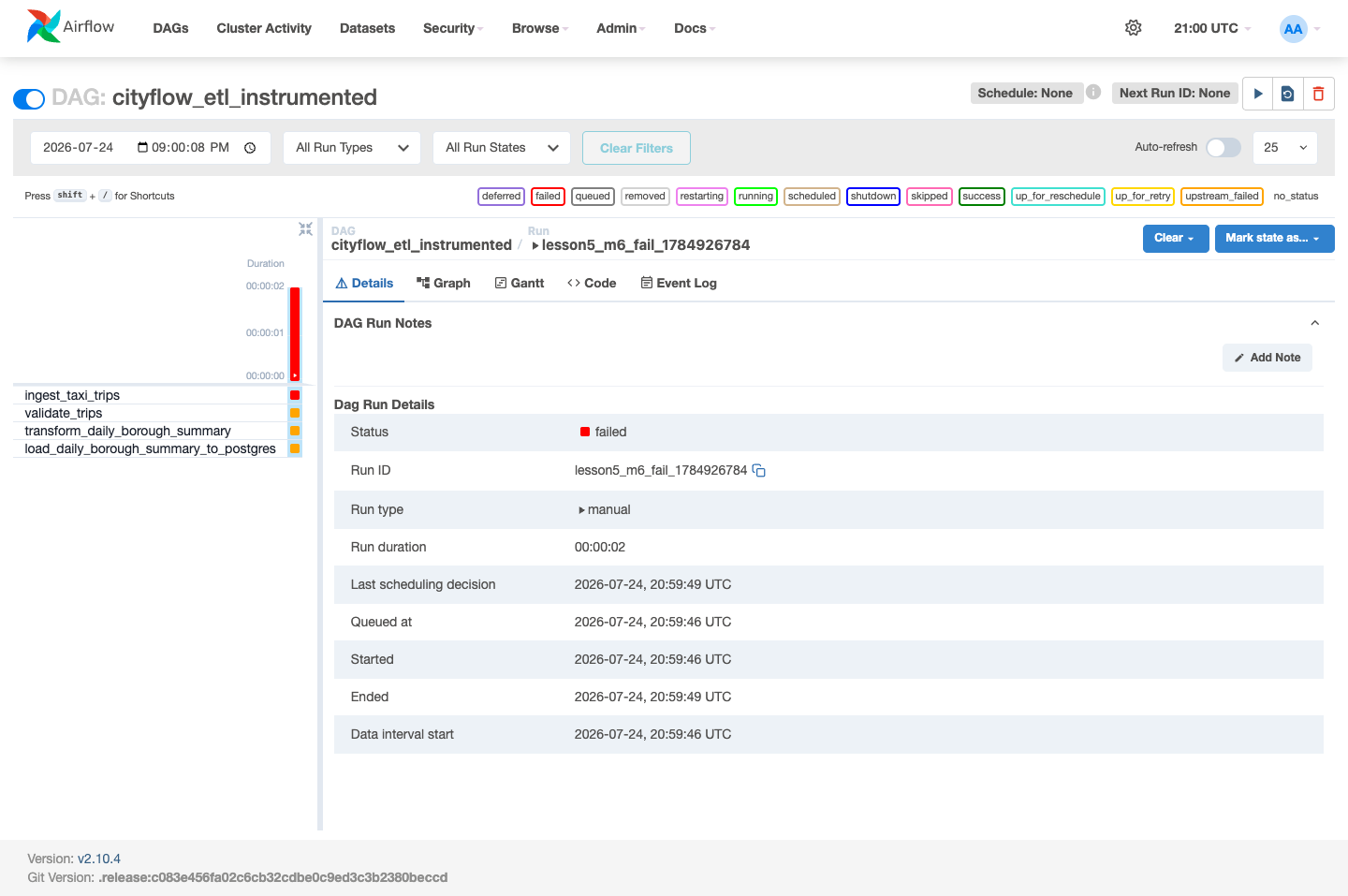
cityflow_etl_instrumented_dag()ingest_taxi_trips is pointed at a path that genuinely does not exist, via dag_run.conf — nothing about this DAG file changes between this run and the successful one below.
# gate: setup: docker rm -f cityflow-lessons-db >/dev/null 2>&1; docker run -d --name cityflow-lessons-db -e POSTGRES_USER=cityflow -e POSTGRES_PASSWORD=cityflow -e POSTGRES_DB=cityflow -p 55432:5432 postgres:13 >/dev/null && sleep 4
import json
import os
import subprocess
import time

dag_id = "cityflow_etl_instrumented"
alert_host_path = ".airflow-local/dags/data/work/etl_instrumented/cityflow_alerts.jsonl"

if os.path.exists(alert_host_path):
    os.remove(alert_host_path)
    print(f"removed pre-existing {alert_host_path} to start from a clean slate")

subprocess.run(["docker", "exec", "airflow-local-airflow-scheduler-1", "airflow", "dags", "unpause", dag_id],
                capture_output=True, text=True, check=True)

run_id = f"lesson5_m6_fail_{int(time.time())}"
conf = json.dumps({"parquet_path": "/opt/airflow/dags/data/does_not_exist_january.parquet"})
trigger = subprocess.run(
    ["docker", "exec", "airflow-local-airflow-scheduler-1", "airflow", "dags", "trigger", dag_id, "--run-id", run_id, "--conf", conf],
    capture_output=True, text=True,
)
if trigger.returncode != 0:
    subprocess.run(["docker", "exec", "airflow-local-airflow-scheduler-1", "airflow", "dags", "reserialize"],
                    capture_output=True, text=True, check=True)
    subprocess.run(
        ["docker", "exec", "airflow-local-airflow-scheduler-1", "airflow", "dags", "trigger", dag_id, "--run-id", run_id, "--conf", conf],
        capture_output=True, text=True, check=True,
    )
print(f"triggered {dag_id!r} as {run_id!r} with conf={conf}")

deadline = time.time() + 90
state = "queued"
while state not in ("success", "failed") and time.time() < deadline:
    time.sleep(2)
    r = subprocess.run(
        ["docker", "exec", "airflow-local-airflow-scheduler-1", "airflow", "dags", "list-runs", "-d", dag_id, "--output", "json"],
        capture_output=True, text=True, check=True,
    )
    runs = json.loads(r.stdout)
    match = [x for x in runs if x["run_id"] == run_id]
    state = match[0]["state"] if match else "queued"
print(f"run {run_id!r} reached state: {state}")
assert state == "failed", f"expected failed, got {state}"

r = subprocess.run(
    ["docker", "exec", "airflow-local-airflow-scheduler-1", "airflow", "tasks", "states-for-dag-run", dag_id, run_id],
    capture_output=True, text=True, check=True,
)
print(r.stdout)

time.sleep(1)
with open(alert_host_path) as f:
    lines = [json.loads(l) for l in f if l.strip()]
print(f"real alert file now has {len(lines)} line(s):")
for l in lines:
    print(" ", l)
assert len(lines) == 1
assert lines[0]["dag_id"] == dag_id
assert lines[0]["task_id"] == "ingest_taxi_trips"
assert lines[0]["run_id"] == run_id
triggered 'cityflow_etl_instrumented' as 'lesson5_m6_fail_1784926784' with conf={"parquet_path": "/opt/airflow/dags/data/does_not_exist_january.parquet"}
run 'lesson5_m6_fail_1784926784' reached state: failed
dag_id | execution_date | task_id | state | start_date | end_date
==========================+===========================+========================================+=================+==================================+=================================
cityflow_etl_instrumented | 2026-07-24T20:59:46+00:00 | ingest_taxi_trips | failed | 2026-07-24T20:59:46.972561+00:00 | 2026-07-24T20:59:47.322413+00:00
cityflow_etl_instrumented | 2026-07-24T20:59:46+00:00 | validate_trips | upstream_failed | 2026-07-24T20:59:47.375095+00:00 | 2026-07-24T20:59:47.375095+00:00
cityflow_etl_instrumented | 2026-07-24T20:59:46+00:00 | transform_daily_borough_summary | upstream_failed | 2026-07-24T20:59:47.444064+00:00 | 2026-07-24T20:59:47.444064+00:00
cityflow_etl_instrumented | 2026-07-24T20:59:46+00:00 | load_daily_borough_summary_to_postgres | upstream_failed | 2026-07-24T20:59:48.479259+00:00 | 2026-07-24T20:59:48.479259+00:00
real alert file now has 1 line(s):
{'dag_id': 'cityflow_etl_instrumented', 'task_id': 'ingest_taxi_trips', 'run_id': 'lesson5_m6_fail_1784926784', 'execution_date': '2026-07-24 20:59:46+00:00', 'exception': "FileNotFoundError(2, 'No such file or directory')"}Exactly the shape Module 5 Lesson 1 first proved: ingest_taxi_trips genuinely fails, and the three tasks behind it — validate_trips, transform_daily_borough_summary, load_daily_borough_summary_to_postgres — all land upstream_failed, never handed to a worker at all. The callback fires exactly once, for the one task that actually failed, with task_id: "ingest_taxi_trips" — not for any of the three upstream_failed tasks, which never ran and therefore never had anything to fail.
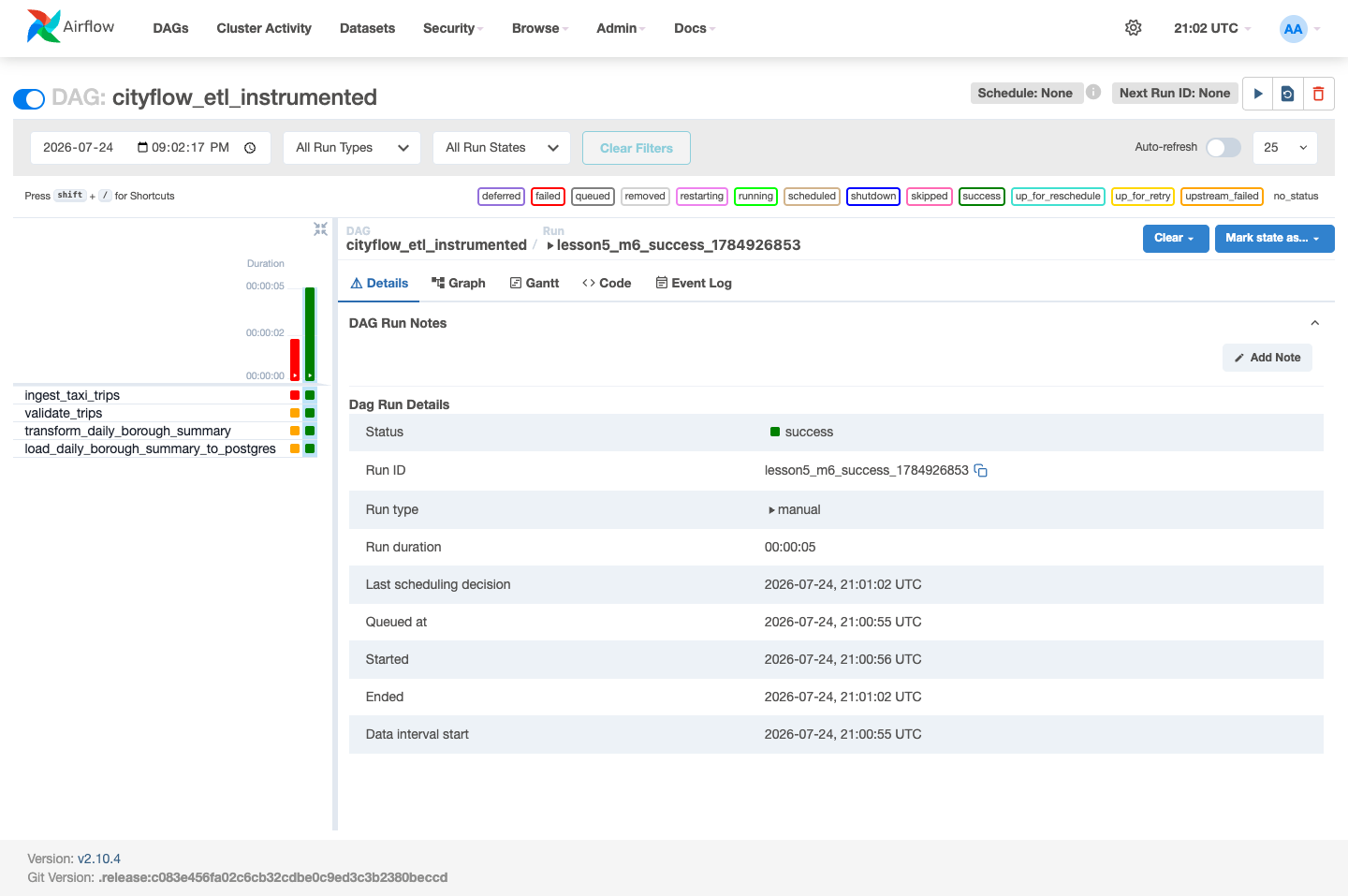
Same file, no conf this time — ingest_taxi_trips falls back to the real parquet path and the real three-day slice Module 5’s guided project already ran.
# gate: teardown: docker rm -f cityflow-lessons-db >/dev/null 2>&1
import json
import subprocess
import time

dag_id = "cityflow_etl_instrumented"
alert_host_path = ".airflow-local/dags/data/work/etl_instrumented/cityflow_alerts.jsonl"

with open(alert_host_path) as f:
    lines_before = [l for l in f if l.strip()]
print(f"alert file has {len(lines_before)} line(s) before this run")

run_id = f"lesson5_m6_success_{int(time.time())}"
trigger = subprocess.run(
    ["docker", "exec", "airflow-local-airflow-scheduler-1", "airflow", "dags", "trigger", dag_id, "--run-id", run_id],
    capture_output=True, text=True,
)
if trigger.returncode != 0:
    subprocess.run(["docker", "exec", "airflow-local-airflow-scheduler-1", "airflow", "dags", "reserialize"],
                    capture_output=True, text=True, check=True)
    subprocess.run(
        ["docker", "exec", "airflow-local-airflow-scheduler-1", "airflow", "dags", "trigger", dag_id, "--run-id", run_id],
        capture_output=True, text=True, check=True,
    )
print(f"triggered {dag_id!r} as {run_id!r} (no conf -- real parquet path, real 3-day slice)")

deadline = time.time() + 120
state = "queued"
while state not in ("success", "failed") and time.time() < deadline:
    time.sleep(3)
    r = subprocess.run(
        ["docker", "exec", "airflow-local-airflow-scheduler-1", "airflow", "dags", "list-runs", "-d", dag_id, "--output", "json"],
        capture_output=True, text=True, check=True,
    )
    runs = json.loads(r.stdout)
    match = [x for x in runs if x["run_id"] == run_id]
    state = match[0]["state"] if match else "queued"
print(f"run {run_id!r} reached state: {state}")
assert state == "success", f"expected success, got {state}"

r = subprocess.run(
    ["docker", "exec", "airflow-local-airflow-scheduler-1", "airflow", "tasks", "states-for-dag-run", dag_id, run_id],
    capture_output=True, text=True, check=True,
)
print(r.stdout)

with open(".airflow-local/dags/data/work/etl_instrumented/validation_report.json") as f:
    report = json.load(f)
print("validation_report.json:", json.dumps(report, indent=2))

import psycopg2

conn = psycopg2.connect(host="localhost", port=55432, user="cityflow", password="cityflow", dbname="cityflow")
cur = conn.cursor()
cur.execute("SELECT COUNT(*), SUM(trip_count) FROM cityflow_etl_instrumented_daily_borough_summary;")
row_count, total_trips = cur.fetchone()
print(f"direct psycopg2 check: {row_count} rows, SUM(trip_count)={total_trips}")
assert total_trips == report["rows_passed"]
conn.close()

time.sleep(1)
with open(alert_host_path) as f:
    lines_after = [l for l in f if l.strip()]
print(f"alert file has {len(lines_after)} line(s) after this run")
assert len(lines_after) == len(lines_before), "the on_failure_callback must NOT have fired on a real success"
print("PROVED: callback did not fire on a genuine successful run")
alert file has 1 line(s) before this run
triggered 'cityflow_etl_instrumented' as 'lesson5_m6_success_1784926853' (no conf -- real parquet path, real 3-day slice)
run 'lesson5_m6_success_1784926853' reached state: success
dag_id | execution_date | task_id | state | start_date | end_date
==========================+===========================+========================================+=========+==================================+=================================
cityflow_etl_instrumented | 2026-07-24T21:00:55+00:00 | ingest_taxi_trips | success | 2026-07-24T21:00:56.267094+00:00 | 2026-07-24T21:00:57.664393+00:00
cityflow_etl_instrumented | 2026-07-24T21:00:55+00:00 | transform_daily_borough_summary | success | 2026-07-24T21:01:00.033106+00:00 | 2026-07-24T21:01:00.683545+00:00
cityflow_etl_instrumented | 2026-07-24T21:00:55+00:00 | validate_trips | success | 2026-07-24T21:00:57.930842+00:00 | 2026-07-24T21:00:59.472316+00:00
cityflow_etl_instrumented | 2026-07-24T21:00:55+00:00 | load_daily_borough_summary_to_postgres | success | 2026-07-24T21:01:01.109587+00:00 | 2026-07-24T21:01:01.551055+00:00
validation_report.json: {
"total_rows": 238959,
"checks": {
"null_required_fields": 14637,
"trip_distance_out_of_range": 6,
"fare_amount_out_of_range": 3536,
"passenger_count_out_of_range": 9,
"pickup_after_dropoff": 8
},
"rows_failed_any_check": 18061,
"rows_passed": 220898,
"pass_rate": 0.9244
}
direct psycopg2 check: 21 rows, SUM(trip_count)=220898
alert file has 1 line(s) after this run
PROVED: callback did not fire on a genuine successful runEvery number here matches Module 5’s guided project exactly — 238,959 rows ingested, 220,898 passed (a 0.9244 pass rate), 21 rows landed in Postgres — because the instrumented DAG’s real logic is unchanged; only the source of the validation checks (Lesson 1’s tested function, not a second copy) and the presence of a callback (Lesson 4’s, silent unless something fails) are different. The alert file’s line count — 1 before, 1 after — is the actual proof: the callback ran zero times during a run where all four tasks genuinely succeeded.
Nothing about cityflow_etl_dag.py’s real logic changed to make it trustworthy — the four-task shape, the five real data-quality checks, the real Postgres load are all exactly what Module 5 built. What changed is provability: the validation logic is the same function this module unit-tested in 200.8 ms (Lesson 1), and a real failure now produces a real, inspectable record of its own identity within milliseconds of happening (Lesson 4) — without a human needing to be watching the Grid view when it does.
validate_trips still takes ingested_rows and returns a report dict; only where its checks come from changed.dag_run.conf is a real, repeatable way to force a specific real failure (a bad path) without touching the DAG file — the exact same file ran both triggers in this lesson.1 line before, 1 line after a real success) is just as real and just as necessary a test as proving it fires — Lesson 4 only proved the positive case; this project proves both.238,959 / 220,898 / 21 — ties back exactly to Module 5’s already-published guided project, which is the whole point: instrumentation didn’t change what the pipeline does, only what it can prove about itself.Exercise 1 — Trigger cityflow_etl_instrumented a third time with dag_run.conf pointing parquet_path at a real file that exists but has none of the expected columns (e.g. taxi_zone_lookup.csv itself). Read the real exception the alert captures — is it still a FileNotFoundError, or something different now that the file exists but is the wrong shape?
Exercise 2 — Add a fifth task, notify_on_success, wired with trigger_rule="all_success" (the default) so it only runs after a genuinely successful load, that reads cityflow_alerting.read_alerts(ALERT_PATH) and prints how many alerts exist for this DAG total (across all past runs, not just this one). Trigger a successful run and confirm the count.
Exercise 3 — Compare this project’s real alert record for ingest_taxi_trips’s failure against Module 5 Lesson 1’s upstream_failed proof for the exact same three downstream tasks. Write two sentences: one on what the alert record adds that the Grid view’s colors alone don’t (a durable, queryable record with an exact timestamp and exception text), and one on what the Grid view still shows that the alert record alone doesn’t (the full shape of what did and didn’t run).
Keep DATATWEETS free. Help fund practical data, AI, and engineering lessons for learners worldwide.