Title here
Summary here
In the last lesson you learned what conditional probability means: how knowing that one event happened reshapes the probability of another. This lesson turns that idea into machinery you can actually compute with. You will chain conditional probabilities through multi-stage problems, use them to decide whether two events are truly independent, and finish with the law of total probability — the rule that stitches a handful of conditional probabilities back into one unconditional answer.
That last rule is more than a curiosity. It is exactly the denominator that Bayes’ theorem needs in the next lesson, so the work you do here is the foundation for everything that follows. We will keep using the Palmer penguins, and add a deck of cards when we need a clean second example.
By the end of this lesson, you will be able to:
You only need a little Python and pandas. Let’s begin.
Last lesson defined conditional probability as
Multiply both sides by and you get a rule for the probability that both events happen — the general multiplication rule:
In words: the chance of and is the chance of , times the chance of once is known. It works in either order, so too — whichever conditional you happen to know.
Let’s see it on the penguins. Load the data and treat all 344 birds as our population.
import pandas as pd

penguins = pd.read_csv("https://datatweets.com/datasets/penguins.csv")
print(pd.crosstab(penguins["island"], penguins["species"], margins=True))
species Adelie Chinstrap Gentoo All
island
Biscoe 44 0 124 168
Dream 56 68 0 124
Torgersen 52 0 0 52
All 152 68 124 344Pick a penguin at random. What is the probability it is on Biscoe and an Adelie? We can read it straight from the table — 44 of 344 birds are both — but let’s instead build it from a condition, the way the multiplication rule does:
total = len(penguins)
p_biscoe = (penguins["island"] == "Biscoe").mean()

biscoe = penguins[penguins["island"] == "Biscoe"]
p_adelie_given_biscoe = (biscoe["species"] == "Adelie").mean()

p_both = p_biscoe * p_adelie_given_biscoe
print(round(p_biscoe, 4), round(p_adelie_given_biscoe, 4), round(p_both, 4))
0.4884 0.2619 0.1279So , and given you are on Biscoe the chance of Adelie is . Multiply them and you get — which is exactly . The rule reconstructs the joint probability from one marginal and one conditional, and that is the move every tree diagram is built on.
A probability tree is the multiplication rule drawn out for a process that happens in stages. Each branch carries a probability, and the chance of any complete path is the product of the branches along it. Stage one here is picking an island; stage two is the species you find there.
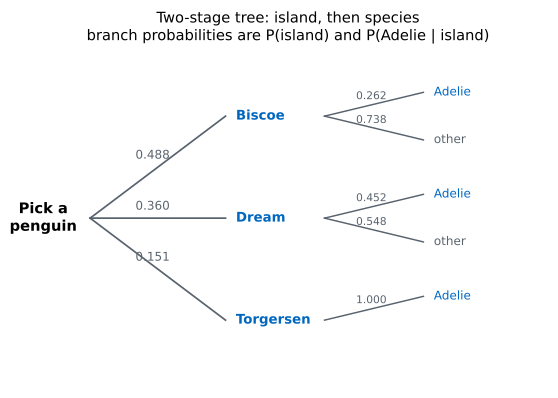
Notice the branch values. The first split uses — how common each island is — and the second uses . The Torgersen branch is because every Torgersen penguin in this dataset happens to be an Adelie. Walking the Biscoe path, , reproduces the joint probability we just computed by hand.
Trees shine when the stages genuinely depend on each other. Draw two cards from a shuffled deck without replacement and ask for the probability that both are hearts. There are 13 hearts in 52 cards, so the first card is a heart with probability . But now only 51 cards remain and one heart is gone, so the second card is a heart with probability — a conditional probability, because it depends on the first draw.
p_first_heart = 13 / 52
p_second_heart_given_first = 12 / 51
p_both_hearts = p_first_heart * p_second_heart_given_first
print(round(p_first_heart, 4), round(p_second_heart_given_first, 4), round(p_both_hearts, 4))
0.25 0.2353 0.0588The chance both cards are hearts is , about 1 in 17. The “without replacement” detail is the whole point: removing the first heart changes the deck, so the second probability is conditional on the first. That dependence is exactly what a tree keeps track of.
Why the second branch shrinks
With replacement, you would put the first card back and the second draw would again be — the draws would be independent. Without replacement, the population changes between stages, so each branch must use the conditional probability given everything that came before. That is the difference the next section makes precise.
Two events are independent when knowing one happened tells you nothing about the other. We can now state that cleanly with conditional probability: and are independent when
The condition simply does not move the probability. When that holds, the multiplication rule collapses to its simplest form, because .
Are island and species independent for our penguins? Compare with the plain :
p_adelie = (penguins["species"] == "Adelie").mean()
print("P(Adelie)            =", round(p_adelie, 4))
print("P(Adelie | Biscoe)   =", round(p_adelie_given_biscoe, 4))
P(Adelie) = 0.4419
P(Adelie | Biscoe) = 0.2619These are far apart — versus — so island and species are not independent. Learning that a penguin lives on Biscoe genuinely lowers your belief that it is an Adelie (Biscoe is dominated by Gentoos). That dependence is not a nuisance; it is information, and Bayes’ theorem will be the tool for cashing it in.
For contrast, the card draws with replacement would be independent: , because putting the card back leaves the deck exactly as it was. Independence is the special case where conditioning changes nothing.
Here is the rule that ties the lesson together. Suppose you split the population into non-overlapping, exhaustive pieces — a partition. Our three islands do exactly this: every penguin lives on exactly one of Biscoe, Dream, or Torgersen. The law of total probability says you can find the overall probability of an event by computing it within each piece and combining:
Each term is one path through the tree (a multiplication-rule joint probability), and summing over all the pieces covers every way can happen.
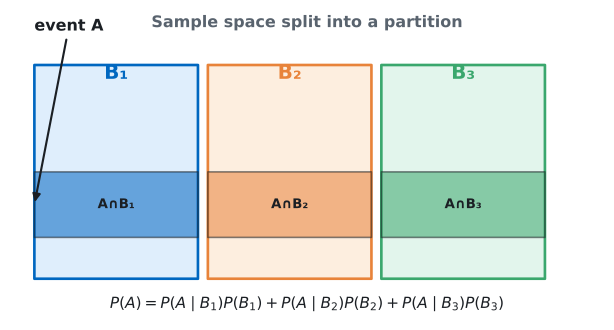
Let’s recover by conditioning on island:
counts = penguins["island"].value_counts()
p_island = counts / total

p_adelie_given = {}
for isl in ["Biscoe", "Dream", "Torgersen"]:
    sub = penguins[penguins["island"] == isl]
    p_adelie_given[isl] = (sub["species"] == "Adelie").mean()

total_prob = sum(p_adelie_given[isl] * p_island[isl] for isl in p_island.index)
print({k: round(v, 4) for k, v in p_adelie_given.items()})
print("Law of total probability P(Adelie) =", round(total_prob, 4))
print("Unconditional        P(Adelie) =", round(p_adelie, 4))
{'Biscoe': 0.2619, 'Dream': 0.4516, 'Torgersen': 1.0}
Law of total probability P(Adelie) = 0.4419
Unconditional P(Adelie) = 0.4419Written out, that sum is
The pieces — , , and — are wildly different, yet weighted by how common each island is, they average back to the single unconditional value . That is the intuition worth keeping: total probability is a weighted average of conditional probabilities, weighted by the probability of each condition. Islands where Adelies are rare pull down, the all-Adelie island pulls up, and the weights settle the balance.
Why build up the answer you already had? Because conditioning is often the only way in. When you cannot see directly but you can reason within each subgroup, the law of total probability assembles the whole from the parts. And the denominator of Bayes’ theorem — coming next lesson — is precisely a law-of-total-probability sum. Master this, and Bayes is mostly bookkeeping.
What makes a valid partition
The pieces must be mutually exclusive (no overlap) and exhaustive (they cover everything), and each must have nonzero probability. Island works because every penguin sits in exactly one island. If your groups overlap or leave gaps, the weights will not sum to 1 and the law breaks.
Using the multiplication rule (not the raw count), compute — the probability a random penguin is on Dream and a Chinstrap. Then check your answer against the count in the crosstab.
Hint
Compute p_dream = (penguins["island"] == "Dream").mean(), then the conditional p_chinstrap_given_dream on the penguins[penguins["island"] == "Dream"] subset, and multiply. It should equal .
Without replacement, what is the probability that the first two cards off a shuffled deck are both aces? Build it as a two-branch tree, then say in one sentence why the second branch is not .
Hint
The first ace has probability . After removing it, 3 aces remain in 51 cards, so the second branch is . Multiply: .
Use the law of total probability, conditioning on island, to recover . Print each and confirm the weighted sum matches the unconditional . Which island dominates the answer, and why?
Hint
Reuse the Exercise loop but test (sub["species"] == "Gentoo"). Only Biscoe has Gentoos, so its term carries almost the whole sum; the other two contribute zero. The total should come to .
You turned conditional probability into a working toolkit. The general multiplication rule builds a joint probability from a marginal and a conditional, and chaining it along a probability tree solves multi-stage problems like drawing cards without replacement. You sharpened independence into a single test — — and saw that island and species fail it, which means the condition carries real information. Finally, the law of total probability reassembled the unconditional from its three island pieces, revealing total probability as a weighted average of conditional probabilities — and quietly setting up the denominator that Bayes’ theorem will demand next.
Almost every real probability you will estimate is hidden inside subgroups — spam rates differ by sender, churn differs by plan, defect rates differ by supplier. The multiplication rule and the law of total probability are how you reason across those subgroups instead of pretending they do not exist, and the same weighted-average logic is the engine inside Bayes’ theorem, Naive Bayes classifiers, and the risk calculations behind medical testing and fraud detection.
Flip a conditional probability around and learn the rule for updating a belief when new evidence arrives.
Return to the Conditional Probability & Bayes module overview
You can now move smoothly between conditional and unconditional probabilities — splitting a problem into subgroups and weaving the pieces back together. Next you will run that machinery in reverse: given that an event happened, what is the probability of the cause behind it? That question is Bayes’ theorem, and you already built its hardest part today.