Title here
Summary here
In the last lesson you learned to put a number on chance — by counting how often something happens in data, and by counting equally likely outcomes in theory. That gives you the probability of a single event. But real questions rarely stop there. You want the chance of not something, or of one thing or another. To answer those, you need a small set of rules that combine probabilities reliably.
In this lesson you will give chance a precise vocabulary — sample spaces and events — see the handful of axioms every probability must obey, and then learn the two rules you will reach for constantly: the complement rule for “not,” and the addition rule for “or.” You will check every rule against real penguin data and against a fair die.
By the end of this lesson, you will be able to:
You only need a little Python and pandas. Let’s begin.
Probability starts with a random experiment — any process whose outcome you cannot predict with certainty, like rolling a die or drawing a penguin at random from the dataset. The sample space, written , is the set of all possible outcomes of that experiment. For a single roll of a six-sided die, the sample space is:
An event is any subset of the sample space — a collection of outcomes you care about. “Rolling an even number” is the event . “Rolling a 5” is the single-outcome event . An event happens when the experiment produces any outcome inside it.
The same vocabulary fits the penguins. Picture the experiment as “pick one of the 344 penguins at random.” The sample space is all 344 birds, and “the penguin is a Gentoo” is an event — the subset of 124 Gentoo penguins. Load the data and list the outcomes for the species experiment:
import pandas as pd

penguins = pd.read_csv("https://datatweets.com/datasets/penguins.csv")
print(penguins["species"].unique())
['Adelie' 'Gentoo' 'Chinstrap']So if the experiment is “read off the species of a randomly chosen penguin,” the sample space is , and each species is an event inside it.
Every probability — no matter how you computed it — obeys three rules called the axioms. They are not deep theorems; they are the minimum any sensible measure of chance must satisfy, and they make excellent sanity checks.
The species experiment shows axioms 1 and 3 directly. Each species probability sits between 0 and 1, and because a penguin is exactly one species, the three add to 1:
probs = penguins["species"].value_counts(normalize=True).round(4)
print(probs)
print("sum:", probs.sum())
species
Adelie 0.4419
Gentoo 0.3605
Chinstrap 0.1977
Name: proportion, dtype: float64
sum: 1.0Each value is a valid probability, and they total exactly 1.0. That total is your first reflex check: if the probabilities of a complete set of separate outcomes do not add to 1, something is wrong — you have double-counted, missed an outcome, or made an arithmetic slip.
Why the axioms matter
The axioms turn “probability” from a vague feeling into a system you can compute with. The rules in the rest of this lesson — complement and addition — are not new assumptions. They are direct consequences of these three axioms, which is why they always hold.
The complement of an event , written , is everything in the sample space except — the event “A does not happen.” Because and together cover the whole sample space and never overlap, their probabilities must add to 1 (axiom 3). Rearranging gives the complement rule:
This is one of the most useful shortcuts in probability. Whenever the chance of “not happening” is easier to find than the chance of “happening” — or vice versa — you flip between them by subtracting from 1.
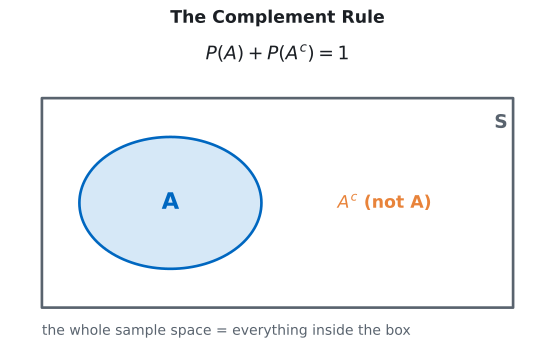
Take the event “the penguin is Adelie.” Its probability is 0.4419, so the chance a randomly chosen penguin is not Adelie is:
Confirm it two ways — once with the rule, once by counting the non-Adelie penguins directly:
p_adelie = (penguins["species"] == "Adelie").mean()
print("P(Adelie):    ", round(p_adelie, 4))
print("rule 1 - P(A):", round(1 - p_adelie, 4))
print("direct count: ", round((penguins["species"] != "Adelie").mean(), 4))
P(Adelie): 0.4419
rule 1 - P(A): 0.5581
direct count: 0.5581Both routes give 0.5581. The rule and the brute-force count agree, exactly as they must — “not Adelie” is just the Gentoo and Chinstrap penguins combined, and up to rounding.
The addition rule answers “or” questions: what is the chance that event happens or event happens (or both)? In set language this is the union, . The form of the rule depends on whether the two events can happen at the same time.
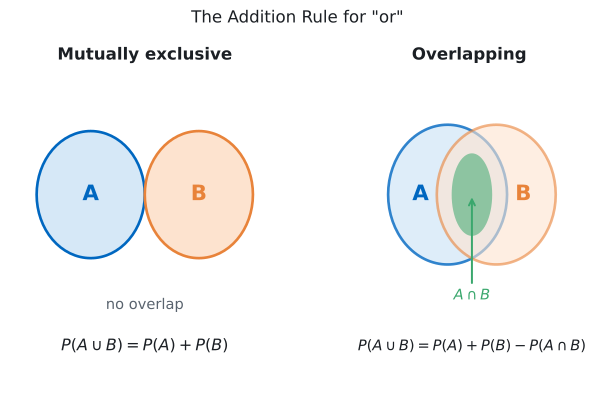
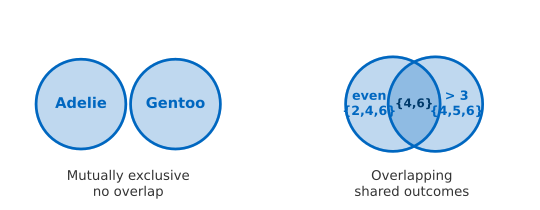
Two events are mutually exclusive (or disjoint) when they cannot both happen on the same trial — they share no outcomes. A single penguin cannot be both Adelie and Gentoo, so those two events are mutually exclusive. For such events the addition rule is simple: just add the probabilities.
So the chance a random penguin is Adelie or Gentoo is:
Verify it against the data — add the two probabilities, then check directly with a boolean mask that flags either species:
p_adelie = (penguins["species"] == "Adelie").mean()
p_gentoo = (penguins["species"] == "Gentoo").mean()

either = (penguins["species"] == "Adelie") | (penguins["species"] == "Gentoo")
print("P(A) + P(G):", round(p_adelie + p_gentoo, 4))
print("direct |:  ", round(either.mean(), 4))
P(A) + P(G): 0.8023
direct |: 0.8023Both give 0.8023. Adding worked here precisely because no penguin was counted twice — there is no penguin that is both Adelie and Gentoo, so nothing got double-counted.
Now watch what goes wrong when events can happen together. Switch from penguins to a fair six-sided die, where the sample space is and every outcome has probability . Consider two events:
These are not mutually exclusive: the outcomes 4 and 6 are both even and greater than 3. If you naively add, you get — which claims it is certain the roll is even or above 3. But rolling a 1 or a 3 satisfies neither. The naive sum is wrong because outcomes 4 and 6 were counted twice, once in each event.
The fix is the general addition rule: add the two probabilities, then subtract the probability of the intersection — the outcomes the events share — so the overlap is counted only once.
Here the overlap is , so . Enumerate the whole sample space to confirm:
outcomes = [1, 2, 3, 4, 5, 6]
even   = [x for x in outcomes if x % 2 == 0]   # {2, 4, 6}
big    = [x for x in outcomes if x > 3]         # {4, 5, 6}
overlap = [x for x in outcomes if x % 2 == 0 and x > 3]   # {4, 6}

p_even = len(even) / 6
p_big  = len(big) / 6
p_overlap = len(overlap) / 6

print("naive P(E)+P(G):     ", round(p_even + p_big, 4))
print("general rule:        ", round(p_even + p_big - p_overlap, 4))
union = sorted(set(even) | set(big))
print("direct union", union, "->", round(len(union) / 6, 4))
naive P(E)+P(G): 1.0
general rule: 0.6667
direct union [2, 4, 5, 6] -> 0.6667The naive sum claimed 1.0; the general rule gives 0.6667, which matches the direct count of the union — four outcomes out of six. Subtracting the overlap fixed the double-count.
The general rule is the one to remember, because it always works. Mutually exclusive events are simply the special case where , so the subtraction term disappears and you are back to plain addition. The penguin species satisfy exactly that: a single penguin cannot be two species, so the intersection is empty and adding alone is correct.
A fair six-sided die is rolled. Let be the event “the roll is greater than 3.” Find , then use the complement rule to find the probability the roll is not greater than 3, and confirm it by counting the outcomes directly.
Hint
. The complement rule gives . Check it with len([x for x in [1,2,3,4,5,6] if x <= 3]) / 6.
Using the penguins dataset, find the probability that a randomly chosen penguin is Gentoo or Chinstrap. These species are mutually exclusive, so add their probabilities — then verify with a boolean mask that flags either species.
Hint
Compute (penguins["species"] == "Gentoo").mean() and (penguins["species"] == "Chinstrap").mean(), add them, then check against ((penguins["species"] == "Gentoo") | (penguins["species"] == "Chinstrap")).mean(). It should also equal 1 - P(Adelie).
A fair die is rolled. Let be “the roll is even” and be “the roll is less than 4.” Use the general addition rule to find . First decide which outcomes the two events share, then subtract that overlap.
Hint
and share only the outcome 2, so . Then . Confirm by listing the union with sorted(set([2,4,6]) | set([1,2,3])).
You gave probability a precise vocabulary and the rules that make it usable. A random experiment has a sample space of all possible outcomes, and an event is any subset of it. Every probability obeys the axioms: each one lies between 0 and 1, and the probabilities of a complete set of separate outcomes sum to 1. From those axioms come the two rules you will use most: the complement rule, , for “not”; and the addition rule for “or.” For mutually exclusive events you simply add, while the general addition rule subtracts the overlap so shared outcomes are not counted twice.
Almost every probability question you will ever face is built from “not” and “or,” and getting them right hinges on one habit: noticing whether events can happen together. Forgetting to subtract an overlap is the single most common probability mistake in real analysis — from estimating the chance a user clicks either of two buttons to combining failure modes in a reliability model. The addition and complement rules give you a dependable way to combine chances without quietly double-counting.
Chain the rules together to break multi-step probability questions into pieces you can actually solve.
Return to the Probability Fundamentals module overview
You can now combine events with confidence — flipping to a complement when it is easier, and adding “or” probabilities without double-counting the overlap. Next you will stack these rules together to take apart probability problems that look intimidating at first glance but dissolve once you break them into the simple pieces you already know.