Title here
Summary here
Lesson 1 established that the ACF and PACF answer different questions, and that the gap between them is informative. This lesson cashes that in: there’s a well-known pair of signatures — one for autoregressive (AR) processes, one for moving-average (MA) processes — where the ACF and PACF behave like mirror images of each other. Once you can recognize both shapes on data where you already know the right answer, reading them on a real, unknown series (Lesson 4) stops being guesswork.
By the end of this lesson, you will be able to:
Let’s build two processes where the answer is known in advance.
An AR(1) process is about as simple as autoregression gets: y_t = phi * y_{t-1} + e_t — today is phi times yesterday, plus fresh randomness. Build one with a known phi = 0.7 and look at both functions:
import numpy as np
from statsmodels.tsa.arima_process import ArmaProcess
from statsmodels.tsa.stattools import acf, pacf

rng = np.random.default_rng(11)
ar1 = ArmaProcess(np.array([1, -0.7]), np.array([1])).generate_sample(
    nsample=2000, distrvs=lambda size: rng.normal(0, 1, size)
)

a_ar = acf(ar1, nlags=8)
p_ar = pacf(ar1, nlags=8)
print(np.round(a_ar, 3))   # [1.0, 0.7, 0.486, 0.349, 0.245, 0.174, 0.127, 0.087]
print(np.round(p_ar, 3))   # [1.0, 0.701, -0.009, 0.024, -0.012, 0.004, 0.008, -0.012]
The ACF tails off gradually: 0.7, 0.486, 0.349, 0.245, 0.174, 0.127, 0.087 — a smooth geometric decay that closely tracks the theoretical 0.7^k (0.7, 0.49, 0.343, 0.24, 0.168, 0.118, 0.082), never dropping to zero abruptly. The PACF cuts off sharply: 0.701 at lag 1, then essentially nothing (-0.009, 0.024, -0.012, 0.004, 0.008, -0.012 — all comfortably inside the ±0.044 significance band for n=2,000). That’s the AR(1) signature exactly: one sharp PACF spike at lag 1, and nothing meaningful after it, while the ACF fades out slowly across many lags.
The intuition: today depends directly only on yesterday, so the PACF — which strips out indirect, chained-through effects — correctly shows nothing beyond lag 1. But because yesterday depended on the day before, and so on, the raw correlation (ACF) between today and points further back doesn’t vanish; it just weakens a little more with each additional step, producing the gradual tail.
An MA(1) process looks different by construction: y_t = e_t + theta * e_{t-1} — today depends directly on a fresh random shock and a fraction of yesterday’s shock, not on yesterday’s observed value at all. Build one with theta = 0.7:
ma1 = ArmaProcess(np.array([1]), np.array([1, 0.7])).generate_sample(
    nsample=2000, distrvs=lambda size: rng.normal(0, 1, size)
)

a_ma = acf(ma1, nlags=8)
p_ma = pacf(ma1, nlags=8)
print(np.round(a_ma, 3))   # [1.0, 0.49, 0.045, 0.038, 0.033, 0.029, 0.002, 0.023]
print(np.round(p_ma, 3))   # [1.0, 0.49, -0.257, 0.193, -0.102, 0.09, -0.077, 0.094]
Now it’s the mirror image. The ACF cuts off sharply: 0.49 at lag 1 (close to the theoretical value of theta / (1 + theta²) = 0.7 / 1.49 ≈ 0.470), then essentially nothing from lag 2 onward (0.045, 0.038, 0.033… — all within noise of the ±0.044 band). The PACF tails off instead — but not smoothly; it oscillates while decaying: 0.49, -0.257, 0.193, -0.102, 0.09, -0.077, 0.094, alternating sign as it shrinks. That alternating-and-decaying shape is the MA signature’s PACF: because an MA process’s dependence structure only extends one step in the “shock” sense, but that one step still has to be reconstructed indirectly at every subsequent lag through the AR-like machinery the PACF uses internally, producing a decaying, sign-flipping tail rather than a clean single spike.
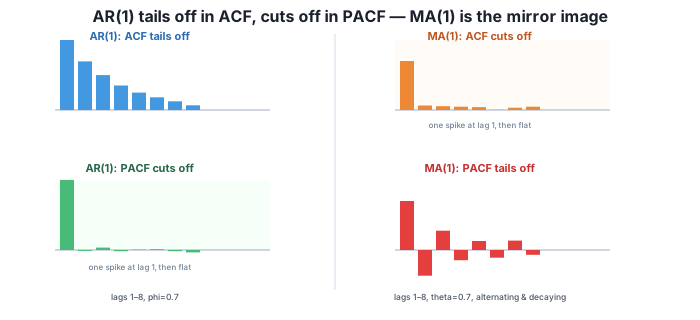
These two examples generalize directly to higher orders:
p — exactly p significant PACF spikes, then nothing.q — exactly q significant ACF spikes, then nothing; PACF tails off.A memory device
“AR: PACF is sharp.” Autoregression is about direct dependence on past values — a fixed number of them — so the PACF, which measures direct dependence, cuts off cleanly at that number. “MA: ACF is sharp.” A moving average is about direct dependence on past shocks — a fixed number of them — so the ACF, which is really measuring “how far does the shared-shock overlap extend,” cuts off cleanly at that number instead. Whichever function shows the clean, sudden stop is the one that’s counting the order directly.
A series’ ACF decays smoothly across ten lags with no sharp drop; its PACF has two clear spikes (at lags 1 and 2) and is essentially flat after that. What process type and order does this suggest?
Hint
This is the AR signature — ACF tails off, PACF cuts off sharply — and since the PACF has exactly two significant spikes before flattening, it suggests an AR(2) process: today depends directly on the last two values. The smooth ACF decay across many lags, rather than a sharp cutoff, is consistent with this: an AR process’s raw correlation fades gradually even though the direct dependence only reaches back two steps.
A different series has an ACF with exactly one significant spike at lag 1 and nothing after; its PACF decays in an alternating, shrinking pattern across many lags. What does this suggest?
Hint
This is the MA(1) signature exactly — ACF cuts off sharply after lag 1, PACF tails off with an alternating decay — matching this lesson’s synthetic MA(1) example almost exactly (ACF: 0.49 then near-zero; PACF: 0.49, -0.257, 0.193, -0.102…). The suggested model is a moving-average process with one MA term.
A series’ ACF and PACF both decay gradually across many lags, with neither showing a sharp cutoff. What does this suggest, and why is it harder to read an exact order from the plot alone?
Hint
Both functions tailing off suggests an ARMA process with both AR and MA components — since each component contributes to smearing out the other function’s cutoff (the AR part keeps the ACF from cutting off cleanly, and the MA part keeps the PACF from cutting off cleanly). Because neither plot gives you a clean “count the spikes” answer in this case, ARMA orders are typically narrowed down to a short list of plausible candidates from the plots and then chosen more rigorously — usually by fitting several candidates and comparing them with a criterion like AIC, the approach Module 5 introduces once you have a shortlist to compare.
An AR(p) process has an ACF that tails off gradually and a PACF that cuts off sharply after exactly p lags — demonstrated here on a known AR(1) process, whose ACF decayed geometrically (0.7, 0.486, 0.349…) while its PACF showed one clean spike (0.701) and nothing significant after. An MA(q) process is the mirror image: its ACF cuts off sharply after q lags, and its PACF tails off, typically with an alternating, decaying pattern — demonstrated on a known MA(1) process (ACF: 0.49 then near-zero; PACF: 0.49, -0.257, 0.193, -0.102, oscillating and shrinking). When both functions tail off instead of one cutting off cleanly, that points toward an ARMA process with both components, which is harder to read an exact order from directly.
These two signatures are the entire reason ACF and PACF plots are useful for model building: without a known reference shape to compare against, a real series’ plot is just two rows of bars. With the AR and MA signatures memorized — and, more importantly, verified here on data where the answer was known in advance — a real plot becomes readable. Next, before applying this to Cyclepath, Lesson 3 covers something just as important as the shapes themselves: which bars in a real plot are actually meaningful, and which are just noise crossing the line by chance.
Learn what the significance band actually means, and why testing many lags at once means some will look significant by chance alone.
Return to the Autocorrelation: ACF and PACF module overview
You’ve now seen the AR and MA signatures on data where the answer was known in advance — a geometric ACF decay with a single sharp PACF spike for AR(1), and the mirror image for MA(1). Before reading Cyclepath’s real, unknown plot, you need one more tool: a proper way to decide which bars are actually significant, since with enough lags tested, some will cross the line purely by chance.