Title here
Summary here
Every module in this course, from decomposition through backtesting, was built and tested on Cyclepath, a single monthly bike-share series. That consistency made each new idea easier to isolate, but it also means you have never had to apply this course’s tools to a series you were not already familiar with. This capstone fixes that. Meet Lantern & Vine, a fictional home-goods shop, and its weekly unit sales over four years, a new series with its own structure, explored here for the very first time.
By the end of this lesson, you will be able to:
Let’s meet the series.
import numpy as np
import pandas as pd

def lantern_vine():
    idx = pd.date_range("2020-01-06", periods=208, freq="W-MON")
    t = np.arange(208)
    rng = np.random.default_rng(7)
    growth_rate = np.where(t < 104, 0.008, 0.003)
    log_level = np.cumsum(growth_rate)
    level = 500 * np.exp(log_level)
    seasonal_factor = 1 + 0.35 * np.sin(2 * np.pi * (t - 35) / 52)
    noise_factor = rng.normal(1, 0.04, 208)
    y = level * seasonal_factor * noise_factor
    return pd.Series(np.round(y).astype(int), index=idx, name="units_sold")

y = lantern_vine()
print(len(y), y.index[0].date(), y.index[-1].date())
print(y.iloc[:5].tolist())
print(y.iloc[-5:].tolist())
208 2020-01-06 2023-12-25
[660, 662, 639, 613, 613]
[2163, 2258, 2227, 2001, 1943]208 weeks, exactly four years, from the first Monday of January 2020 through the last Monday of December 2023. The series is built from a level that grows over time, multiplied by a seasonal factor that swings around 1.0, multiplied by a small amount of random noise also centered near 1.0. That multiplication, rather than addition, is deliberate, and Lesson 2 will confirm exactly what it implies. For now, treat this the way Module 1 treated Cyclepath on first contact: a series to explore, not yet to theorize about.
print(y.describe())count 208.000000
mean 1070.826923
std 453.250577
min 362.000000
25% 714.250000
50% 992.000000
75% 1381.250000
max 2258.000000
Name: units_sold, dtype: float64Weekly unit sales range from 362 to 2,258, averaging 1,070.8 across the full four years, with a standard deviation (453.3) that is unusually large relative to the mean, over 40%, a first hint that this series’ swings are large relative to its level, exactly the kind of relationship Module 2 taught you to check for directly rather than assume.
yearly = y.resample("YE").sum()
print(yearly.values.tolist())
[32464, 49558, 64549, 76161]Yearly totals climb every year, 32,464 in 2020 up to 76,161 in 2023, more than doubling over four years. But look at the year-over-year growth rate, not just the totals: 2020 to 2021 grew by 52.6%, 2021 to 2022 by 30.3%, and 2022 to 2023 by only 18.0%. Cyclepath’s yearly growth was remarkably steady across all eight of its years. Here, growth is clearly slowing down, a second hint this lesson will not yet resolve, and Lesson 2 will chase down directly.
ma = y.rolling(52).mean()
print(round(ma.dropna().iloc[0], 1), ma.dropna().index[0].date())
print(round(ma.dropna().iloc[-1], 1), ma.dropna().index[-1].date())
624.3 2020-12-28
1464.6 2023-12-25A 52-week rolling mean, the weekly equivalent of Cyclepath’s 12-month rolling mean, smooths away the seasonal swing and confirms the same rising trend the yearly totals already showed, climbing from about 624 to about 1,465 units a week.
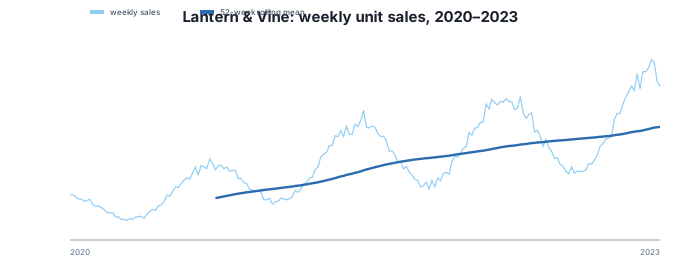
Before running a single formal test, three structural differences are already showing:
The pipeline this module runs
This capstone follows the same seven stages every real forecasting project follows, and that this course has built one piece at a time: explore (this lesson), decompose and diagnose structure (Lesson 2), make stationary and identify candidate orders (Lesson 3), fit and backtest models (Lesson 4), and finally report a genuine forecast against an honest baseline (Lesson 5). Nothing new is being invented; every tool already exists from Modules 1 through 8. What is new is applying all of them, in order, to a series that does not behave exactly like the one you learned them on.
Lantern & Vine’s standard deviation (453.3) is about 42% of its mean (1,070.8). Why is that ratio worth noticing before running any formal test?
Hint
A standard deviation that is a large fraction of the mean is a rough, informal early signal that the series’ spread might be tied to its level, exactly the multiplicative signature Module 2 taught you to check for formally. It is not proof of anything on its own, since a series with a large but constant seasonal swing on top of a small mean could produce the same ratio, but it is exactly the kind of observation that should make you reach for Module 2’s swing-to-level test rather than assume the series behaves like Cyclepath by default.
Cyclepath had eight full yearly cycles (96 months, period 12). Lantern & Vine has four full yearly cycles (208 weeks, period 52). Why might having fewer cycles make some of this course’s later tools harder to apply?
Hint
Several tools from this course need to average or difference across full seasonal cycles, seasonal differencing, seasonal decomposition, and seasonal ACF all lose more relative data, and become noisier estimates, with only four cycles to work with than with eight. A single seasonal difference on a 52-period series discards a full year, a quarter of the entire dataset, versus an eighth of Cyclepath’s. Fewer repeats of the seasonal pattern also means less averaging-out of noise when estimating what that pattern actually looks like, something Lesson 2 and Lesson 3 will both have to work around.
Without running any more code, and using only the yearly growth rates already computed (52.6%, 30.3%, 18.0%), does this look more like a single smooth slowdown or a sudden change at one specific point?
Hint
With only three year-over-year numbers, either explanation is still plausible from this evidence alone, a gradually decaying growth rate would produce a similar-looking sequence to a single abrupt change roughly in the middle of the series. Telling the two apart needs a finer-grained look at the trend within each year, not just year-to-year totals, exactly the kind of investigation Lesson 2 takes on next by working with the trend at the resolution of individual weeks rather than whole years.
Lantern & Vine is a new, seeded, 208-week series, four years of a fictional home-goods shop’s weekly unit sales, ranging from 362 to 2,258 and averaging 1,070.8. Yearly totals climb from 32,464 to 76,161, but the year-over-year growth rate itself decelerates, 52.6%, then 30.3%, then 18.0%, unlike Cyclepath’s steady pace. A first exploration already surfaces three structural differences from Cyclepath that this capstone will have to handle: a weekly frequency with a 52-week seasonal period instead of 12, an unusually large standard deviation relative to the mean hinting at multiplicative structure, and a decelerating trend rather than a constant one.
Every technique this course has built was learned on a series designed to teach that technique cleanly. A real forecasting project rarely offers that convenience, and the true test of whether you have learned a method is whether you can apply it to a series that does not match the one you learned it on. Lantern & Vine’s three visible differences, weekly data, a possibly multiplicative structure, and a changing growth rate, are exactly the kind of complications a real dataset introduces, and this module will confront each one directly rather than assume Cyclepath’s answers still apply. Next, Lesson 2 chases down the growth-rate deceleration precisely, and settles the additive-versus-multiplicative question with real evidence.
Pin down exactly when this series' growth rate changed, and confirm its multiplicative structure with real evidence.
Return to the Capstone module overview
You have met Lantern & Vine and already spotted three ways it differs from Cyclepath: a weekly cadence, a hint of multiplicative structure, and a decelerating trend. Next, you will pin down exactly when that deceleration happened and confirm, with the same real-evidence discipline Module 2 taught, whether this series is genuinely multiplicative rather than additive.
Keep DATATWEETS free. Help fund practical data, AI, and engineering lessons for learners worldwide.
