Title here
Summary here
This is the capstone the whole course has been building toward. Since Module 1, one number has stood as the bar: the seasonal-naive baseline at 5.9% MAPE. Module 5 threw every non-seasonal ARIMA at it and lost — the best managed only 16%. Now you’ll fit a SARIMA end to end, prove it’s adequate, and finally clear that bar — not by a hair, but by more than fivefold. Then you’ll do what forecasting is actually for: retrain on all the data and predict a year that hasn’t happened yet.
By the end of this project, you will be able to:
Let’s clear the bar.
Rebuild Cyclepath, split off the test year, fit the model, and immediately check it’s adequate — the fit-then-diagnose workflow from Lessons 3 and 4, compressed:
import warnings; warnings.filterwarnings("ignore")
import numpy as np, pandas as pd
from statsmodels.tsa.statespace.sarimax import SARIMAX
from statsmodels.stats.diagnostic import acorr_ljungbox

def cyclepath():
    idx = pd.date_range("2016-01-01", periods=96, freq="MS")
    t = np.arange(96); rng = np.random.default_rng(42)
    trend = 9000 + 90*t; seasonal = 3200*np.sin(2*np.pi*(t-3)/12); noise = rng.normal(0,350,96)
    return pd.Series(np.round(trend+seasonal+noise).astype(int), index=idx, name="trips")

y = cyclepath()
train, test = y.iloc[:-12], y.iloc[-12:]

model = SARIMAX(train, order=(1, 1, 0), seasonal_order=(1, 1, 0, 12)).fit(disp=False)
resid = model.resid.iloc[model.loglikelihood_burn:]
lb = acorr_ljungbox(resid, lags=[12], return_df=True)["lb_pvalue"].iloc[0]

print(round(model.aic, 2))    # 1056.25
print(round(lb, 4))           # 0.2091  -> passes, residuals are white noise
AIC 1056.25, Ljung-Box p = 0.209 — the model is fit and certified adequate (residuals white, as Lesson 4 established). Only now, with adequacy confirmed, is it worth scoring the forecast.
Forecast the 12 test months and compare against the full lineage of baselines this course has built — the naive and seasonal-naive from Module 1, and the best non-seasonal ARIMA from Module 5:
from statsmodels.tsa.arima.model import ARIMA
def mape(a, f): return np.mean(np.abs((a - f) / a)) * 100

naive          = pd.Series(train.iloc[-1], index=test.index)
seasonal_naive = pd.Series(train.iloc[-12:].values, index=test.index)
arima          = ARIMA(train, order=(0,1,0), trend="t").fit().forecast(12)
sarima         = model.forecast(12)

print(f"naive           {mape(test, naive):.1f}%")   # 19.0%
print(f"seasonal-naive  {mape(test, seasonal_naive):.1f}%")   # 5.9%
print(f"non-seasonal    {mape(test, arima):.1f}%")   # 16.0%
print(f"SARIMA          {mape(test, sarima):.2f}%")  # 1.06%
naive 19.0%
seasonal-naive 5.9%
non-seasonal 16.0%
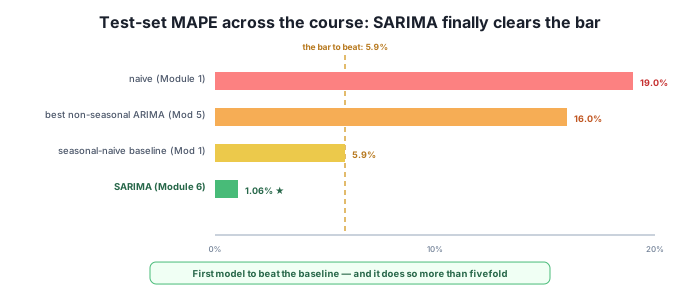
SARIMA 1.06%There it is. The SARIMA forecasts the held-out year at 1.06% MAPE — 5.6 times better than the seasonal-naive baseline (5.9%) that has stood unbeaten since Module 1, and 15 times better than the best non-seasonal ARIMA (16.0%). This is the first model in the entire course to beat the seasonal-naive bar, and it doesn’t just edge past it — it leaves it far behind. In absolute terms, the SARIMA’s mean error is 175 trips per month against the baseline’s 998.
The featured model isn’t the only good one. The famous airline model — SARIMA(0,1,1)(0,1,1)[12], seasonal differencing plus MA terms instead of AR terms — also fits Cyclepath well. Compare them on both criteria that matter:
airline = SARIMAX(train, order=(0,1,1), seasonal_order=(0,1,1,12)).fit(disp=False)

print(f"featured (1,1,0)(1,1,0)  AIC={model.aic:.1f}  MAPE={mape(test, sarima):.2f}%")
print(f"airline  (0,1,1)(0,1,1)  AIC={airline.aic:.1f}  MAPE={mape(test, airline.forecast(12)):.2f}%")
# featured (1,1,0)(1,1,0)  AIC=1056.2  MAPE=1.06%
# airline  (0,1,1)(0,1,1)  AIC=1033.0  MAPE=1.33%
A familiar tension resurfaces: the airline model has the better AIC (1033.0 vs. 1056.2), but the featured model has the better test MAPE (1.06% vs. 1.33%) — the same AIC-versus-out-of-sample disagreement you saw in Module 5, now between two good models rather than as a warning sign. Both pass diagnostics, both crush the baseline; the choice between them is a reasonable judgment call. The featured model wins on the metric that matters most for deployment (held-out accuracy), so it’s the one to carry forward — but reporting that the airline model is a close, defensible alternative is exactly the honesty this course has emphasized throughout.
A validated model measured on a held-out year is trustworthy — so now use it for its actual purpose. Retrain on the full 96 months (no hold-out; you want every scrap of data for a real forward forecast) and predict all of 2024, a year Cyclepath hasn’t lived yet:
production = SARIMAX(y, order=(1, 1, 0), seasonal_order=(1, 1, 0, 12)).fit(disp=False)
fc2024 = production.get_forecast(steps=12).predicted_mean

print(f"{fc2024.loc['2024-01-01']:.0f}")   # 13800   <- winter low
print(f"{fc2024.loc['2024-07-01']:.0f}")   # 21346   <- summer peak
print(f"{fc2024.sum():.0f}")               # 213839  <- full-year total
The 2024 forecast has exactly the shape you’d expect and can now trust: a winter low near 13,800 in January, climbing to a summer peak of 21,346 in July, for a full-year total of 213,839 trips — about 5% above 2023’s actual 203,501, continuing the steady growth the trend captured. This is what all the work was for: not a backward-looking fit, but a credible, seasonally-shaped prediction of a year that hasn’t happened, from a model you’ve proven adequate and accurate.
Why retrain on the full series for the real forecast
The train/test split exists to measure a model honestly — you hold out data the model never saw, forecast it, and compare. But once you’ve measured the model and trust it, throwing away the most recent 12 months for the actual forward forecast would be wasteful: those are the freshest, most relevant observations. So the workflow is: split to validate, then refit on everything to forecast the genuine future. The validated error (1.06% MAPE) is your honest estimate of how well the full-data forecast will do — you measured it on data the model hadn’t seen, which is the whole point of the hold-out.
Step back and see what this project — and the whole course — produced:
The arc is complete. Module 1 built the series, the honest test split, and the baseline. Modules 2–4 decomposed, stationarized, and read the autocorrelation structure. Module 5 built the ARIMA family and proved, rigorously, that it wasn’t enough. This module added the one missing piece — explicit seasonal terms — and finally beat the bar. That’s the discipline of classical forecasting in miniature: understand the data, respect the baseline, add complexity only when you can prove it earns its place, and validate honestly before you trust a forecast.
Stage 1 checked the Ljung-Box test before Stage 2 scored the forecast. Why is that ordering deliberate?
Hint
Because a good test-set score from an inadequate model can’t be trusted — if the residuals still contain structure (failing Ljung-Box), the model got lucky on this particular year rather than genuinely capturing the process, and its performance may not generalize. Diagnosing first ensures you’re scoring a model that’s actually sound, so its low MAPE reflects real skill, not a fluke. It’s the discipline from Lesson 4’s Exercise 3: when a good forecast and a diagnostic disagree, trust the diagnostic — so you check the diagnostic first, and only celebrate the forecast once the model has earned it.
The airline model had a better AIC but the featured model had a better test MAPE. Give one reasonable argument for each choice.
Hint
For the featured model: it directly wins on out-of-sample accuracy (1.06% vs 1.33%), which is what you ultimately care about for forecasting, and held-out error is the most trustworthy guide (Module 5’s lesson). For the airline model: it has the better AIC, suggesting a better fit-to-complexity balance in-sample, and it’s the widely-validated canonical seasonal model with a long track record, so it may be more robust across different test years than a single hold-out reveals. Both are defensible — with only one test year, the MAPE difference could partly be luck, so a practitioner might even average the two forecasts. The key skill is recognizing there’s no single “correct” answer here, and reporting the tradeoff honestly rather than hiding it.
The 2024 forecast totals 213,839 trips, about 5% above 2023. Where does that growth come from in the model, given the featured model has no explicit trend term?
Hint
The growth comes from the differencing, not an explicit trend coefficient. The non-seasonal difference (d=1) means the model forecasts changes and sums them back up, so a persistent average month-to-month increase carries the level upward — and the seasonal difference (D=1) compares each month to the same month last year, so a consistent year-over-year rise propagates forward. Together they let the model project continued growth without a dedicated drift term: the upward trajectory is baked into how the differenced series behaves, which the model learned from eight years of steady climbing. This is the same “differencing handles the trend” principle from Module 5, Lesson 3, now producing a real forward projection.
The capstone fit SARIMA(1,1,0)(1,1,0)[12] to Cyclepath, confirmed adequacy (Ljung-Box p = 0.209), and scored its forecast against every baseline in the course: naive (19.0%), best non-seasonal ARIMA (16.0%), and the seasonal-naive bar (5.9%). The SARIMA landed at 1.06% MAPE — 5.6 times better than the baseline, the first model in the course to beat it, with a mean error of 175 trips versus the baseline’s 998. Compared against the canonical airline model (0,1,1)(0,1,1)[12], the featured model won on test MAPE (1.06% vs 1.33%) though the airline model had a better AIC (1033 vs 1056) — both adequate, both crushing the baseline. Finally, retrained on all 96 months, the model forecast 2024 from a winter low near 13,800 to a July peak of 21,346, totaling 213,839 trips (~5% growth) — a genuine, validated forward prediction.
This is the destination of the entire course: a model that beats the honest baseline, passes every diagnostic, and produces a trustworthy forecast of a year that hasn’t happened. But the deeper lesson is the process that got here — building a baseline first, proving simpler models insufficient before adding complexity, validating on held-out data, and diagnosing rigorously before trusting. That discipline is what separates real forecasting from curve-fitting, and it transfers to any forecasting problem you’ll face, with any model, seasonal or not. You now have both the SARIMA toolkit and the judgment to use it well.
Module 7 - Exponential Smoothing is coming soon. Check the course overview for what's live.
Return to the Seasonality: SARIMA module overview
You’ve reached the course’s turning point: a SARIMA that beats the seasonal-naive baseline more than fivefold, passes every diagnostic, and forecasts a genuine future year. From here, the remaining modules broaden your toolkit — exponential smoothing as a complementary forecasting approach, and rigorous backtesting to validate models across many windows rather than a single hold-out — but the core discipline you’ve built here, of respecting baselines and validating honestly, carries through all of it.