Title here
Summary here
Lesson 2 confirmed formally that Cyclepath is non-stationary. Now you fix it — starting with differencing, the standard tool for removing trend. The idea is almost embarrassingly simple: instead of modeling the level of the series, model the change from one point to the next. A steadily climbing trend becomes, after differencing, a roughly constant number — no more climbing left to explain.
By the end of this lesson, you will be able to:
Let’s difference Cyclepath.
import numpy as np, pandas as pd
from statsmodels.tsa.stattools import adfuller

def cyclepath():
    idx = pd.date_range("2016-01-01", periods=96, freq="MS")
    t = np.arange(96); rng = np.random.default_rng(42)
    trend = 9000 + 90*t; seasonal = 3200*np.sin(2*np.pi*(t-3)/12); noise = rng.normal(0,350,96)
    return pd.Series(np.round(trend+seasonal+noise).astype(int), index=idx, name="trips")

y = cyclepath()

d1 = y.diff().dropna()
print(len(d1))                # 95
print(round(d1.mean(), 2))    # 88.05
y.diff() computes y_t - y_{t-1} at every point, which is why the result has 95 values instead of 96 — the very first month has no prior value to subtract. The mean of the differenced series is about 88.05 — and that’s not a coincidence: Cyclepath’s trend was built with a slope of exactly 90 per month (trend = 9000 + 90*t), so differencing recovers something very close to that slope directly. This is the intuition behind why differencing works: subtracting consecutive values cancels out a constant level and leaves behind the constant rate of change — which is a much easier thing for a model to treat as “roughly constant” than an ever-rising level.
stat, pval, *_ = adfuller(d1, autolag="AIC")
print(round(stat, 3))   # -8.642
print(round(pval, 4))   # 0.0
The ADF statistic drops from -0.920 (raw series) to -8.642, and the p-value collapses from 0.7815 to effectively 0 — nowhere close to the 0.05 threshold, decisively rejecting the unit-root null. By the ADF test’s definition, first-differenced Cyclepath is stationary. One .diff() call and a trend that visibly climbed for eight years is gone.
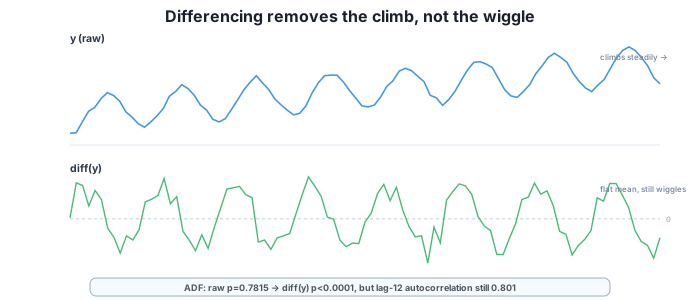
Before treating this as finished, look at what’s still hiding in the differenced series. Autocorrelation at lag 12 asks: does this month’s change relate to the change from exactly one year ago?
from statsmodels.tsa.stattools import acf

a = acf(d1, nlags=13, fft=True)
print(round(a[1], 3))    # 0.746
print(round(a[6], 3))    # -0.853
print(round(a[12], 3))   # 0.801
That 0.801 at lag 12 is a big number — nearly as strong as a series correlated with itself. Differencing was built to cancel a trend; it was never built to touch seasonality, and this is the proof. Cyclepath’s differenced series passes the ADF test (no unit root, no drifting mean) while still carrying almost the entire seasonal rhythm Module 2 measured — the changes from one July to the next July, one January to the next January, are still strongly related, exactly as they were in the raw series. The lag-6 value of -0.853 tells the same story from the other direction: a change six months apart (roughly opposite points in the seasonal cycle) is strongly negatively related.
ADF-stationary and structure-free are different claims
The ADF test specifically checks for a unit root — the mathematical signature of trend-like drift. It says nothing about seasonality, and a series can pass with flying colors while still having an obvious, strong, repeating pattern left in it. That’s not a flaw in the test; it’s testing exactly what it claims to test. The practical lesson is: passing ADF is necessary before fitting an ARIMA-family model, but it is not the whole stationarity story for a seasonal series like Cyclepath — which is exactly why this module doesn’t stop here.
If a series had a quadratic trend (curving, not a straight line) instead of Cyclepath’s linear one, would a single first difference (d=1) be enough to remove it?
Hint
No — differencing once removes a linear trend because the slope of a straight line is constant, so subtracting consecutive points cancels it out to a constant. A quadratic trend has a slope that itself changes over time, so a single difference would leave behind a linear trend in the differenced series (the derivative of a quadratic is linear) rather than a constant. You’d need to difference twice (d=2) — difference the already-differenced series again — to fully cancel a quadratic trend, the same way taking a second derivative of a quadratic gives a constant.
Suppose a different series’ first difference has a mean very close to 0, unlike Cyclepath’s 88.05. What does that tell you about the original series?
Hint
A first-differenced mean near zero means the original series had no net linear trend — on average, it goes up about as often and by about as much as it goes down, so the changes cancel out over time. That’s different from Cyclepath, whose differenced mean of 88.05 reflects a real, consistent per-month climb. A series could still have plenty of other structure (seasonality, volatility clusters) with a differenced mean near zero; zero mean in the difference specifically rules out a trend, nothing else.
Given that differencing fixed the trend but left a lag-12 autocorrelation of 0.801, what would you try next, and why?
Hint
Since the leftover structure is specifically tied to lag 12 (one full year), the natural next tool is seasonal differencing — subtracting each value from the one 12 months earlier (y.diff(12)) instead of, or possibly in addition to, the regular one-step difference just used. That directly targets the “this year vs. last year” relationship the way first differencing targeted “this month vs. last month.” Lesson 4 builds exactly this.
First differencing (y.diff()) replaces each value with its change from the previous one, and on Cyclepath it works exactly as intended: the ADF p-value drops from 0.7815 to effectively 0, and the differenced mean of 88.05 closely matches the series’ true per-month trend slope of 90. The differenced series is, by the ADF test’s definition, stationary. But its autocorrelation at lag 12 is a striking 0.801 — proof that differencing, built specifically to cancel a linear trend, left the entire seasonal pattern untouched. Passing the ADF test is a real, necessary milestone, but for a seasonal series it is not the end of the stationarity story.
y_t - y_{t-1}, cancels a constant (linear) trend by construction.It’s tempting to treat “the ADF test passed” as “I’m done” — but for any series with real seasonality, that’s premature, and Cyclepath’s lag-12 autocorrelation of 0.801 is exactly the kind of evidence that should stop you from moving on too early. The habit this lesson builds — check the test, then check what’s still left in the autocorrelation — is what keeps a differencing decision honest instead of just technically passing. Next, Lesson 4 introduces seasonal differencing to deal with that leftover structure directly, and discusses when a transformation like a log is the better tool instead.
Remove the leftover seasonal structure with seasonal differencing, and learn when a log transform actually helps.
Return to the Stationarity and Differencing module overview
First differencing fixed Cyclepath’s trend and passed the ADF test — but that lag-12 autocorrelation of 0.801 is unfinished business. Next you’ll meet seasonal differencing, built specifically to target a relationship at a fixed seasonal lag instead of the one-step relationship regular differencing handles, and see how it compares.