Title here
Summary here
If you’ve done any machine learning, you’ve internalized a set of habits: shuffle your data, split it randomly into train and test, treat each row as an independent example. Every one of those habits is wrong for time series — and applying them is the single most common way forecasting projects fool themselves into thinking they work. A time series isn’t a bag of independent rows; it’s a sequence, where the order is the information, each value is tied to the ones around it, and the whole point is to predict what comes next. Before you fit a single model, you need to understand why temporal data is a different kind of thing. That’s this lesson.
By the end of this lesson, you will be able to:
Let’s start with what “special” actually means here.
A time series is a sequence of observations indexed by time — monthly bike rides, daily sales, hourly temperatures. Three properties set it apart from ordinary tabular data, and each one invalidates a habit you might bring from standard ML:
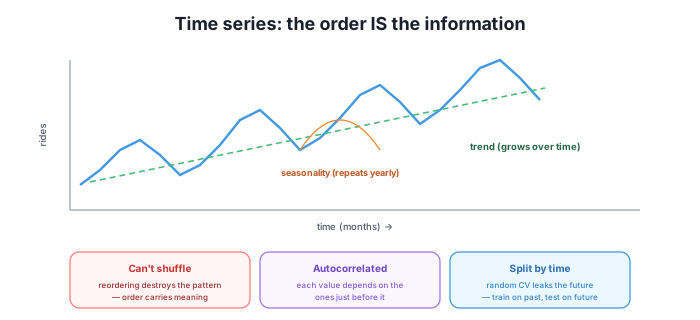
If every value depended only on randomness, forecasting would be impossible. What makes it work is that most real series have structure — predictable patterns you can learn and project forward. Two kinds dominate:
Almost everything in this course is about isolating and modeling these components. You’ll formally separate trend, seasonality, and the leftover “residual” in the next module; test whether a series is “stationary” (roughly, free of trend and seasonality) and fix it if not; and then fit models that capture the autocorrelation that’s left. The visible structure in the picture above isn’t decoration — it’s the raw material of every forecast you’ll make.
Meet Cyclepath, your series for the whole course
Throughout this course you’ll forecast Cyclepath, a fictional city bike-share whose monthly ridership you’ll model over eight years (2016–2023). It has exactly the two structures above: a clear upward trend (ridership roughly doubles as the city adopts bikes) and strong yearly seasonality (big summer peaks, deep winter troughs). It’s seeded synthetic data — generated in code with a fixed random seed — so every number you compute will match the lesson exactly and you can rerun any analysis end to end. Using one series across the whole course means each technique builds on the last: by the capstone, you’ll take Cyclepath from raw data to a backtested forecast. You’ll build and explore it hands-on in this module’s guided project.
A colleague suggests shuffling the monthly ridership data before modeling “to remove any ordering bias, like we do in machine learning.” What’s wrong with that here?
Hint
In a time series the order is the data. Shuffling scrambles the sequence, destroying the trend and seasonality — the exact patterns you’re trying to forecast — and severs the autocorrelation between each value and its recent past. “Ordering bias” is a tabular-data concern where rows are independent; here the ordering is the signal, not a bias. You never shuffle a time series.
Cyclepath’s ridership this July is likely to be close to which other months? What does that tell you about independence?
Hint
Close to this June and August (adjacent months, similar level) and especially to last July (same point in the seasonal cycle). That’s autocorrelation: a value is predictable from its own recent and seasonal past, so the observations are not independent. This dependence is a gift for forecasting — it’s precisely what lets you predict the future — but it breaks methods that assume independent rows.
You randomly split the ridership series 80/20 into train and test, get a fantastic test score, deploy the model, and it forecasts terribly. What went wrong?
Hint
A random split puts future months into the training set and past months into the test set, so the model effectively trained on data from after the period it was tested on — it “saw the future.” That inflates the test score, but in production the future genuinely isn’t available, so performance collapses. The fix is a chronological split: train on the earliest months, test on the latest ones, mimicking how forecasting actually works. You’ll do exactly that in Lesson 4.
Time series data breaks the habits you built on ordinary tabular data, in three ways. The order is the information — shuffling destroys the trend and seasonality you want to model. Values are autocorrelated — each depends on its recent and seasonal past, so points are not independent as most standard methods assume. And you must split by time — a random train/test split leaks future data into training, inflating your score and collapsing in production; you train on the past and test on the future instead. What makes forecasting possible is structure: trend (the long-run direction) and seasonality (a fixed-cycle repeating pattern), which the rest of the course isolates and models. Your running example is Cyclepath, a seeded monthly bike-share series with both, which you’ll take from raw data to a backtested forecast.
Almost every serious forecasting mistake traces back to treating a time series like ordinary data — shuffling it, splitting it randomly, or assuming independence — which produces models that look brilliant in a notebook and fail the moment they meet the real future. Internalizing why temporal data is different is what makes the rest of this course trustworthy: it’s the reason you’ll decompose before modeling, split chronologically, and always compare against a naive baseline. Get this foundation right and everything downstream — ARIMA, SARIMA, backtesting — rests on solid ground. Next, you’ll get hands-on with the pandas datetime index that makes working with a real series practical.
Handle a real series in pandas: the DatetimeIndex, changing frequency with resampling, and smoothing with rolling windows.
Return to the Time Series Foundations module overview
You now understand what makes time series a distinct discipline — temporal order, autocorrelation, and the chronological split — and the trend and seasonality that make forecasting possible. Next you’ll put a real series into pandas: build a datetime index, resample it to different frequencies, and smooth it with rolling windows, the everyday mechanics you’ll use in every lesson that follows.