Title here
Summary here
This is the payoff. Over six modules you built every piece of a transformer and proved each one correct; over this module you built the machinery to train it. Now you’ll put it all in motion: configure a model, run a full training session, watch the loss fall while checking it isn’t overfitting, see the model produce recognizable text, and save the trained weights to disk. What you finish with is a real, trained language model — small, but genuinely working — ready to generate from in Module 8.
By the end of this project, you will be able to:
Every stage below runs for real in pure NumPy, reusing the MiniGPT, get_batch, and Adam you built. Let’s train it.
We choose a deliberately small configuration so the whole run finishes in seconds on a CPU, then tokenize the corpus and hold out a validation split (Lesson 1).
import numpy as np, time
# MiniGPT (Module 6), get_batch + tokenized data/vocab_size/decode (Lesson 1),
# Adam (Lesson 2) are reused unchanged.

block_size, n_embd, n_head, n_layer = 32, 64, 4, 3
batch_size, lr, steps = 32, 3e-3, 1200

n = int(len(data) * 0.9)
train_data, val_data = data[:n], data[n:]

model = MiniGPT(vocab_size, block_size, n_embd, n_head, n_layer, seed=42)
opt = Adam(model.P, lr=lr)
print("config: n_embd=%d n_head=%d n_layer=%d block_size=%d" % (n_embd, n_head, n_layer, block_size))
print("parameters:", model.n_params())
print("train tokens:", len(train_data), "| val tokens:", len(val_data))
config: n_embd=64 n_head=4 n_layer=3 block_size=32
parameters: 154456
train tokens: 9018 | val tokens: 1002A three-layer, four-head model with a 64-dimensional embedding comes to 154,456 parameters — tiny by modern standards, plenty to learn a ten-sentence corpus.
Now the training loop from Lesson 3, with a validation estimate (Lesson 4) every 200 steps so we can confirm the model is learning rather than memorizing.
def estimate_loss(model, data, rng, iters=20):
    total = 0.0
    for _ in range(iters):
        xb, yb = get_batch(data, block_size, batch_size, rng)
        _, loss = model.forward(xb, yb)
        total += loss
    return total / iters

rng = np.random.default_rng(42)
t0 = time.time()
for step in range(steps + 1):
    xb, yb = get_batch(train_data, block_size, batch_size, rng)
    _, loss = model.forward(xb, yb)
    grads = model.backward()
    opt.step(model.P, grads)
    if step % 200 == 0:
        val = estimate_loss(model, val_data, rng)
        print(f"step {step:4d}  train {loss:.4f}  val {val:.4f}")
print("wall clock: %.1f s" % (time.time() - t0))
step 0 train 3.2026 val 2.9107
step 200 train 0.1950 val 0.1829
step 400 train 0.1548 val 0.1393
step 600 train 0.1446 val 0.1358
step 800 train 0.1460 val 0.1329
step 1000 train 0.1351 val 0.1389
step 1200 train 0.1112 val 0.1254
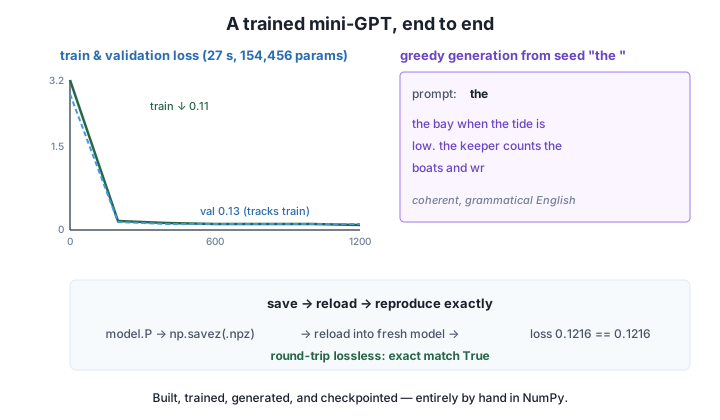
wall clock: 26.8 sThe loss falls from the random baseline of 3.20 to around 0.12 in about 27 seconds, and — the healthy sign — training and validation loss stay locked together the entire way (they even cross, with validation dipping slightly lower at some checkpoints because its batches happen to be easier). The repetitive corpus generalizes perfectly from the training split to the held-out split, so there’s no overfitting gap. This is a model that has genuinely learned its data.
The truest test is to let the model write. We do a simple greedy continuation: feed a seed prompt, take the single most likely next character, append it, and repeat. (Module 8 covers smarter sampling; greedy is enough to see whether anything was learned.)
def generate_greedy(model, prompt, n_new):
    ids = list(encode(prompt))
    for _ in range(n_new):
        context = np.array([ids[-block_size:]])
        logits, _ = model.forward(context)
        next_id = int(logits[0, -1].argmax())
        ids.append(next_id)
    return decode(ids)

print(repr(generate_greedy(model, "the ", 60)))
'the bay when the tide is low. the keeper counts the boats and wr'From the seed "the ", the model produces the bay when the tide is low. the keeper counts the boats and wr — fully coherent Lantern Bay English, with correct spelling, spacing, sentence structure, and a period in the right place. Every word is real and the phrasing is lifted straight from the corpus’s grammar. That a 154,456-parameter model, built and trained by hand in NumPy in under half a minute, writes grammatical English at all is the whole point of the course. (Greedy decoding follows the single most likely path, so on this small corpus it tends to reproduce fluent stretches of the training text; the next module’s sampling methods trade a little of that fidelity for variety.)
Greedy decoding is deterministic and repetitive
Always taking the single most likely character makes generation deterministic and prone to getting stuck in loops or bland repetition — which is exactly why Module 8 introduces temperature and top-k sampling to trade a little accuracy for variety. For now, greedy is the simplest possible probe that the model learned something.
A trained model is only useful if you can keep it. We serialize the parameter dictionary to a compressed .npz file (written to a temporary directory, not the repository), reload it into a fresh model, and confirm the reloaded model reproduces the original’s loss to the last digit.
import tempfile, os

path = os.path.join(tempfile.mkdtemp(), "mini_gpt.npz")
np.savez(path, **model.P)

reloaded = MiniGPT(vocab_size, block_size, n_embd, n_head, n_layer, seed=0)
weights = np.load(path)
for k in reloaded.P:
    reloaded.P[k] = weights[k]

check_rng = np.random.default_rng(7)
xb, yb = get_batch(train_data, block_size, batch_size, check_rng)
_, loss_original = model.forward(xb, yb)
_, loss_reloaded = reloaded.forward(xb, yb)
print("original loss:", round(float(loss_original), 4))
print("reloaded loss:", round(float(loss_reloaded), 4))
print("exact match:", abs(float(loss_original) - float(loss_reloaded)) < 1e-9)
original loss: 0.1216
reloaded loss: 0.1216
exact match: TrueThe reloaded model gives byte-for-byte the same loss, 0.1216, on the same batch — the save/load round-trip is lossless. This .npz file is your trained mini-GPT: a set of weights you can reload any time to generate text, which is exactly what Module 8 will do.
Rerun with n_layer=2 and n_embd=32. How much does the final loss change, and how does the parameter count drop? Is the smaller model still enough for this corpus?
Hint
A smaller model has far fewer parameters and trains even faster; on this tiny repetitive corpus it still reaches a low loss because there is not much to learn — capacity is not the bottleneck here.
Generate from the prompts "a small " and "the keeper ". Do the continuations stay on-theme? What does that say about what the model has captured?
Hint
Both should continue into plausible Lantern Bay phrasing (boats, the bay, the lantern), because the model has learned the corpus’s word-to-word transitions — its little grammar — rather than a single memorized string.
Train two models with the same seed=42 and compare their step-0 and step-200 losses. Are they identical? Which single line makes the whole run reproducible?
Hint
With the same seed the losses match exactly — the seeded default_rng(42) driving both weight initialization and batch sampling is what makes the entire run deterministic and reproducible.
You ran a complete training session end to end: a 154,456-parameter mini-GPT trained in about 27 seconds of pure NumPy, its loss falling from the random baseline of 3.20 to about 0.12 with training and validation loss tracking together the whole way. A greedy continuation produced a coherent Lantern Bay sentence, and you saved the trained weights to disk and reloaded them to reproduce the model exactly. You now have a working, trained language model — built and trained entirely by hand.
np.savez the parameter dict and reload it to reproduce the model losslessly.This is the complete arc of training a neural language model, with nothing hidden: your own architecture, your own optimizer, your own training loop, producing a model that demonstrably learned real text and can be saved and reused. The workflow — pick a config, train while watching both losses, sanity-check by generating, checkpoint the result — is exactly the workflow behind models a million times larger. Having done it once, by hand, at a scale you can hold in your head, you understand what those larger runs are really doing.
You have a trained mini-GPT and a saved checkpoint, and you’ve seen it write with greedy decoding — which, as you noticed, is deterministic and prone to getting stuck. Module 8 is about generation itself: you’ll load this trained model and learn to sample from it well, with temperature to control randomness and top-k and top-p to keep samples coherent, turning the same weights into text that is varied instead of repetitive.
Keep DATATWEETS free. Help fund practical data, AI, and engineering lessons for learners worldwide.