Title here
Summary here
A practical life manual for aspiring data analysts, data scientists, and data engineers — honest about the market, specific about the moves.
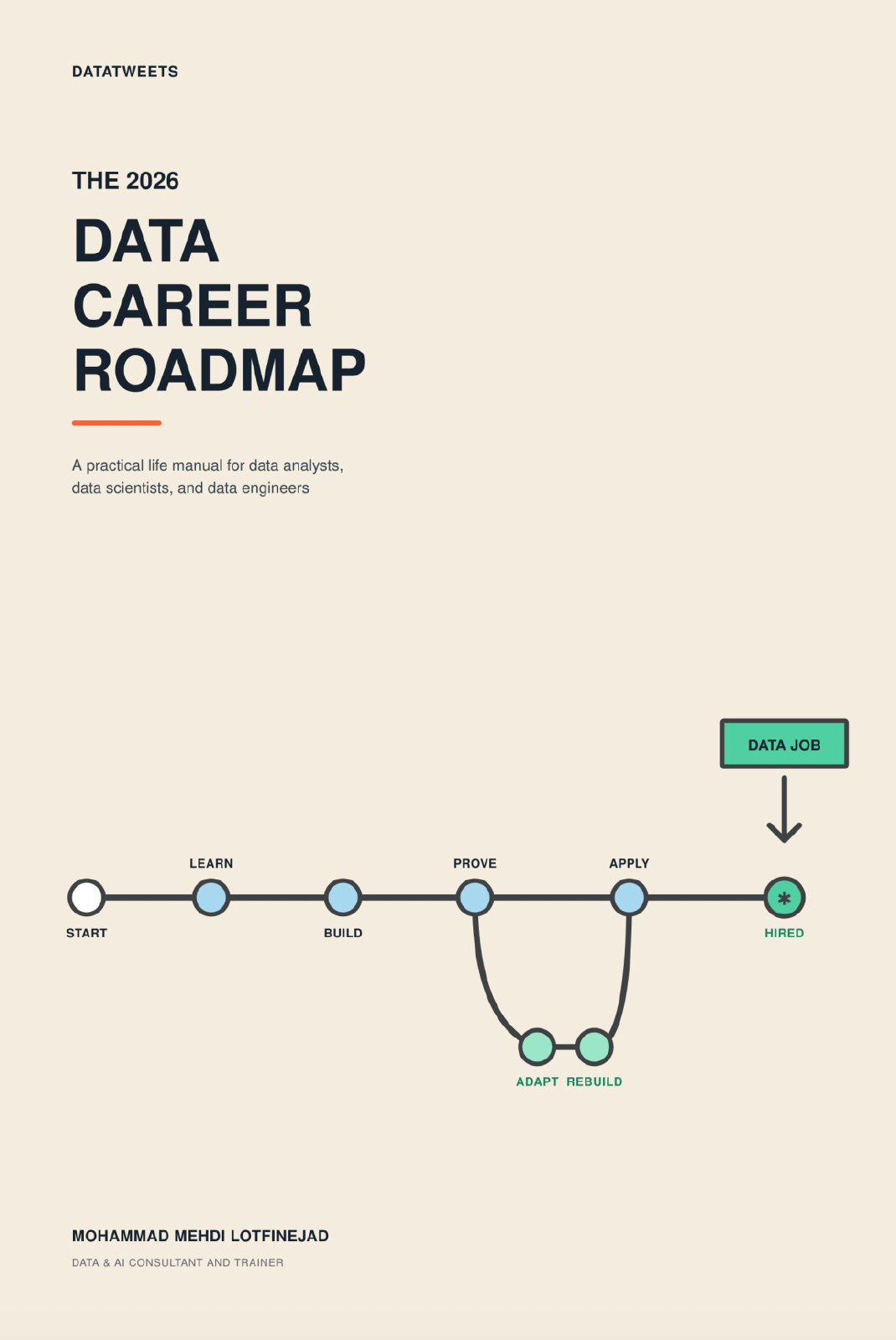
Booming demand and a tough beginner market are both true in 2026. This book is built for exactly that: not “it’s easy,” but “here’s how to win anyway.” Choose your path, learn the right skills, build proof employers trust, and run a job search that works.
Talent is widely distributed; opportunity is not. You don’t need a CS degree, perfect English, or insider knowledge to follow this book.
You want your first job in data and have no idea where to start. This turns a blank page into a map.
From teaching, finance, marketing, sales, ops, support, admin, or engineering — your background is an asset, and this shows you how to translate it.
You can’t quite tell a Data Analyst from a Scientist from an Engineer — or where ML, AI, Analytics, and BI roles fit. Chapter 2 settles it.
A junior data pro who wants a better role, a specialization, or a raise — and a clearer next 90 days.
Most guides fail you in one of three ways: they’re hype, they’re vague, or they’re out of date. This one is built to be the opposite.
It tells you when a market is tough, when advice won’t work, and when a shortcut is a trap. No “$150k in a weekend.”
Scripts, templates, worked examples, checklists, and exact next actions — not just “build a strong portfolio.”
Every market claim is tied to a named, recent source, and AI is treated as it actually is: a tool that changed the work, not a monster that ended it.
A few simple mental models you carry in your head — the Data Value Line, the 60% Rule, the T-A-R bullet, the Watch-to-Build Ratio.
Read Chapters 1–2 in order to choose your lane, then jump to the stage you’re at. Every chapter ends with a “Do This Next” action box.
The honest big picture: why data careers still matter, how AI reshaped the work, the three core paths (with the restaurant analogy and the Data Value Line), a realistic timeline, and a 90-day starter map.
A decision quiz, a “typical day” comparison, and a Translate-Your-Background table for ten origin fields — so you pick for fit, not for the internet’s applause.
The real skill stack, role-by-role skill maps, the exact tools named in job postings, overhyped vs underrated skills, and a practical learning sequence.
Titles and seniority, the Analytics Engineer “sweet spot,” an honest salary talk with named sources, the 60% Rule for reading a job description, and the red flags.
What hiring managers actually look for, project ideas per role (including AI), how to write a case study, a copy-paste README skeleton, and how to use AI honestly.
Turn any background into data-relevant experience, the T-A-R bullet that makes results land, ATS tips, and a LinkedIn profile that brings opportunities to you.
Worked questions and model answers for every stage — SQL, Python, stats, ML, data engineering, case, take-home, behavioral — plus P-P-P, D-I-P, C-B-T, and STAR structures.
A repeatable system: where to find jobs, tailoring and tracking, networking without feeling fake, message templates, handling rejection, and negotiating offers.
How to vet a course or bootcamp, when certifications help, detailed 3/6/12-month study plans, and the Watch-to-Build Ratio that ends tutorial hell.
A realistic action plan, plus working templates: an application tracker, the README skeleton, an application-note skeleton, 30/90-day checklists, and reflection questions.
Where the book cites the market, it names the source. Figures below are U.S. Bureau of Labor Statistics medians (May 2024) and projections; treat them as ranges and scale to your market.
The advice sticks because it’s built on a handful of simple tools you can use in a real job search tomorrow.
How raw data becomes decisions — and exactly where the Analyst, Scientist, and Engineer each fit.
Meet ~60% of a posting and you should apply. Job descriptions are wish lists, not locked doors.
Task → Action → Result. Turn duties into impact on your resume — without ever inventing a number.
At least as much building as watching. The single habit that ends tutorial hell for good.
A fictional ex-teacher with no CS degree, real doubts, a busy life, and exactly enough determination. Over the course of the book she goes from typing “I don’t even know what the jobs are” to a junior data analyst offer — not because she was exceptional, but because she was consistent. When the abstract gets heavy, Maya makes it real. She’s a stand-in for you.

Yes. It assumes no prior data experience and starts by helping you choose a path, then tells you exactly what to learn first (SQL) and what to skip. It’s also written for career changers and junior professionals who want a clearer next step.
It’s a downloadable PDF eBook, delivered through Ko-fi. You buy once and download instantly — no subscription, no account on this site required.
Yes. This is the 2026 first edition. It treats AI honestly — as a tool that changed the daily work and raised the bar for beginners — and threads practical AI literacy through skills, portfolios, and interviews.
The guidance is written for international readers in plain English. Salary figures are U.S.-based ranges and clearly labelled as such — scale them to your local market and cost of living.
No honest book can promise that. It gives you a realistic process to follow, test, and adapt — the map and the templates. You still do the building, applying, and interviewing; the book makes each step far clearer.
Yes — and they pair well. The free courses give you structured, hands-on skill practice; the book is the career map around them: choosing a path, building proof, and getting hired.
Get the map, the frameworks, and the templates — then open a dataset and build one small thing. Your data career starts with one query.
Get The 2026 Data Career RoadmapInstant PDF download via Ko-fi · by Mehdi Lotfinejad