Title here
Summary here
Current German Data Scientist vacancies point to a broad role: strong Python and SQL foundations, applied machine learning, business context, and growing production and GenAI expectations.

If you read enough Data Scientist vacancies in Germany, the title starts to lose its neat shape.
One employer wants pricing models and experiments. Another wants dashboards, stakeholder advice, and SQL. A third expects cloud deployment, pipelines, and monitoring. Some now add large language models, RAG, or AI agents. Others remain firmly grounded in statistics, forecasting, risk, or scientific research.
The title is broad, but the market is not random.
I analyzed an export of 100 active German listings collected on July 25, 2026. After removing obvious location duplicates, one recruiter mirror, and five roles that were actually based in Bangkok, the cleaned sample contained 88 distinct role profiles from 74 employers.
The clearest result is not that traditional data science has disappeared. It is that the role has widened around a durable core:
Python, machine learning, SQL, statistics, and business judgment still form the center. Cloud and generative AI increasingly sit around that center.
This is a snapshot of one selected dataset, not a census of every Data Scientist job in Germany. Used carefully, however, it gives candidates a much better study plan than a generic list of fashionable tools.
For Data Scientist roles in Germany, start with Python, SQL, machine learning, statistics, and clear communication. Then add one delivery layer—such as cloud, data pipelines, dashboards, or production ML—and one domain where you can solve real problems. GenAI skills can strengthen that profile, but the sample does not support replacing the foundations with prompt engineering alone.
Job-board exports often look more precise than they are.
The original file contained 100 active rows labeled as Data Scientist roles in Germany. I did not treat those rows as 100 independent vacancies.
The cleaning removed:
That left 88 role profiles. Skill percentages in this article use that cleaned denominator.
This matters because duplicate ads can distort both skills and geography. Three copies of one cloud-heavy role should not count as three separate employer decisions. A listing shown in Berlin is not a Berlin job when its title says the successful candidate must relocate to Bangkok.
The downloadable table contains aggregate counts rather than personal or application data: download the cleaned skill counts as CSV.
Python appeared in 77 of the 88 cleaned profiles, or 87.5%. Machine learning appeared in 54, and SQL in exactly half.
| Skill or capability | Role profiles | Share of cleaned sample |
|---|---|---|
| Python | 77 | 87.5% |
| Machine learning | 54 | 61.4% |
| SQL | 44 | 50.0% |
| Cloud | 37 | 42.0% |
| Statistics | 27 | 30.7% |
| Large language models | 26 | 29.5% |
| AWS | 24 | 27.3% |
| PyTorch | 18 | 20.5% |
| pandas | 16 | 18.2% |
| Azure | 12 | 13.6% |
| Google Cloud | 12 | 13.6% |
| RAG | 11 | 12.5% |
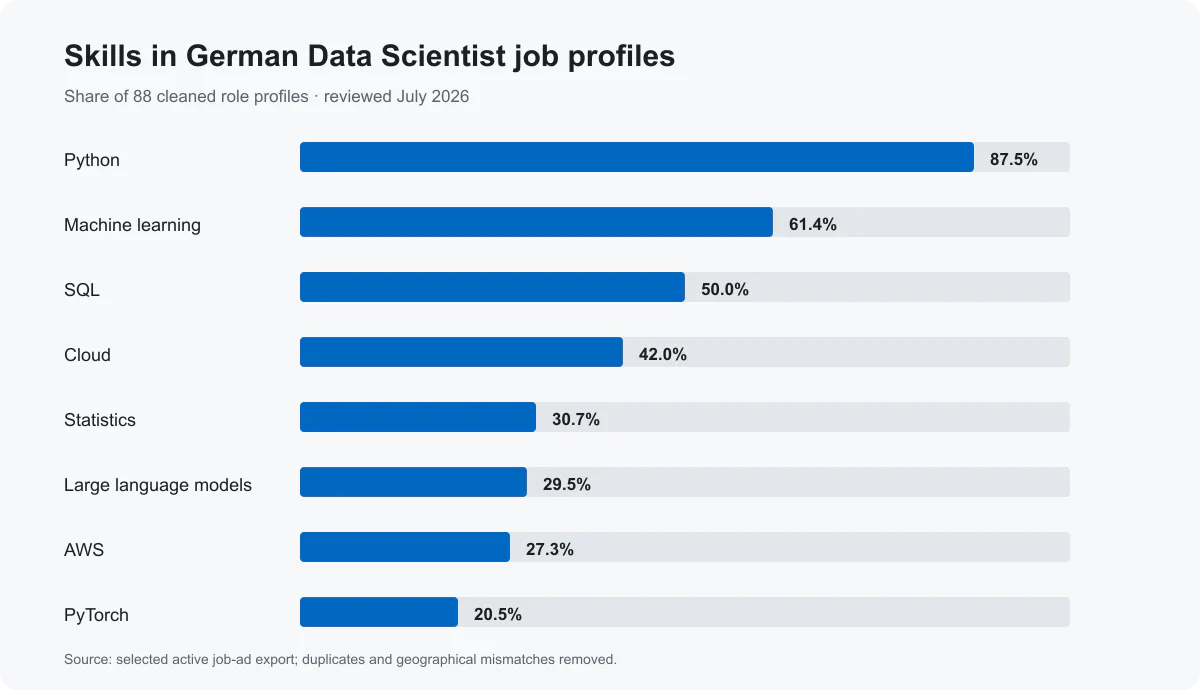
Figure 1. The eight most frequently extracted capabilities in the cleaned sample of 88 role profiles.
The chart suggests a useful order. Python is close to universal. Machine learning and SQL form the next layer. Cloud, statistics, and LLM work then separate different versions of the role.
It does not mean a candidate needs every item. A clinical statistician, a product Data Scientist, and a GenAI Data Scientist solve different problems. The counts show common ground, not one perfect resume.
These advertisements were active when reviewed on July 26, 2026. Job pages can close or move, so the cards record what each listing showed at review time.
Requested: Python; SQL; statistics and machine learning; AWS; PostgreSQL and Redshift; Tableau; data pipelines
What it shows: The role connects modeling and analysis to revenue, product decisions, trusted data, reporting, and cross-functional ownership.
View the original job adRequested: Python; SQL; statistics; machine learning; cloud; experimentation and product analysis
What it shows: Product data science combines models with marketplace behavior, experiments, decision support, and measurable product outcomes.
View the original job adRequested: Python; classical machine learning; LLM applications; RAG; tool use; evaluation; deployment and monitoring
What it shows: GenAI appears as an added production specialty, while problem framing, classical ML, evaluation, and end-to-end ownership remain essential.
View the original job adRequested: Python; SQL; statistics; machine learning; LLMs and RAG; AWS, Azure, and Google Cloud; PyTorch
What it shows: Enterprise AI roles can combine the traditional data-science base with modern model applications and multi-cloud delivery.
View the original job adRequested: Statistical study design; clinical-trial analysis; SAS or R; regulatory standards; interdisciplinary communication
What it shows: Specialist Data Scientist work may value domain methods, regulation, and statistical rigor more than the common Python-centered stack.
View the original job adTogether, the ads show why “learn the Data Scientist stack” is weak advice. There is no single stack. There is a shared foundation plus a work context.
Python’s 87.5% share makes it the safest technical starting point. It connects data preparation, modeling, automation, APIs, visualization, and modern AI libraries.
But Python alone does not describe the work.
SQL appeared in 44 profiles. Many of these jobs involve operational databases, product events, transactions, customer behavior, pricing, fraud, logistics, or reporting. Before a model can help, someone has to find the right records, understand how tables relate, test data quality, and create a trustworthy analytical dataset.
That is why a notebook full of model experiments can still look incomplete to an employer. It may show that you can call a library, but not that you can move from business data to a defensible result.
A practical foundation would include:
The free Python course and SQL and Databases course cover those two foundations. For a smaller bridge between them, the Pandas and SQLite tutorial shows how queried data becomes an analysis-ready DataFrame.
Large language models appeared in 26 profiles, or 29.5%. RAG appeared in 11, and AI agents in seven.
Those are meaningful numbers. They show that generative AI is now part of some Data Scientist roles in Germany, especially in product, consulting, enterprise AI, and automation work.
They do not show that every Data Scientist is becoming an LLM engineer.
Machine learning appeared in 61.4% of the profiles—more than twice the LLM count. Statistics appeared in 30.7%, almost the same as LLMs. The sample included forecasting, pricing, fraud, experimentation, optimization, clinical studies, customer analytics, marketing measurement, anomaly detection, and recommendation work.
The sensible learning order is therefore:
| Learn first | Add next | Specialize when the role needs it |
|---|---|---|
| Python, SQL, data cleaning | Statistics, validation, machine learning | LLM applications, RAG, agents |
| Clear problem framing | Experiment design and business metrics | Retrieval and answer evaluation |
| Reproducible analysis | Deployment and monitoring | Guardrails, tool use, cost and latency |
This order is not anti-AI. It makes AI skills more useful.
If you understand classification, validation, leakage, precision, recall, and error analysis, you are better prepared to evaluate an LLM workflow. If you understand data quality and sampling, you are less likely to trust a polished demo built on weak evidence.
The Machine Learning course builds that broader foundation. The first machine-learning model tutorial is a good starting point, while preparing data for machine learning addresses the less glamorous work that real projects depend on.
Cloud-related skills appeared in 37 profiles, or 42.0%.
AWS was named in 24 profiles. Azure and Google Cloud each appeared in 12. Docker appeared in 10, Airflow in nine, and Kubernetes in four.
These counts do not turn every Data Scientist into a platform engineer. They do show that employers increasingly expect analytical work to live inside a larger system.
A model may need scheduled data. A dashboard needs a reliable source. A pricing recommendation needs monitoring. An LLM feature needs evaluation, latency limits, and cost control. Even a strong analysis becomes more valuable when the team can repeat it after the original author closes the notebook.
For a candidate, “cloud experience” should mean more than listing AWS, Azure, or Google Cloud in a skills section. Better evidence would show that you can:
You do not need to learn every cloud. One coherent project on one platform is easier to defend than shallow familiarity with three logos. The Docker and Kubernetes for Data course is useful when you are ready to move from a local environment to repeatable delivery.
Only five of the 88 cleaned profiles were classified as entry level. Thirty-five were classified as senior, and six as lead or management. The remaining 42 had no reliable experience label.
The unknown group means we should not claim that 46.6% of all roles were definitely senior. It does mean that explicitly junior opportunities were a small part of this sample.
That changes how an early-career candidate should read the market.
Do not try to imitate a senior resume by collecting more tool names. Build evidence that reduces uncertainty:
This is also where adjacent titles matter. Search for Data Analyst, Product Analyst, Decision Scientist, BI Analyst, Junior ML Engineer, Analytics Engineer, and domain-specific quantitative roles. The related Vienna job-listing guide explains how to search by work bundle rather than trusting one title.
After cleaning, 27 profiles were associated with Berlin and 17 with Munich. Together, those cities represented exactly half of the sample. Hamburg followed with six.
That concentration is useful for planning, but it needs careful interpretation.
This dataset came from one job collection process with a limit of 100 rows. It does not measure every German vacancy, every job board, or hidden hiring through referrals and recruiters. Multi-location ads can also make a city look larger than the underlying number of teams.
Still, the roles reveal different local mixtures. Berlin included product analytics, marketplaces, fintech, advertising, fraud, and GenAI. Munich included automotive, travel, pricing, SaaS, and senior product work. Other cities showed insurance, industrial engineering, energy, logistics, consulting, and clinical statistics.
The practical lesson is to search by industry as well as city. Germany’s Data Scientist market is not only a Berlin startup market.
Some listings explicitly required fluent German, sometimes at C1 level. Others asked for strong English and described international teams. Many did not provide a clean language label.
The descriptions suggest a simple pattern: language requirements follow the workflow.
Client consulting, local stakeholder work, regulated operations, and German-language business processes are more likely to require German. International product teams and some specialist technical roles may operate mainly in English.
Do not infer the working language only from the language of the advertisement. Check:
For international applicants, German can widen the reachable market. It is not a substitute for technical evidence, and technical evidence does not cancel an explicit language requirement.
The strongest common thread in this sample is not a library. It is ownership of a useful decision.
Peter Park wanted analysis tied to revenue and product choices. Vinted connected modeling to marketplace behavior. Boehringer Ingelheim connected statistics to clinical-study decisions. Moss connected LLM and ML systems to finance workflows. DHL combined modern AI with enterprise delivery.
A portfolio can mirror that pattern without copying any employer’s business.
Choose one problem and make the path visible:
| Portfolio layer | What to show |
|---|---|
| Decision | Who needs the result, and what will they do differently? |
| Data | Source, meaning, quality checks, missing information |
| Method | Baseline, model choice, assumptions, validation |
| Result | Metric, uncertainty, errors, practical interpretation |
| Delivery | Report, dashboard, API, or scheduled output |
| Operations | Reproducibility, monitoring, update path, known limits |
This is more demanding than a generic notebook, but it is also easier for an employer to understand.
The broader note on practical AI skills for the job market explains why visible proof matters. For candidates leaning toward production-heavy AI roles, the AI Engineer job-ad analysis shows how much further the software and infrastructure expectations can go.
Based on this sample, I would organize the learning plan into four layers.
Layer 1: analysis foundations
Learn Python, SQL, data cleaning, visualization, descriptive statistics, and clear written explanation.
Layer 2: modeling judgment
Learn baselines, supervised and unsupervised learning, feature design, cross-validation, experiment design, error analysis, and how to connect a metric to a decision.
Layer 3: delivery
Add Git, testing, APIs, Docker, one cloud platform, basic pipelines, logging, and monitoring.
Layer 4: role-specific depth
Choose what the target work repeatedly asks for: forecasting, pricing, experimentation, fraud, clinical statistics, recommender systems, computer vision, LLM applications, RAG, or agents.
Do not reverse the order because the fourth layer looks more exciting.
The German roles in this dataset reward breadth, but useful breadth grows from a clear center. A candidate who can move from raw data to a tested decision has a stronger base than someone who has tried every new framework but cannot explain the data, metric, or failure cases.
Germany’s 2026 Data Scientist vacancies do not point to the death of data science or the victory of one new AI stack.
They point to a broader job.
Python is the common language. SQL keeps the work connected to real data. Machine learning and statistics remain central. Cloud skills help the work leave the notebook. LLMs, RAG, and agents are growing specializations, but they sit on top of the same need for validation, delivery, and business judgment.
The best response is not to learn everything.
Build a strong analytical core. Add one delivery path. Choose one domain or problem family. Then use local job evidence to decide which specialization deserves your next month of serious work.
That will not guarantee a job. It will make your preparation more focused, your portfolio easier to assess, and your applications better matched to the work employers are actually describing.